A mini jumbotron is not simply a big television made smaller. The name can describe two very different products: a decorative, multi-TV centerpiece for a home or man cave, or a compact version of the modular LED video displays suspended above professional sports floors. Buying the wrong category is an expensive mistake because the structure, image quality, installation, maintenance, and price are completely different.
This guide explains both categories, shows where portable LED screens fit, gives realistic budget bands, and provides nine checks to use before choosing a supplier.
1. What Is a Mini Jumbotron?
A mini jumbotron is a compact, arena-inspired video display designed to show live games, scores, replays, advertising, or entertainment content. It usually has screens on two or four sides so people in different parts of a room or venue can see it.
The term is informal. It does not define a particular screen size, pixel pitch, brightness, or construction standard. Suppliers may use it for:
- a four-sided housing built around consumer or commercial TVs;
- a cube assembled from direct-view LED cabinets;
- a freestanding or trailer-mounted portable LED screen;
- a decorative scoreboard with static graphics, lighting, or a scrolling ticker;
- a custom center-hung video and scoring system for a school gym or small arena.
The relationship to a large jumbotron-style LED display is mainly one of form and function. Both are intended to make content visible to a crowd and may combine video, scores, sponsor messages, and event graphics. A large stadium system, however, normally uses purpose-built direct-view LED modules, redundant processing, engineered steelwork, service access, and venue control integration. A mini version scales down that experience, but it does not automatically include those professional features.
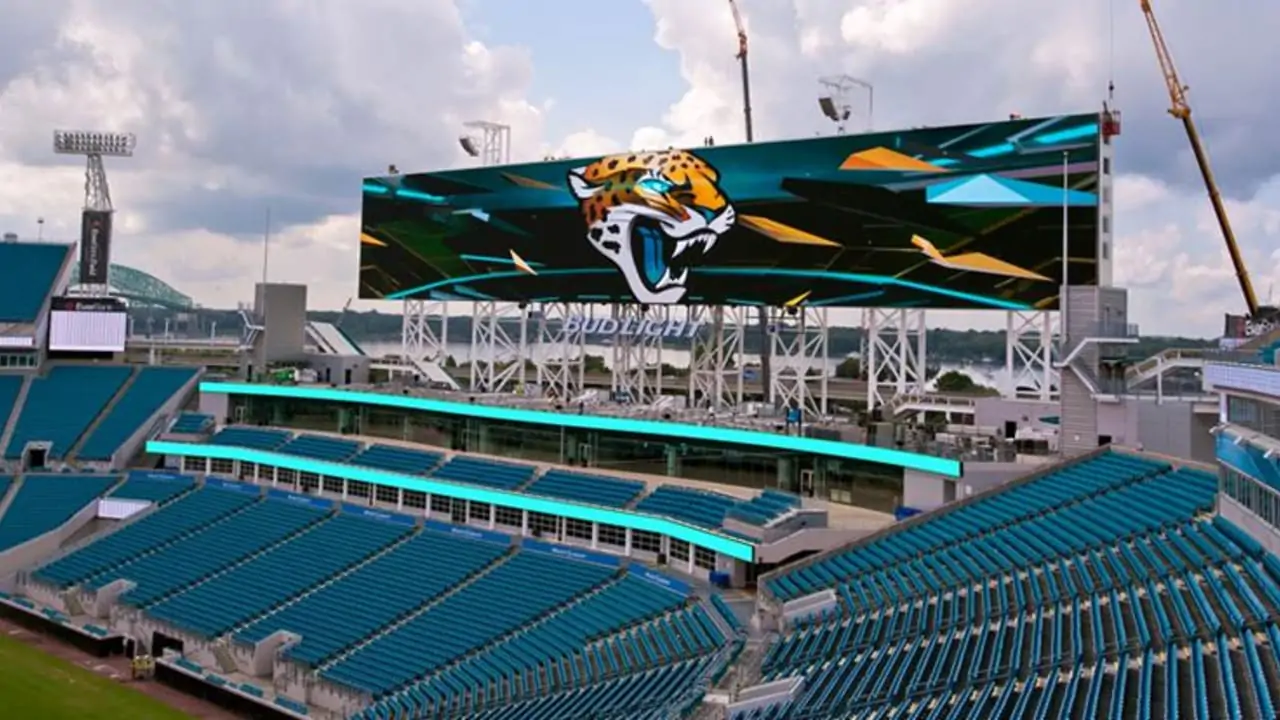
The fastest way to clarify a quote is to ask one question: Are the image surfaces LCD/OLED televisions or modular direct-view LED cabinets? That answer determines most of the remaining specifications.
2. Mini Jumbotron Sizes, Types, and Constructions
Mini jumbotrons range from compact 24-inch TV structures to multi-meter LED cubes. Instead of shopping by the word “mini,” define the available space and expected viewing distance, number of viewers, installation method, and content sources.
2.1 Common size categories
| Category | Typical format | Best suited to | Important constraint |
|---|---|---|---|
| Compact home unit | Two or four 24- to 43-inch TVs | Bedrooms, bars, game rooms, man caves | Ceiling height, TV ventilation, and safe mounting |
| Large home or hospitality unit | Four 43- to 65-inch TVs | Restaurants, clubhouses, large recreation rooms | Weight, sightlines, cable routing, and service access |
| Portable LED display | Roughly 2-15 m² of LED surface | Events, fan zones, school fields, temporary promotions | Setup time, transport, wind loading, power, and weather protection |
| Small venue LED cube | Four LED faces, often custom-sized | Gyms, combat-sports venues, small arenas | Structural engineering, rigging, maintenance access, and control integration |
These are planning categories rather than formal standards. A supplier should provide an exact dimensioned drawing showing the screen faces, overall housing, trim, suspension points, service clearance, and total operating weight.
2.2 Type 1: Mini jumbotron TV
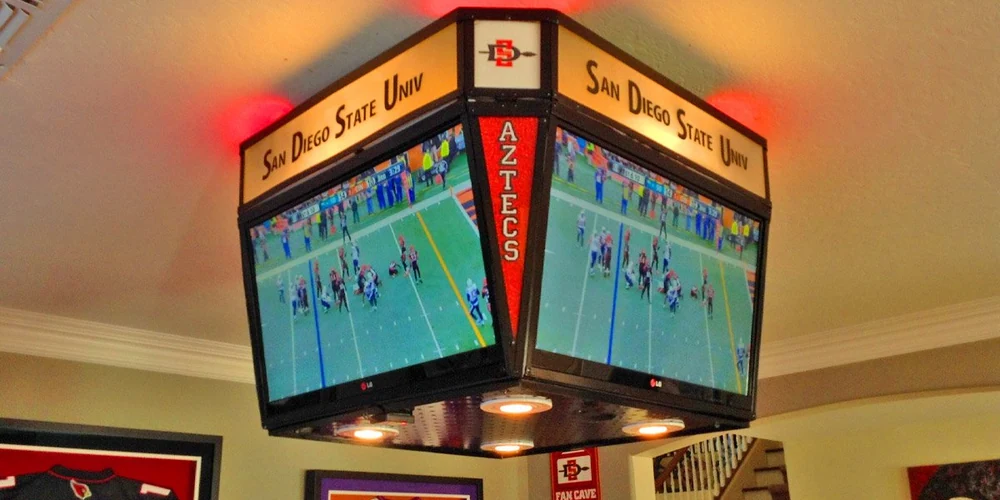
A mini jumbotron TV uses standard flat-panel televisions inside an arena-style frame. The frame may include illuminated graphics, a lower scoreboard ring, speakers, or an LED ticker. This format is popular at home because it can show several channels at once and uses familiar HDMI, streaming, or cable sources.
Its advantages are high resolution at close range, widely available replacement displays, simple content inputs, and a lower starting cost. Its limitations are visible bezels, lower outdoor suitability, inconsistent color between different TV models, and a housing that can make repairs awkward if service panels were not planned.
2.3 Type 2: Modular LED mini jumbotron
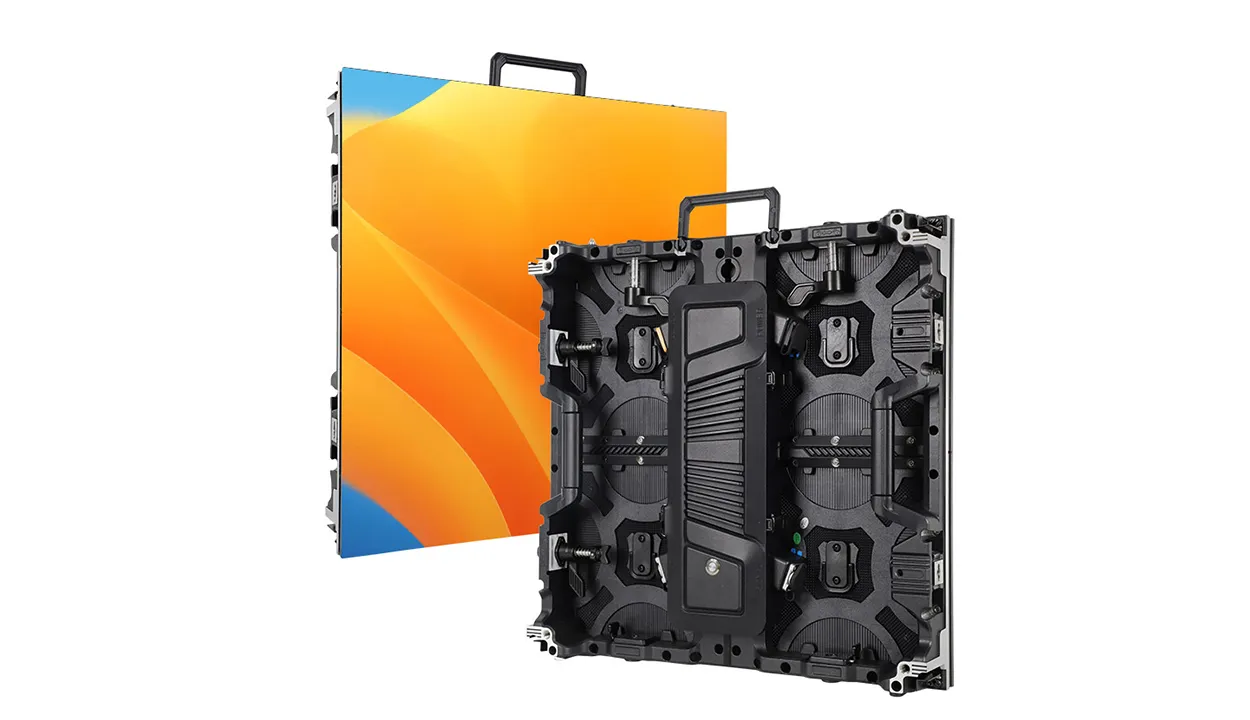
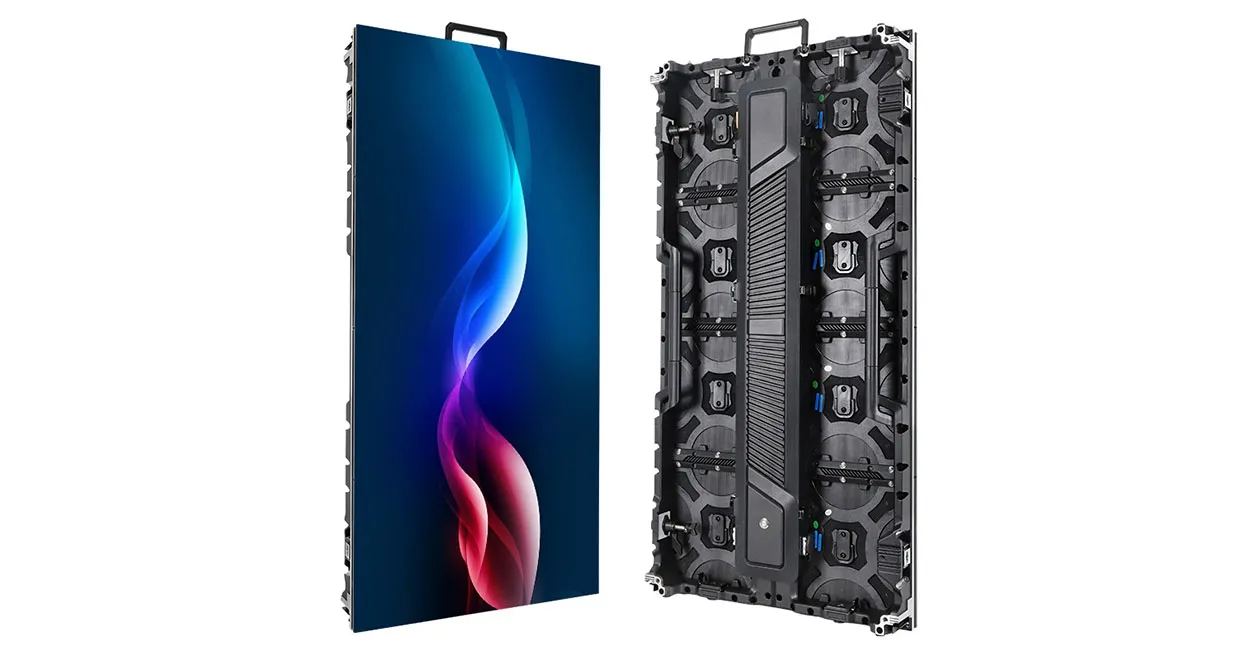
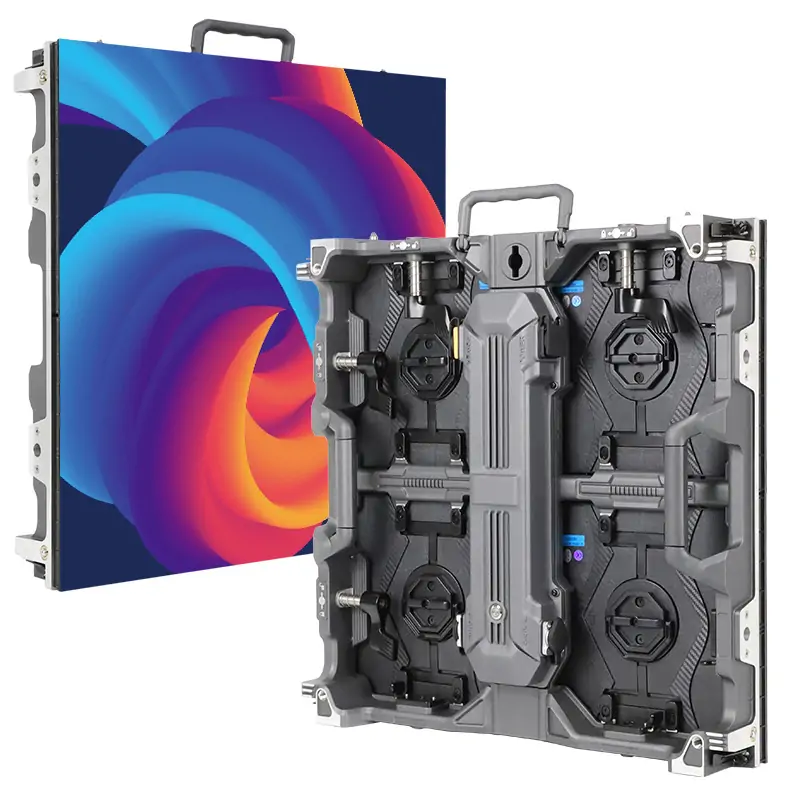
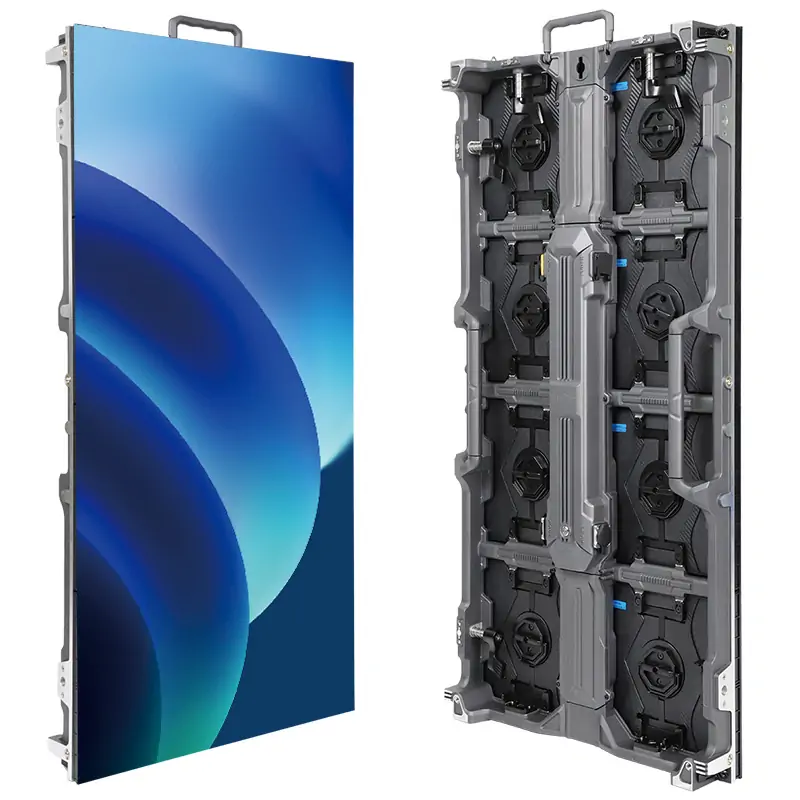
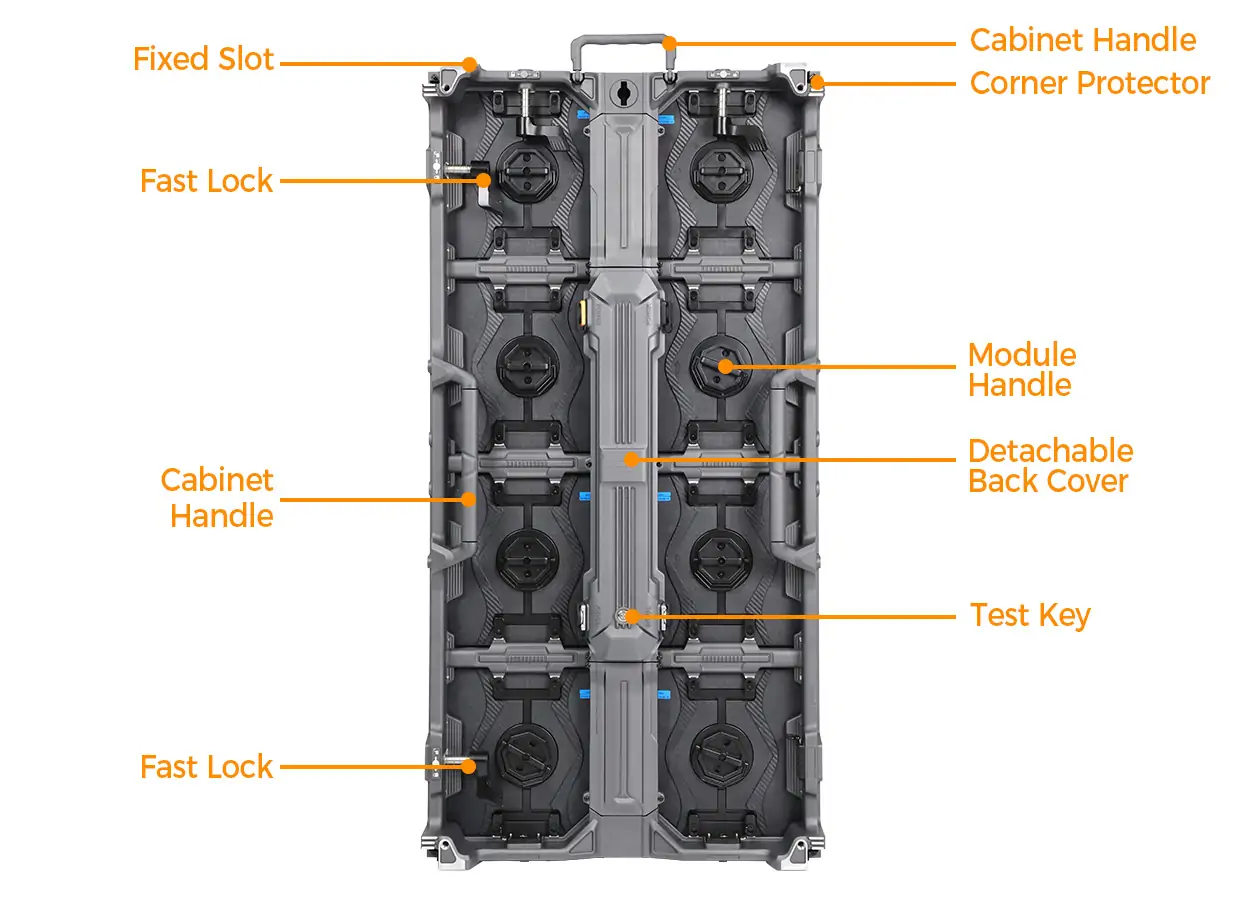
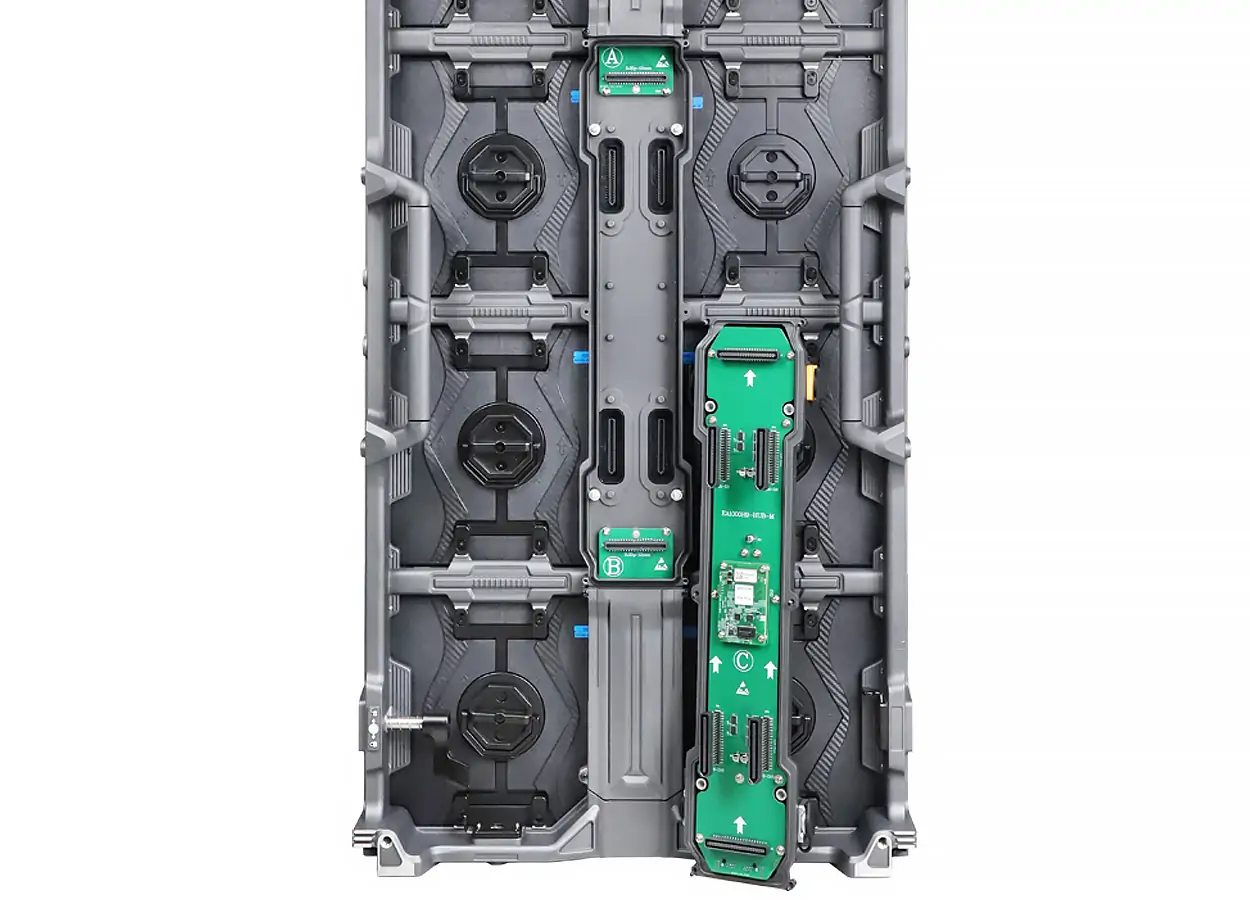
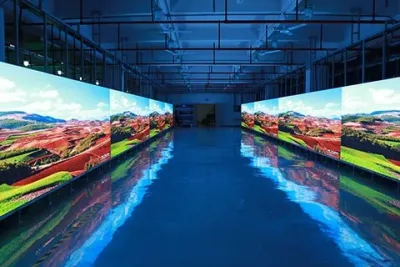
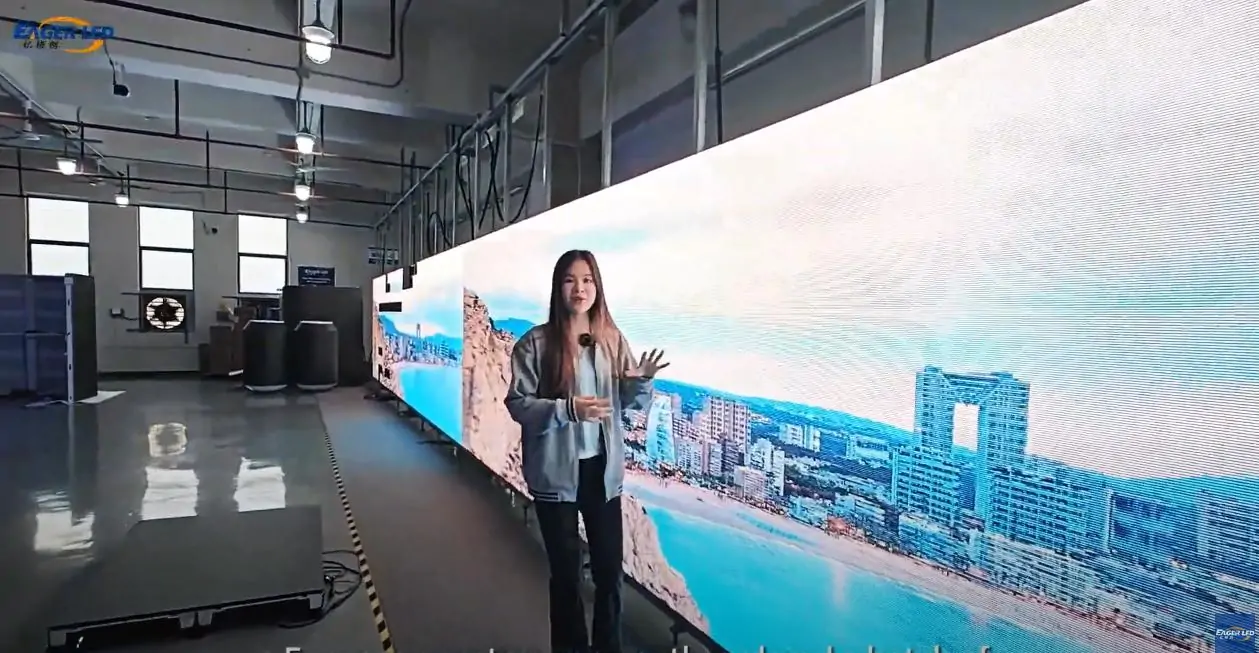
A true LED mini jumbotron builds each face from cabinets or modules containing thousands of individual LEDs. Multiple cabinets form one seamless canvas, while a video processor maps the source signal across the display.
This construction is better for larger audiences, higher brightness, custom dimensions, seamless graphics, and professional event workflows. It also requires more decisions: pixel pitch, scan method, brightness, refresh rate, calibration, receiving cards, power distribution, spare modules, and front or rear service access.
2.4 Type 3: Portable LED screen
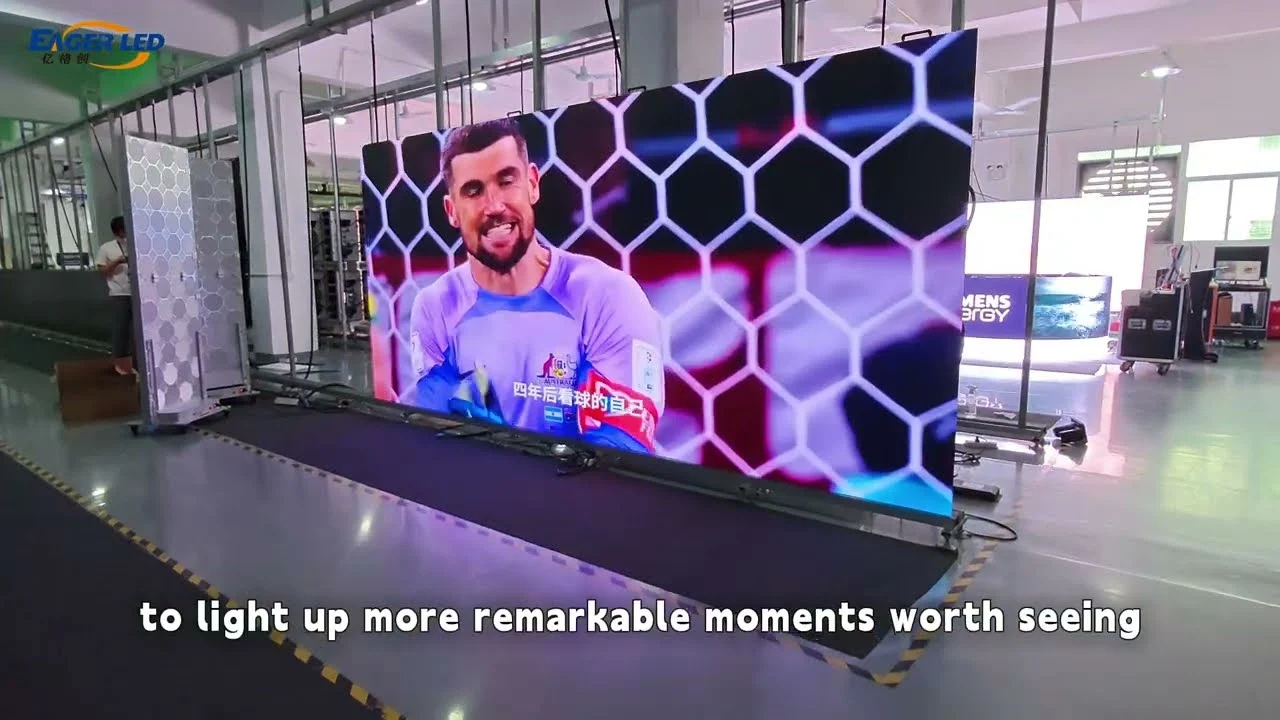
A portable LED screen may be assembled from rental LED display cabinets on a ground-support frame, mounted on a mobile stand, or integrated into a trailer with hydraulic lifting. It usually has one main viewing face rather than a four-sided cube, but it serves the same crowd-visibility purpose and is often marketed as a portable or mobile jumbotron.
For occasional events, renting is often more economical than buying. For frequent use, ownership can make sense only after budgeting for transport, trained setup staff, storage, spares, insurance, and local permitting.
2.5 How the construction fits together
A complete LED system normally includes:
- LED modules or cabinets;
- sending and receiving hardware;
- a video processor or switcher;
- power supplies, distribution, and protected cabling;
- a steel or aluminum support structure;
- trim, cladding, scoreboards, or decorative rings;
- rigging or ground-support hardware;
- content playback and optional scoring integration;
- spare modules, power supplies, receiving cards, and service tools.
A quote that lists only “LED screen” is not a complete system quote.
3. Mini Jumbotron for Home, Man Cave, and Small Arenas
The best design follows the viewing environment. Copying an arena cube at a smaller scale without adjusting height, brightness, sound, and controls can create a display that looks impressive in photos but is uncomfortable to use.
3.1 Mini jumbotron for home or man cave
For a mini jumbotron for home, a TV-based structure is usually the practical choice. Four independent TVs let viewers watch several games, while an HDMI matrix can send one source to all screens when a major event starts.
Before ordering, check:
- whether the ceiling or wall structure can carry the complete load;
- whether every TV can be removed without dismantling the enclosure;
- where heat will escape;
- whether remote-control signals will reach each TV;
- how power, HDMI, network, and audio cables will be concealed;
- whether the lowest edge stays above normal walking and standing zones.
Use a qualified installer for suspended equipment. A decorative frame is still an overhead load.
3.2 Baseball mini jumbotron
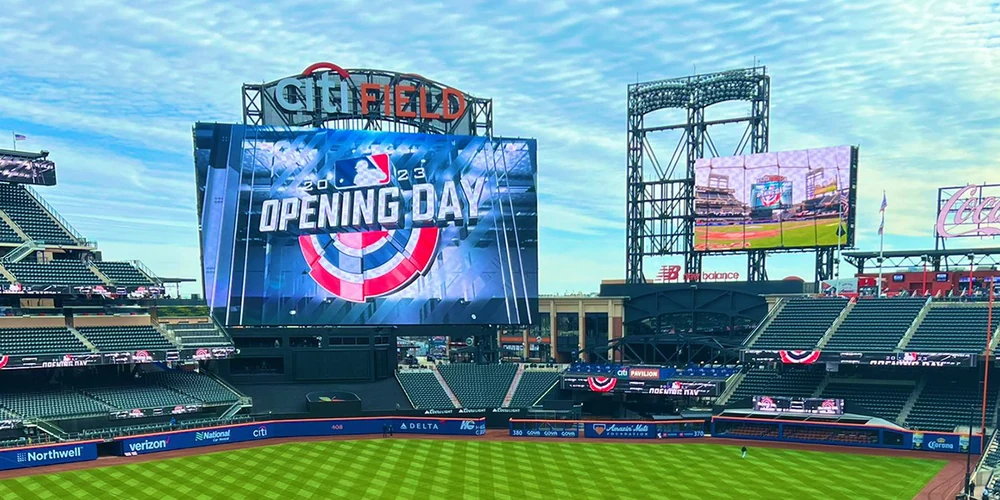
A baseball mini jumbotron may be a mobile LED screen behind the outfield, a fixed display near the scoreboard, or a compact screen serving bleachers at a training complex. Daylight brightness, long viewing distance, weather protection, and readable score graphics matter more than close-up resolution.
Ask for a content demonstration using the actual baseball scoreboard layout. Thin type and small sponsor logos that look sharp on a laptop can disappear from the stands.
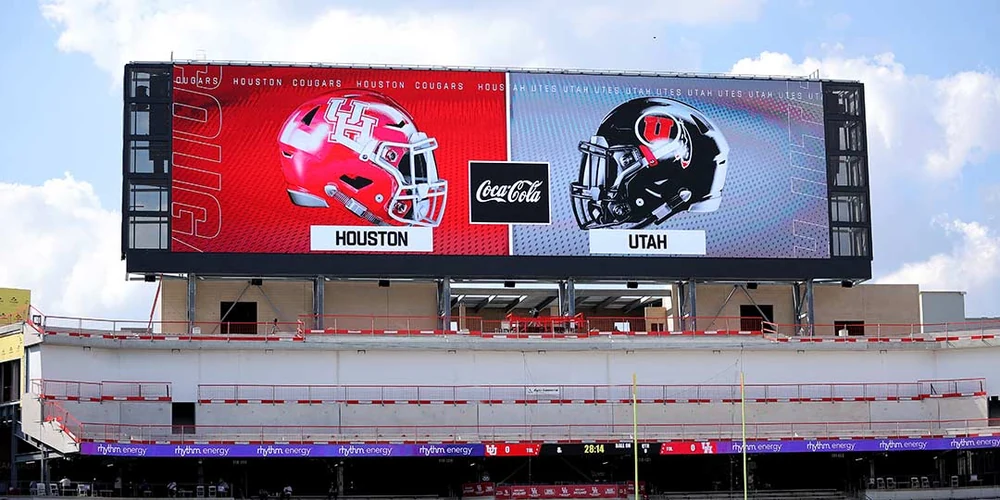
3.3 Football jumbotron for a small venue
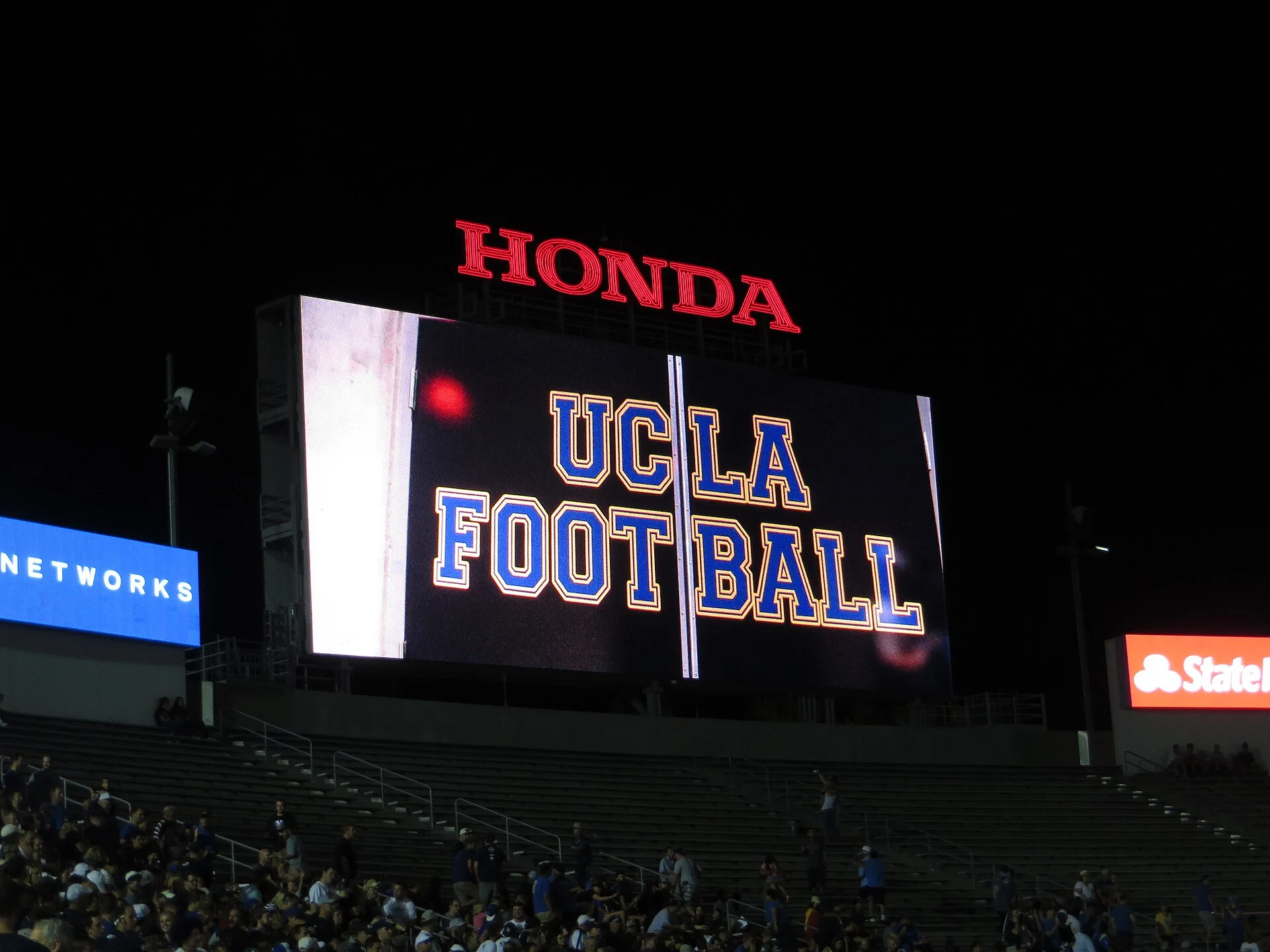
A small-school football jumbotron is commonly a single outdoor LED display rather than a four-sided cube. Prioritize brightness, remote diagnostics, easy module replacement, and a controller that accepts the scoring and production sources already used by the venue.
Also budget for foundations, structural steel, permits, electrical work, lightning or surge protection, data connectivity, and a weatherproof control location. These site costs can equal or exceed the screen hardware on difficult installations.
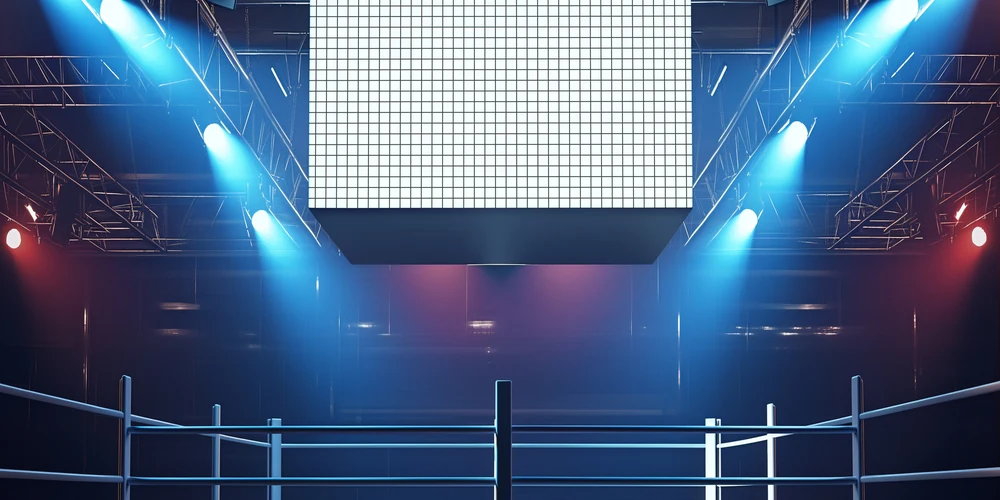
3.4 Mini UFC jumbotron or combat-sports display
A “mini UFC jumbotron” generally means a center-hung video cube for boxing, MMA, wrestling, or another combat-sports event; “UFC” is a specific brand, so unlicensed sellers and venues should use generic terms in product marketing.
For combat sports, low latency and camera-friendly refresh performance are critical. Spectators should see the action without a distracting delay, and recorded footage should not show rolling bands or flicker. The bottom of the display must also preserve clear sightlines to the ring or cage.
4. Indoor vs. Outdoor Mini Jumbotron
An outdoor screen is not simply an indoor screen with a roof over it. The enclosure, LEDs, cooling, structure, electrical protection, and brightness all change.
| Specification | Indoor system | Outdoor system |
|---|---|---|
| Brightness | Lower output for visual comfort | Higher output to compete with daylight |
| Pixel pitch | Often finer for close viewing | Often wider because viewers stand farther away |
| Weather protection | Dry, controlled environment | Weather-rated cabinets, connections, and power distribution |
| Structure | Designed for indoor loads and rigging | Must account for wind, rain, temperature, corrosion, and local code |
| Surface | Matte or low-glare options help at close range | High-contrast louvers and sun-facing performance matter |
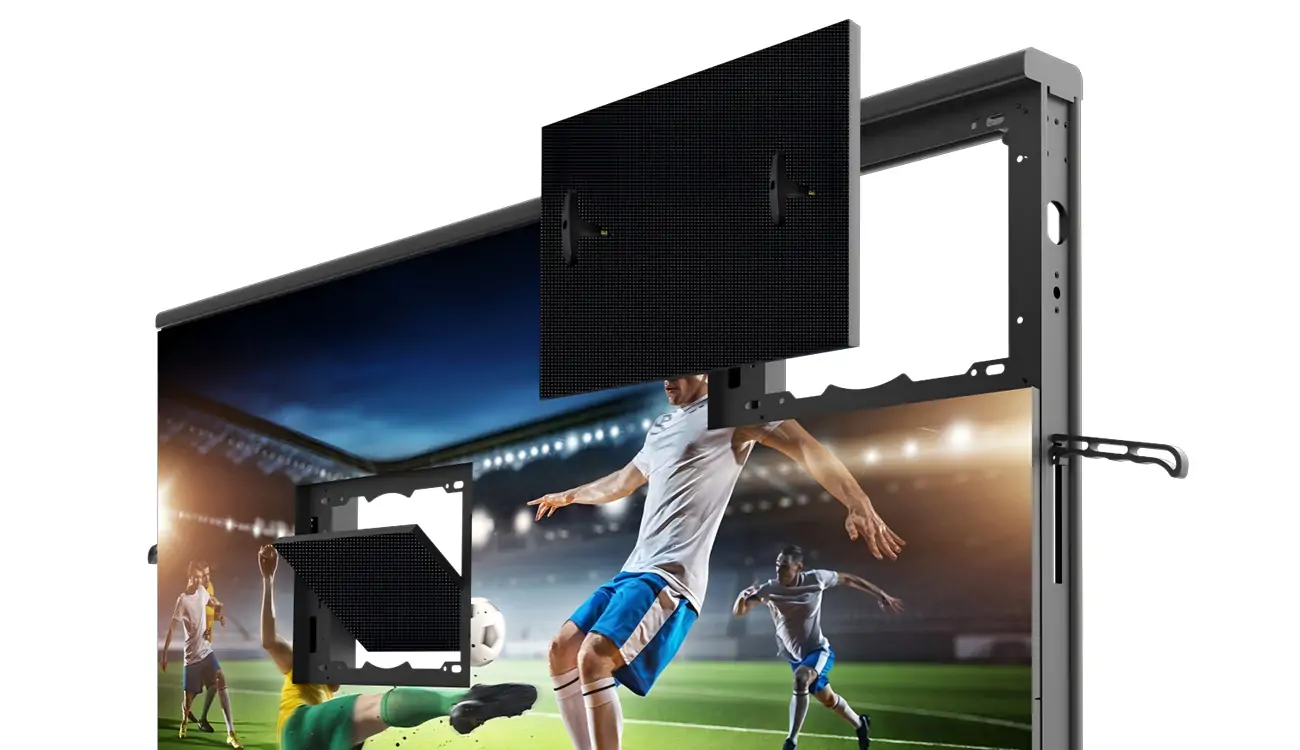
| Service plan | Access may be constrained by ceilings | Front-service LED display construction can reduce the need for rear weatherproof access space |
For outdoor purchasing, do not accept “waterproof” as a complete specification. Ask for the exact ingress-protection rating of the cabinet front, rear, connectors, and power equipment, plus the permitted operating temperature and humidity range. Confirm that the proposed rating fits the actual exposure; a covered concourse and an open football field are not the same environment.
Brightness should be specified in nits, but the highest number is not automatically best. Indoor displays that cannot dim sufficiently can cause eye fatigue and poor camera exposure. Outdoor displays need enough output for the orientation and local sunlight, along with automatic or scheduled brightness control.
5. Why the Small Jumbotron Is More Popular Than Ever
The small jumbotron has grown from a novelty into a practical display format for five reasons.
First, modular hardware scales. LED cabinets, video processors, and control systems are available in more sizes than before, so buyers no longer need a major-league venue to create an arena-style presentation.
Second, sports viewing is more fragmented. A four-screen home system can show several games at once. A venue can combine live video, score data, social content, and sponsor messages without giving the entire canvas to one source.
Third, content has become easier to produce. Modern processors accept common video inputs, while template-based graphics systems can create scoreboards and branded loops without a broadcast truck.
Fourth, sponsors want measurable visibility. A small arena can rotate more partners through digital inventory than through one permanent printed sign. That does not guarantee a return, but it creates a realistic revenue path when the venue has an organized sales plan.
Fifth, the display is part of the experience. Lighting, player introductions, instant replays, and live statistics can make a school gym, sports bar, or fan zone feel more intentional. The value comes from coordinated content, not screen size alone.
6. What Is the Price of a Mini Jumbotron?
The price of a mini jumbotron can start in the low thousands for a TV enclosure and reach six figures for an engineered, center-hung LED system. Any single advertised number is incomplete until you know whether it includes the displays, structure, processor, graphics, installation, freight, tax, commissioning, and spares.
When comparing a mini jumbotron for sale, treat the advertised figure as a starting point. The only meaningful mini jumbotron price is the total for a working system delivered, installed, tested, and supported at your site.
6.1 Practical 2026 planning ranges
| Mini jumbotron type | Planning budget (USD) | What commonly changes the price |
|---|---|---|
| DIY or basic TV-based home unit | $1,000-$4,000 | TV count and size, frame materials, graphics, lighting, mounts, and switching |
| Finished premium home/man-cave system | $3,000-$12,000+ | Custom enclosure, four matching TVs, ticker, audio, control, shipping, and installation |
| Small portable direct-view LED package | $10,000-$50,000+ | Screen area, pixel pitch, frame or trailer, processor, flight cases, power, and spares |
| Custom four-sided LED cube for a gym or small arena | $25,000-$150,000+ | Four-face area, structure, rigging, redundancy, scoring, installation, engineering, and access |
These are budgetary planning ranges, not quotations. Local labor, steel, permits, freight, tariffs, electrical upgrades, and currency can move the total substantially.
As one transparent retail reference, The Mini Jumbotron Company listed 24- to 43-inch TV-frame models from $1,250 to $3,450 when checked on August 4, 2026. Its page also stated that TVs were not included; printing was listed separately at $125-$375 per set, and a round ticker frame started at $600. This is useful evidence of how an attractive starting price can exclude essential parts of a complete installation.
6.2 Use total installed cost, not panel price
For an LED system, compare suppliers using the same scope:
Total installed cost = display hardware + processing + structure + electrical + installation + freight/tax + content integration + spare parts + training.
Then calculate a five-year ownership budget that includes preventive inspection, replacement modules, lift or access costs, storage for portable systems, software subscriptions, and expected power use. A cheaper screen with proprietary parts or slow support can cost more after the first failure.
7. 9 Useful Buying Tips for Choosing a Reliable Supplier
7.1 Define the use case before requesting a quote
State whether the display is for a home, school gym, outdoor field, rental fleet, restaurant, or small arena. Provide the available dimensions, photos, viewing distances, audience size, content sources, operating hours, and whether the system will be fixed, suspended, or portable.
A reliable supplier will ask follow-up questions. A quote produced from only a width and height is likely to hide assumptions.
7.2 Choose pixel pitch from the nearest real viewer
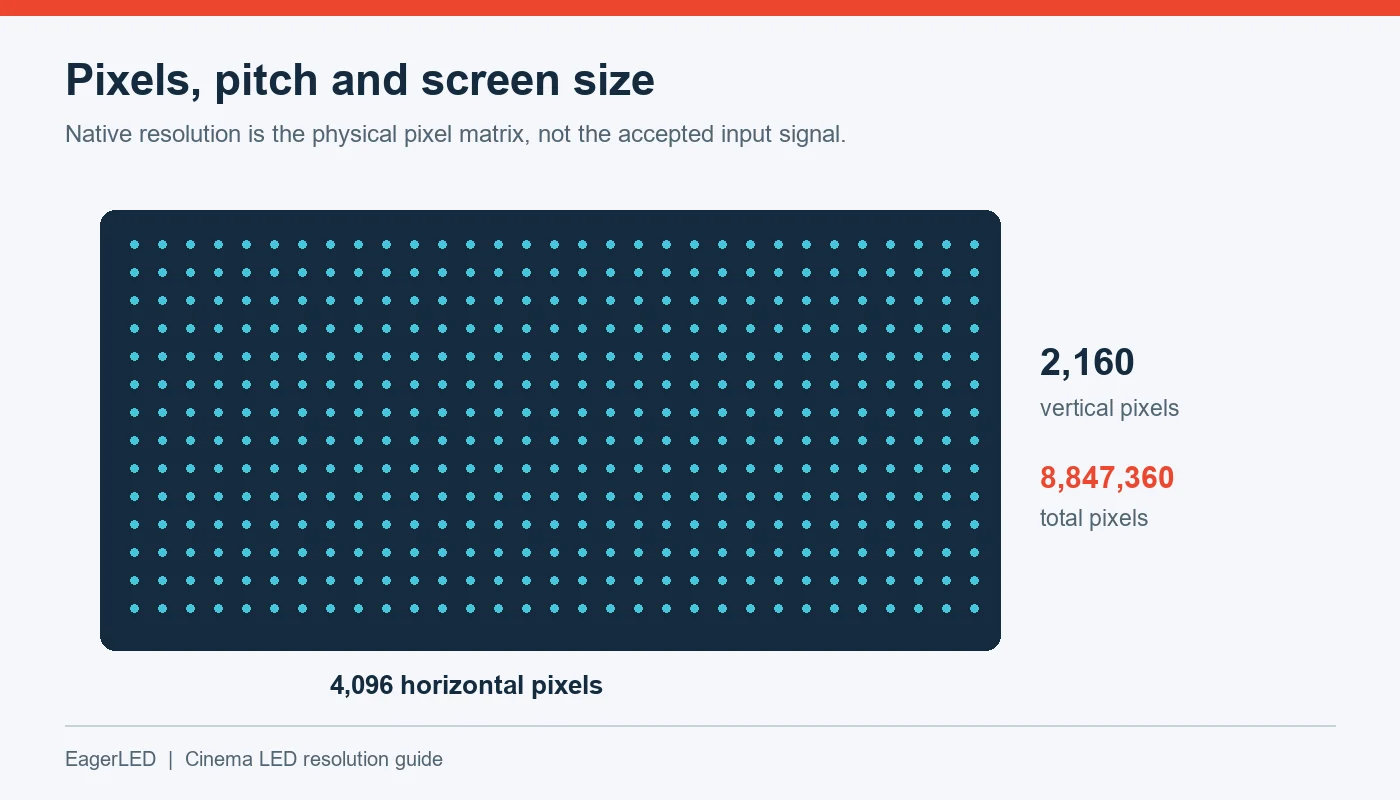
Pixel pitch is the center-to-center distance between LEDs, measured in millimeters. A smaller pitch creates more pixels in the same area and usually looks smoother at close range, but it costs more and may increase power and processing requirements.
Do not select pitch from a catalog slogan. Ask to view the proposed product with representative video and score graphics from your nearest and typical viewing positions. For a home, TV panels may offer better close-range detail than direct-view LED at the same budget.
7.3 Demand a complete, line-item quotation
The quotation should identify the exact cabinet or TV model, quantities, processor, controller, structure, mounts, cables, distribution, spares, packing, freight terms, installation, commissioning, training, and warranty. Ask the supplier to mark every exclusion.
For international purchases, request the shipping term and confirm who pays duties, customs fees, local delivery, unloading, and insurance.
7.4 Verify brightness, refresh rate, and camera performance
Ask for typical and maximum brightness, refresh rate, grayscale performance at low brightness, and the recommended camera settings. For live sports, worship, broadcast, or combat events, test the actual display with the cameras and frame rates you use.
Marketing numbers are not substitutes for a recorded camera test. Buyers comparing LED packaging can also review this DIP vs. SMD LED display guide before finalizing an outdoor specification. Look for flicker, scan lines, crushed dark detail, color shifts, and visible latency.
7.5 Match the environmental rating to the site
For outdoor installations, obtain the IP ratings for the cabinet faces and connections, operating temperature limits, corrosion protection, drainage approach, and brightness-control method. For coastal or high-humidity sites, ask specifically about coatings and metal finishes.
For indoor installations, confirm fire and electrical documentation required by the venue or local authority. Never assume a product certificate covers the complete custom structure.
7.6 Review the structure, rigging, and service access
Request stamped engineering when required by local code, plus the total weight, center of gravity, suspension-point loads, safety factors, and maintenance procedure. Portable outdoor systems also need defined wind limits and an action plan for unsafe conditions.
Every module, TV, power supply, receiving card, and cable should be replaceable. Ask the supplier to demonstrate the longest service task before approval.
7.7 Confirm content and scoring compatibility
List every required source: HDMI, SDI, streaming device, media player, camera switcher, scoreboard controller, computer, IPTV receiver, or cloud content platform. Ask who is responsible for signal conversion, scaling, aspect ratios, and audio synchronization.
If live scoring matters, require a test using the exact scoring hardware and software version. “Compatible with scoreboards” is too vague.
7.8 Inspect proof of delivery and after-sales support
Ask for recent projects with similar size, environment, and installation method. With the owner’s permission, speak to at least one customer about delivery accuracy, commissioning, failures, and response time.
The support plan should state contact hours, remote-diagnostic capability, parts location, expected response time, warranty claim process, labor coverage, and who pays freight for failed components.
7.9 Include spares, training, acceptance testing, and documentation
Buy a defined spare-parts package from the same production batch when color matching matters. Require operator and maintenance training, cabinet calibration files, wiring diagrams, configuration backups, part numbers, manuals, and software credentials.
Before final payment, run a written acceptance test covering dead pixels, uniformity, color, inputs, scoring, audio/video sync, brightness control, network recovery, and a simulated component replacement. A reliable supplier should agree on pass/fail criteria before manufacturing begins.
8. Small Jumbotron FAQs
9. Conclusion
A mini jumbotron can be a four-TV centerpiece for a home, a mobile LED display for a field, or a professional four-sided cube for a small arena. The name alone tells you almost nothing about the engineering or price.
Begin by choosing between TV-based and direct-view LED construction. Then define the viewing distance, environment, mounting method, content workflow, and complete installed scope. Compare suppliers on documented performance, structural safety, service access, compatible controls, spares, and support rather than the lowest advertised screen price.
The right buying request is not “How much is a mini jumbotron?” It is: “What complete system will safely deliver the required image to this audience, in this location, for the next five years?”
 Huidu HD-B8H: Specs, Setup, Price & B8L Comparison
 Black Spots on Screen: 7 Causes and Fixes to Try
Related Posts
Fill In Your Needs In Detail
Fill in the screen usage scene and size you need in “Content”.You will get a quote.