4K resolution, 4K, 4K UHD, UHD, and QLED, do you know exactly what they mean? Do they even refer to the same thing? I believe most people will be frustrated when facing the professional industry jargon. If you don’t comprehensively realize these terms, it will possibly lead to a bad decision for your investments.
Generally speaking, 4K UHD means a resolution of 3840 x 2160 pixels, while QLED describes quantum-dot technology used to enhance color reproduction in an LCD display. Think of it like comparing the size of a canvas (4K UHD) to the type of paint used to create the artwork (QLED).
In this 4K UHD vs QLED article, we will break down what 4K UHD and QLED mean, what the difference is, and which one is the right pick for you. It will help you make the right choice when you are ready to upgrade your LED displays.
1. UHD vs QLED: What Are They?
4K UHD and QLED are not direct competitors. In fact, they describe two different aspects of LED displays: resolution and display technology. We will explain them in detail and explore what exactly they are.
1.1 What is UHD?
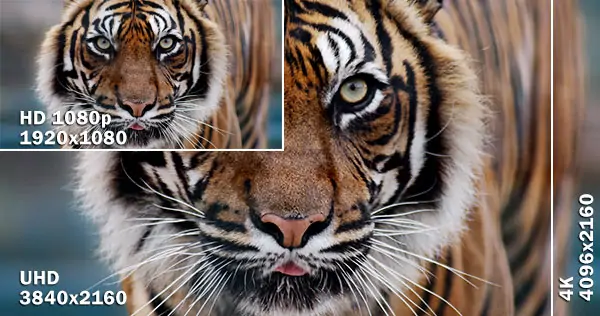
UHD(Ultra High Definition), identified as 4K, 4K resolution, and 4K UHD, refers to a resolution standard of 3840 x 2160 pixels. It is four times the resolution of Full HD(1920 x 1080 pixels).
UHD stands for a resolution standard to describe the clarity and sharpness of the screen image. It is noted that UHD is not a type of display(LCD or OLED), just the number of pixels. So more pixels result in sharper, clearer, and more immersive images.
The SD, Full HD, UHD, 8K Ultra HD can be found in a variety of screen types such as LED, OLED, and QLED. Here is a comparison table of these resolution standards.
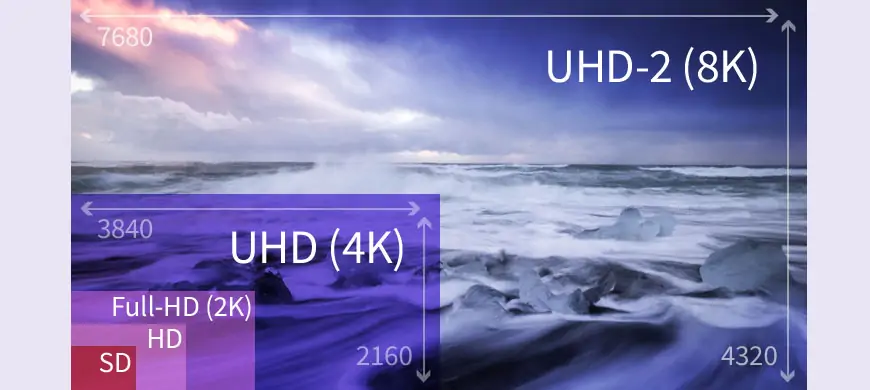
| Resolution Standard | Width × Height | Total Pixels (approx.) | Aspect Ratio |
|---|---|---|---|
| SD (Standard Definition) | 720×480 (NTSC) 720×576 (PAL) | 340K–410K | 4:3 |
| Full HD (Full High Definition) | 1920×1080 (1080p) | 2.07 million | 16:9 |
| UHD (Ultra High Definition, 4K) | 3840×2160 (2160p) | 8.29 million | 16:9 |
| 8K Ultra HD | 7680×4320 (4320p) | 33 million | 16:9 |
More information: What is LED Screen Resolution?
1.2 What is QLED?
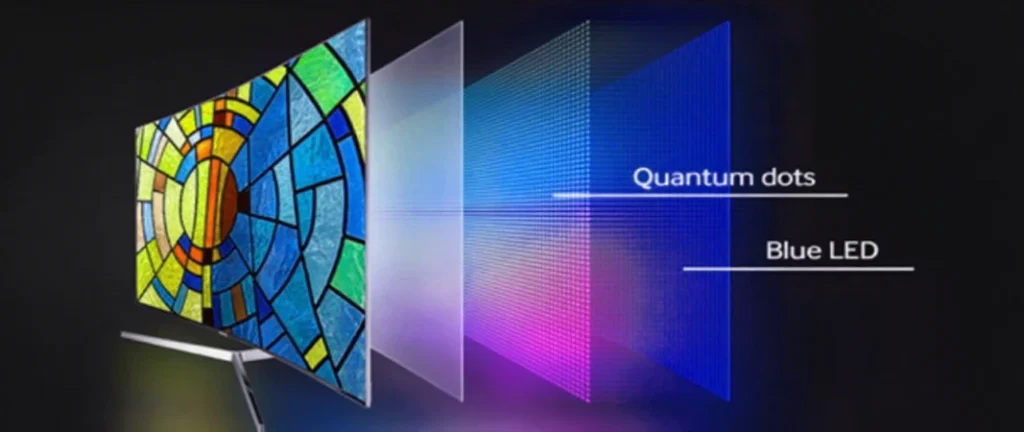
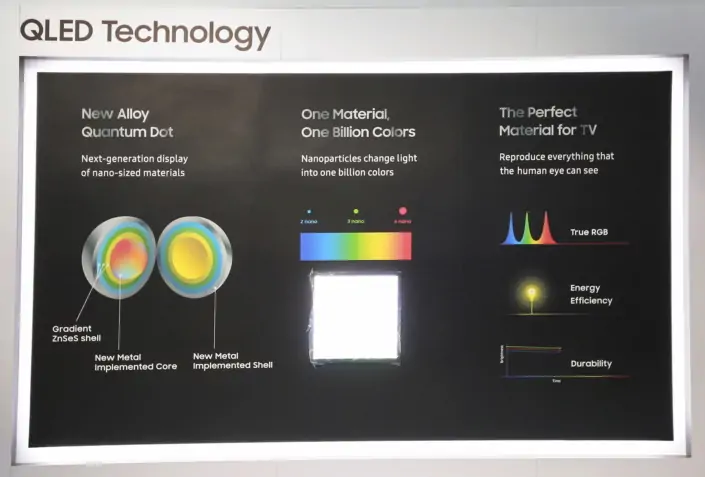
QLED, Quantum Dot Light Emitting Diode, refers to a display technology that defines how the screen produces color and light. The quantum dot layer is its core technology.
Compared with 4K UHD, QLED focuses on high-quality screens with high brightness, high contrast, and better color accuracy.
You will see UHD resolution occurs in the specification list of the OLED TVs, which means it offers upgraded 4K pictures with a wide color range and higher contrast, delivering a more vivid visual experience for audiences.
1.3 Comparison Table: 4K UHD vs QLED?
| Feature | 4K UHD | QLED |
|---|---|---|
| Category | Resolution Standard (How many pixels) | Panel Technology (How light/color is made) |
| What it affects | Sharpness, detail, clarity | Brightness, color volume, vibrancy |
| Mutual Exclusivity? | No. A QLED TV is almost always 4K UHD. | No. You can have 1080p QLED (rare) or 4K QLED (common). |
| Bottom Line | How clear is the picture? | How good are the colors and brightness |
2. 4K UHD vs QLED: What is the Difference?
For the basic concept, I think you have a general understanding of it. Now, we will walk you through the difference between 4K UHD and QLED. Reading on! You will get an insight into 4K UHD vs QLED.
2.1 Brightness and Color Accuracy
4K UHD stands out for its exceptional image sharpness, intricate detail rendering, and high pixel density that brings every visual element to vivid life.
QLED excels in color accuracy, expansive color volume, and brightness, delivering stunningly lifelike and immersive viewing experiences due to quantum dot technology.
2.2 Backlighting and Contrast
QLED uses LED backlighting enhanced with quantum dots, often combined with local dimming to improve contrast and highlight details.
4K UHD does not define contrast—this depends entirely on the display technology behind it.
2.3 Viewing Angles
UHD has not direct impact on the viewing angle as it only refers to a resolution. Its viewing angle is more likely to depend on the LED panels.
QLED viewing angles vary depending on the panel (IPS vs VA), with some models offering wide angles but others more limited.
2.4 Image Quality Focus
4K UHD is all about sharpness, detail, and clarity, providing four times the pixels of Full HD (1080P).
QLED aims at visual performance, which increases brightness, richness of colors, and vibrancy.
2.5 Use Case Differences
4K UHD is best for large screens, close viewing distances, and content where detail matters (movies, text, gaming UI).
QLED suits bright rooms, sporting, and rich content with an emphasis on brightness and color.
2.6 Price
QLED TVs are generally more expensive due to enhanced display technology and better visual performance.
4K UHD TVs are widely available at different price levels, making them more budget-friendly overall.
Therefore, 4K UHD and QLED complement each other. In the market, a lot of TVs are actually 4K QLED, integrating high resolution with improved color accuracy and brightness for the best overall viewing experience.
3. Standard 4K LED-LCD vs 4K QLED: What Actually Changes?
Once resolution is the same, the useful comparison is between a conventional LED-backlit LCD display and a quantum-dot-enhanced LCD display. Both can have 3840 × 2160 pixels, so QLED does not automatically mean more detail.
| Feature | Standard 4K LED-LCD | 4K QLED |
|---|---|---|
| Resolution | 3840 × 2160 pixels | 3840 × 2160 pixels |
| Color reproduction | Depends on the backlight and color filters | Quantum dots can support a wider color gamut |
| Brightness | Depends on the model and backlight | Can be high, but the QLED label guarantees no specific brightness |
| Contrast and black levels | Depend on panel type and local dimming | Also depend on panel type and local dimming; quantum dots alone do not produce deeper blacks |
| Viewing angles | Depend on panel construction | Also model-dependent; QLED does not guarantee wider viewing angles |
| Gaming performance | Check refresh rate, input lag, and VRR | Check the same specifications; QLED does not guarantee faster response |
| Price | Available across different budgets | May cost more than a comparable conventional LCD, but prices overlap |
QLED, Mini LED, and UHD can coexist. UHD describes resolution, QLED describes quantum-dot color technology, and Mini LED describes a type of backlight. OLED is different: its pixels emit their own light.
4. 4K UHD vs QLED: Pros and Cons
When coming into a new theme about the pros and cons of 4K vs QLED, you should remember that one defines resolution, the other is display technology. Alright, let’s explore their unique strengths.
4.1 4K UHD
Pros:
- Sharper image quality: UHD offers four times the pixels of Full HD, delivering clearer details and cleaner text.
- Better for large screens: Higher resolution keeps images crisp even on bigger LED.
- Affordable and wide availability: Found across many display types (LED, OLED, QLED), offering flexible price options. Standard 4K UHD TVs are more affordable.
- No burn-in risk: Mature LCD technology ensures stable performance with no permanent image retention.
- Enhanced content: Great for movies, gaming, shows, and high-resolution visuals.
Cons:
- Does not enhance color or contrast itself: Image quality is determined by the panel technology.
- Poor performance with low-quality content: Non-4K content depends on upscaling, which can decrease clarity.
- Can reveal weaknesses: Low brightness or contrast is more apparent on higher resolution displays.
- Bad black levels: Low contrast results in grayish blacks and lack of depth in dark scenes.
- Bad off-angle viewing: The picture becomes dull, the color is changed, and the contrast becomes much lower when seeing off-angle.
4.2 QLED
Pros:
- Ultra-High brightness:QLED displays are bright enough to be used in sunny rooms and during the day.
- Richer color reproduction:Quantum dots deliver a wider color gamut with more accurate and lifelike colors.
- Better HDR performance:Enhanced highlights and color volume of modern content.
- Long lifespan:Quantum dots are stable and maintain performance over time.
Cons:
- Weaker black levels than OLED: As an LCD-based technology, it may struggle with deep blacks and contrast.
- Possible blooming effect: The bright objects can give halo on the darker backgrounds.
- Limitations on viewing angles: When the panel is viewed at a side, performance may decrease based on the type of panels.
- More expensive: QLED display is more expensive than regular 4K LED/LCD displays.
- Not self-emissive: Uses backlighting rather than the individual pixel lighting, which restricts contrast potential.
4.3 Is QLED Better Than UHD?
5. Is QLED Better Than 4K? When Is It Worth Paying More?
QLED is not an alternative to UHD. The practical question is whether a particular 4K QLED display offers enough improvement over another 4K display to justify its price.
| Your priority | What to check | When paying more makes sense |
|---|---|---|
| A bright room | Measured brightness and reflection handling | The QLED model performs visibly better in your lighting conditions |
| Movies in a dark room | Black levels, blooming, and local dimming | The model has better contrast and backlight control, not simply a QLED badge |
| Gaming | Native refresh rate, input lag, VRR, and supported input modes | It supports the resolution and frame rate your hardware can deliver |
| Sports | Motion handling, viewing angles, and screen uniformity | It keeps motion clear and the picture consistent across your seating positions |
| Everyday viewing on a budget | Screen size, upscaling, warranty, and overall picture quality | The improvement is noticeable with the content you actually watch |
6. Where Can the UHD and QLED Display Technology be Used?
Since we have dived into their definitions, differences, and pros and cons, let’s together learn about where UHD and QLED display technology can be used. It helps you decide which one is better suited for specific environments and applications.
6.1 UHD Applications
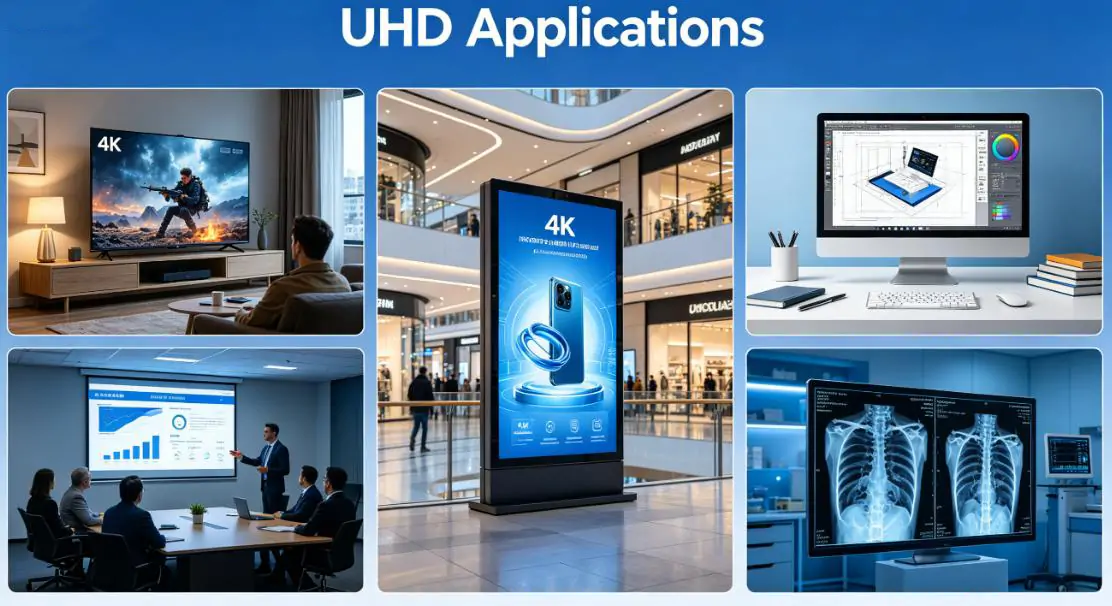
4K UHD centers on sharp details and high resolution. It is better for applications where clarity plays a pivotal role.
- Home televisions: Offers high quality and clarity in viewing movies, shows, and stream content.
- Computer monitors: Provides details to work on designs, editing, office and gaming.
- Digital signage: Designed to display high-resolution public information in a shopping mall, airport, or bank.
- Education & conference rooms: Helps in making clear projection and on a large screen teaching or meeting presentation.
- Medical imaging: Provides accurate display of details on diagnostic screens in medical settings.
6.2 QLED Display Technology Applications
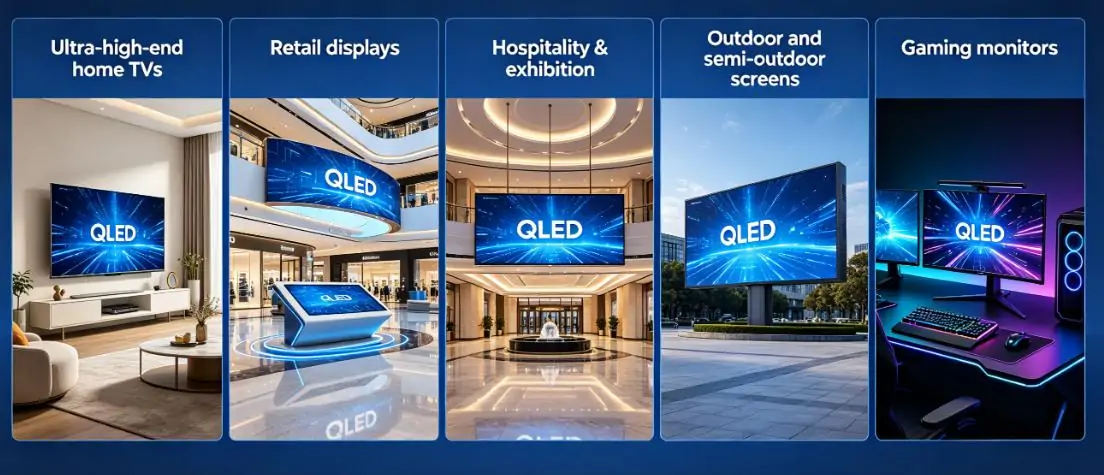
QLED display technology excels in high brightness, superior HDR performance, and vibrant colors. It suits for applications where visual performance matters most.
- Ultra-high-end home TVs: Provides bright and vivid colors and good performance of HDR in bright living rooms.
- Retail displays: use life-like colors in advertising and promotional screens.
- Hospitality & exhibition: Applied in high-impact visual experiences in hotels, museums and expos.
- Outdoor and semi-outdoor screens: Screen does not fade in strong ambient light.
- Gaming monitors: This offers high brightness, low motion blur and realistic color to gaming systems.
6.3 Combined Uses
Combining UHD with QLED display technology provides images with high brightness, vivid colors, and sharp details. It is an ideal for applications that focus on these aspects.
- High-end smart televisions: The majority of new TVs with QLED are 4K UHD resolution to provide better overall picture quality.
- Premium digital signage: UHD sharpness with QLED brightness and color in a commercial advertising setting.
- Home theater systems: Combines high-resolution 4K images with the rich color and HDR capabilities of QLED.
- Professional monitoring: Applied in broadcast, control rooms, and post-production to provide high-resolution, bright, and accurate visuals.
6.4 Comparison Table about Applications
- These ads have URLs or QR codes and other types of social media promotions that convert offline viewers to online customers.
- Although they are physical ads, a kind of digital, allows for tracking the data by measuring impressions, analyzing routes, and engagement through various tools, e.g., GPD analytics.
| Application Scene | UHD Technology | QLED Technology | Combined (UHD + QLED) |
|---|---|---|---|
| Home TV | Basic clear viewing | Bright, vivid colors | Best premium viewing experience |
| Digital Signage | Clear text & images | Good visibility in light | High-end commercial advertising |
| Gaming | Sharp details | Bright, dynamic colors | Immersive high-quality gaming |
| Office/Conference | Clear presentation | Better color performance | Professional high-end meeting rooms |
| Home Theater | High-definition content | Richer color depth | Cinema-level picture quality |
7. How to Choose 4K UHD and QLED? Which is Better for you?
The 4K UHD vs. QLED is not about picking one over the other—it is about knowing what will be the most important to your viewing space and use. As 4K = resolution and QLED = display technology, the best choice will be based on your priorities.
7.1 Viewing Environment Consideration
When you have a dark or light-controlled room, you can watch comfortably with normal 4K UHD.
QLED is more compatible with greater brightness and better sight in case your space is bright and has a lot of natural light.
7.2 Consider What You Watch Most
- Movies & streaming: UHD provides sharper detail and better cinematic clarity.
- Sports & live TV: QLED offers brighter visuals and more vivid colors.
- Gaming: The best experience comes from combining both (4K QLED) for detail + color impact.
7.3 Think About Screen Size and Viewing Distance
- Larger screens benefit more from 4K UHD, as higher resolution keeps images sharp.
- If you sit close to the LED screen, UHD makes a big difference in clarity.
- For distant viewing or large venues, brightnessmay matter more than resolution. QLED is the right choice for excellent visual experiences.
7.4 Decide Based on Budget
4K UHD displays are of lower prices but still offer decent resolution. It is a budget-friendly option for those who have budget limitations.
QLED is more expensive and also provides better color, brightness and durability. It is suitable for someone who focuses on visual performance and viewing effects but has enough budgets.
7.5 Which Is the Best Choice for Businesses and Personal Uses?
For Personal Use:
- UHD is great for everyday TV watching and budget-friendly setups.
- QLED is better for immersive viewing, gaming, and high-impact visuals.
For Business:
4K UHD works well for offices, conference rooms, and basic indoor signage.
QLED is a solid choice for retail displays, exhibitions, hotels, and bright public areas due to its high brightness and color performance.
8. 4K UHD vs QLED: Which is Better for Your Eyes?
There is no direct “4K UHD vs QLED” comparison, because most QLED TVs are 4K UHD. They are not competing screen technologies.
- 4K UHD: It refers to resolution, telling you how many pixels make up the image.
- QLED: It is a color technology, telling you how quantum dots are used to improve brightness and color.
They work together, not compete with each other. Therefore, when evaluating eye comfort, you need to look at screen settings, viewing environments, and your eye conditions.
8.1 How Each Factor Impacts Your Eyes
8.1.1 Screen Setting
How hard you eye muscles depends on how you set up your displays.
- Brightness: A screen that looks glaringly bright relative to its surroundings can cause discomfort. Excessively low brightness can make details difficult to see.
- Resolution and Text Size: 4K can display finer detail, but small text remains difficult to read regardless of pixel count. The benefit also depends on screen size, distance, and source quality.
- Contrast and HDR: For light-sensitive viewers, extreme HDR highlights may feel uncomfortable. Additionally, clear contrast helps distinguish text and objects.
- Flicker and Motion Settings: Flickering or pulsing light can aggravate symptoms in some people with migraine. Some motion-clarity settings insert black frames.
- Color Temperature and Blue-Light Modes: Cool blue light spreads more inside your eyes. It causes a faint cloudy effect and makes glare worse.Warmer light scatters less. It matches natural light and helps your eyes feel less tired at night.
8.1.2 Viewing Environments
- Room Lighting: A bright screen against dark surroundings may feel harsh. Strong room lighting can also create glare.
- Viewing Distance: Sitting too far back makes it hard to see small details. When you sit close to a computer, your eyes work harder to focus and align than they do when watching a TV far away.
- Windows and Reflections: Reflections hide details and lower contrast. This makes you squint or sit in an uncomfortable position.
- Viewing Duration: Long, uninterrupted viewing can contribute to eye fatigue and dryness.
- Airflow and Humidity: Fans, air conditioning, and dry air can worsen dry-eye symptoms.
8.1.3 Your Eye Conditions
8.2 How to Protect Your Eyes
Whether you use a 4K UHD TV or QLED display, these tips can help you reduce your eye fatigue and dryness.
- Match your room lighting: Don’t watch a high-bright TV in a ultra-black room. Keep a gentle ambient light in a room to reduce eye strain.
- Adjust the brightness: Keep the picture comfortably readable without making it look glaringly bright.
- Keep warm color: Enable a “warm” or “night” color profile in the evening to reduce harsh blue light exposure.
- Reduce glare and reflections: Position screens away from reflected windows and lamps. Use curtains or soft, indirect lighting when needed.
- Take regular breaks: For close screen work, follow the 20-20-20 reminder: every 20 minutes, look at something about 20 feet away for 20 seconds.
- Make text easy to read: Make fonts and subtitles bigger so you don’t squint or lean in. Place your computer screen about an arm’s length away and a little below your eyes.
Whether you use a 4K UHD TV or QLED display, these tips can help you reduce your eye fatigue and dryness.
- Match your room lighting: Don’t watch a high-bright TV in a ultra-black room. Keep a gentle ambient light in a room to reduce eye strain.
- Adjust the brightness: Keep the picture comfortably readable without making it look glaringly bright.
- Keep warm color: Enable a “warm” or “night” color profile in the evening to reduce harsh blue light exposure.
- Reduce glare and reflections: Position screens away from reflected windows and lamps. Use curtains or soft, indirect lighting when needed.
- Take regular breaks: For close screen work, follow the 20-20-20 reminder: every 20 minutes, look at something about 20 feet away for 20 seconds.
- Make text easy to read: Make fonts and subtitles bigger so you don’t squint or lean in. Place your computer screen about an arm’s length away and a little below your eyes.
9. FAQs
10. Conclusion
Simply speaking, 4K UHD describes resolution, while QLED means quantum-dot LCD technology. QLED and 4K UHD both have unique advantages. QLED stands out in colors and brightness, while 4K UHD is good at sharp details. If you want to choose them, the budget and visual focus are two essentials to consider.
As an experienced LED display supplier, we can customize professional LED display solutions according to your special demands. Contact us and get the first information.
 How to Choose the Best Transparent LED Video Wall in 2026
 NovaStar ET1S-G Guide: Media Server Features and Setup
Related Posts

Fill In Your Needs In Detail
Fill in the screen usage scene and size you need in “Content”.You will get a quote.