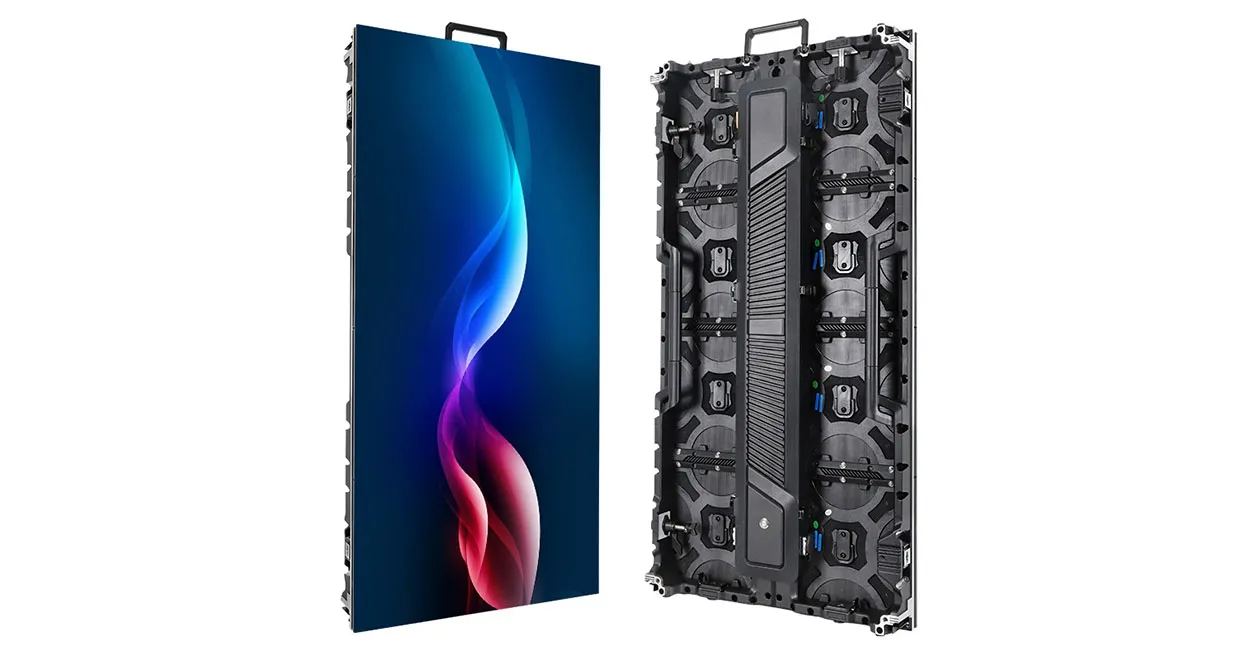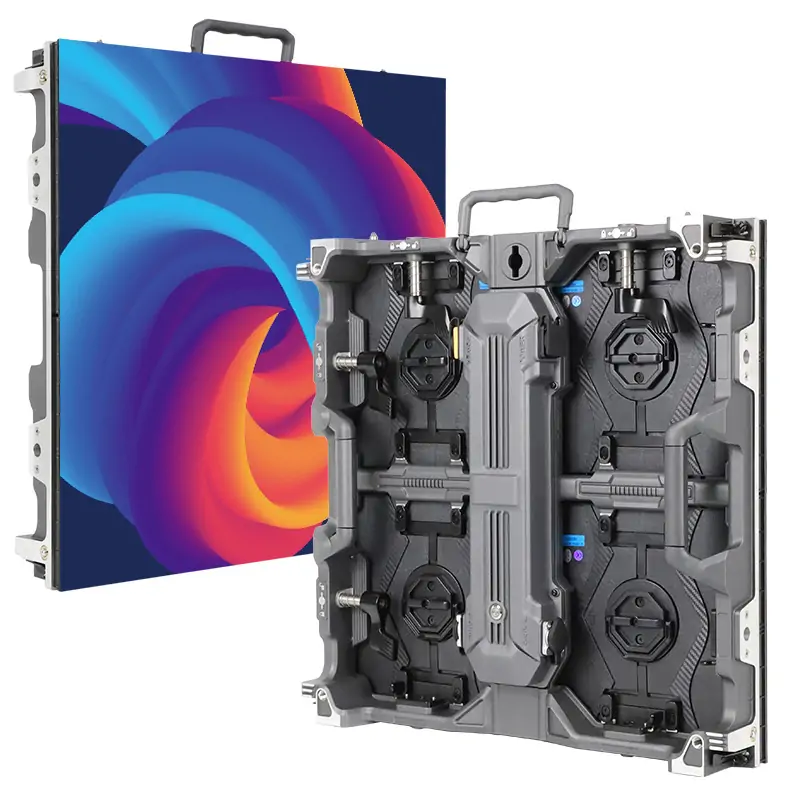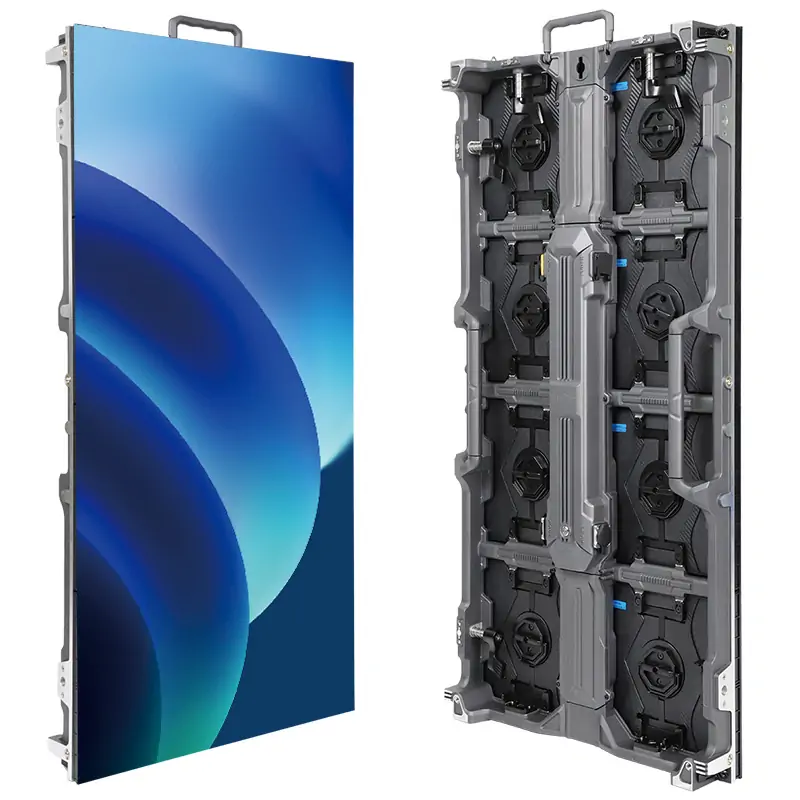
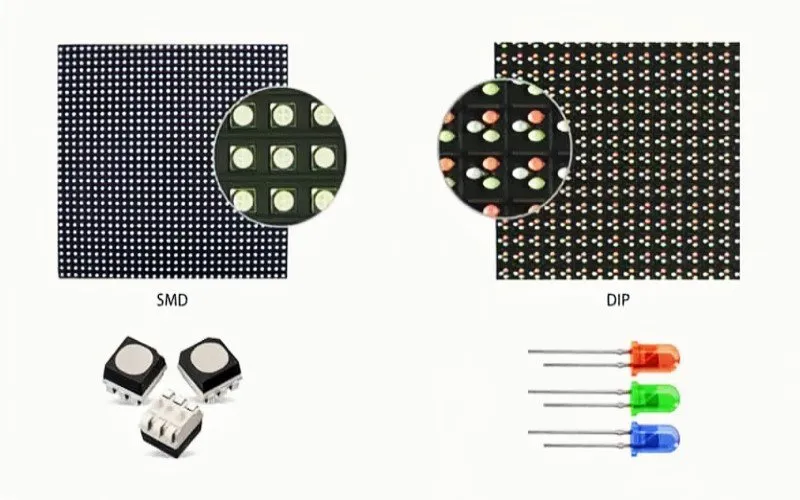
DIP vs SMD LED display technology describes how the LEDs are packaged and mounted. Traditional DIP displays use through-hole lamps, often separate red, green and blue emitters per pixel. Full-color SMD displays commonly combine RGB chips in one surface-mounted package. DIP can suit directional, long-distance signage; SMD offers more fine-pitch options and is used both indoors and outdoors.
Choose the actual display by pixel pitch, viewing positions, calibrated brightness, environmental ratings and lifetime cost. Packaging alone does not guarantee better durability or lower price. Specialized products such as an indoor GOB floor LED display also need application-specific protection; they are not interchangeable with ordinary wall screens.
1. DIP vs SMD: What They Actually Are
1.1 DIP — Dual In-line Package
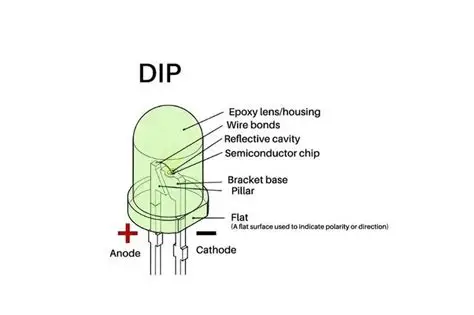
DIP means Dual In-line Package; in LED-display terminology it commonly refers to through-hole lamps whose leads pass through the circuit board. In a traditional full-color arrangement, separate red, green and blue lamps form a pixel. A lamp is therefore not necessarily a complete pixel, and lamp diameter is different from pixel pitch.
The lens can concentrate light toward the audience. Larger packages and their mounting holes constrain spacing, making this approach more relevant to coarser-pitch signage than close-viewing walls. Cree LED’s signage portfolio includes through-hole and SMD emitters with different beam angles. Check the component and display specifications rather than treating a particular pitch cutoff as universal.
The diagram below labels the epoxy lens/housing, wire bonds, reflective cavity, semiconductor chip, support structure, and anode/cathode leads. These are parts of one lamp. Display luminance in nits (cd/m²) describes the assembled screen, not the output rating of an individual lamp.
1.2 SMD — Surface-Mount Device
SMD means Surface-Mount Device. A common full-color display package contains red, green and blue chips and is soldered to pads on the board surface. Surface mounting does not mean there are no electrical terminals or spaces between pixels; package sizes and structures vary.
Compact packages support finer pitches and automated assembly. Indoor and outdoor SMD products have different brightness and protection requirements. For example, Planar’s AT Series specifications list SMD models from 0.945 to 4 mm pitch; those figures describe that product family, not the limits of all SMD displays.
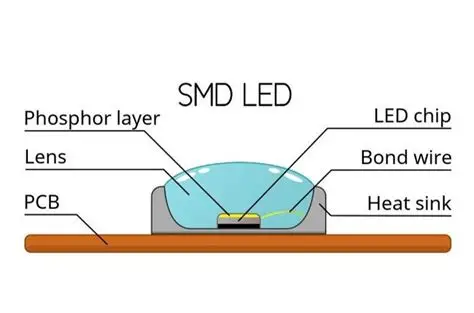
The illustration below is a generic phosphor-converted LED cross-section, labeled lens, phosphor layer, chip, bond wire, heat sink and PCB. It does not show the usual three-chip RGB display package. Use the actual RGB component drawing when comparing construction.
2. DIP vs SMD: Head-to-Head Comparison
| Feature | DIP | SMD |
|---|---|---|
| LED size | Separate through-hole lamps; check package drawing | Surface-mounted packages; dimensions vary |
| Pixel pitch range | Usually coarser-pitch signage; verify the product | Fine and coarse pitches; verify the product |
| Brightness | Model-specific; directional optics can help | Model-specific; outdoor products can exceed 2,500 nits |
| Viewing angle | Often directional; depends on lens design | Often broad; directional designs also exist |
| Color blending | Separate RGB emitters may be visible close up | Compact RGB package; pitch and calibration still matter |
| Weather resistance | Requires a suitably protected complete system | Requires outdoor-rated parts and system protection |
| Power consumption | Compare at matched area, brightness and content | Compare at matched area, brightness and content |
| Weight | Cabinet and structure determine installed weight | Cabinet and structure determine installed weight |
| Repairability | Lamp/module repair depends on access and skills | Package/module repair depends on access and skills |
| Cost per m² | Obtain a matched project quote | Obtain a matched project quote |
| Minimum viewing distance | Depends on pitch, content and visual expectations | Depends on pitch, content and visual expectations |
These are selection considerations, not guaranteed performance rankings. Compare specifications for complete displays.
3. Where DIP Wins
3.1 Raw outdoor brightness
DIP’s directional optics can be useful when light needs to reach a defined viewing area. However, outdoor brightness is not exclusive to DIP, and SMD has no general 2,500-nit ceiling. EagerLED’s EA250F outdoor display description specifies SMD packaging and 6,500 cd/m² brightness.
Compare sustained, calibrated brightness at the required color temperature, not only a peak claim. Readability also depends on ambient light, contrast, character size and viewing angle. Ask for brightness adjustment suitable for both daytime and nighttime operation.
3.2 Mechanical durability
Through-hole construction can provide a robust mechanical connection, but it does not make the complete board or cabinet waterproof. Connectors, power supplies, exposed conductors and ventilation paths still need protection appropriate to the installation.
For an outdoor advertising display cabinet, verify the specified front/rear protection, operating conditions and maintenance access. Do not infer DIP packaging from its outdoor application. Neither an unsealed DIP module nor an indoor SMD module should be assumed suitable for direct rain.
3.3 Cost at large pixel pitches
A coarse-pitch DIP design may be cost-effective when it meets the audience and content requirements, especially where compatible spares and maintenance skills already exist. That is a quotation-level comparison, not a guarantee that DIP is always cheapest.
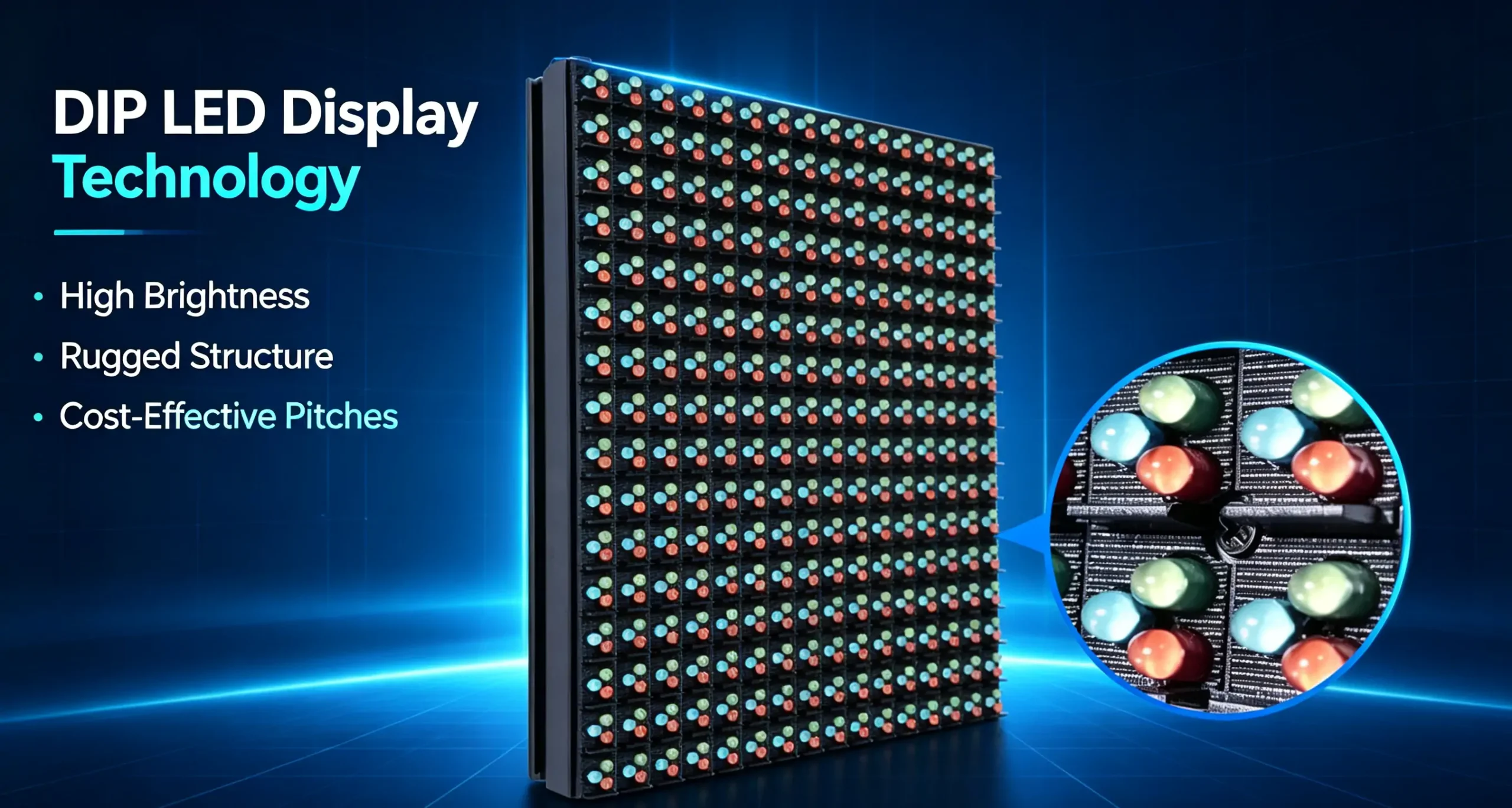
Request matched offers for the same area, resolution, brightness and protection. Include support structure, controllers, power distribution and service access. The illustration summarizes potential DIP benefits—brightness, rugged construction and cost-effective pitches—but none follows from the package name alone.
4. Where SMD Wins
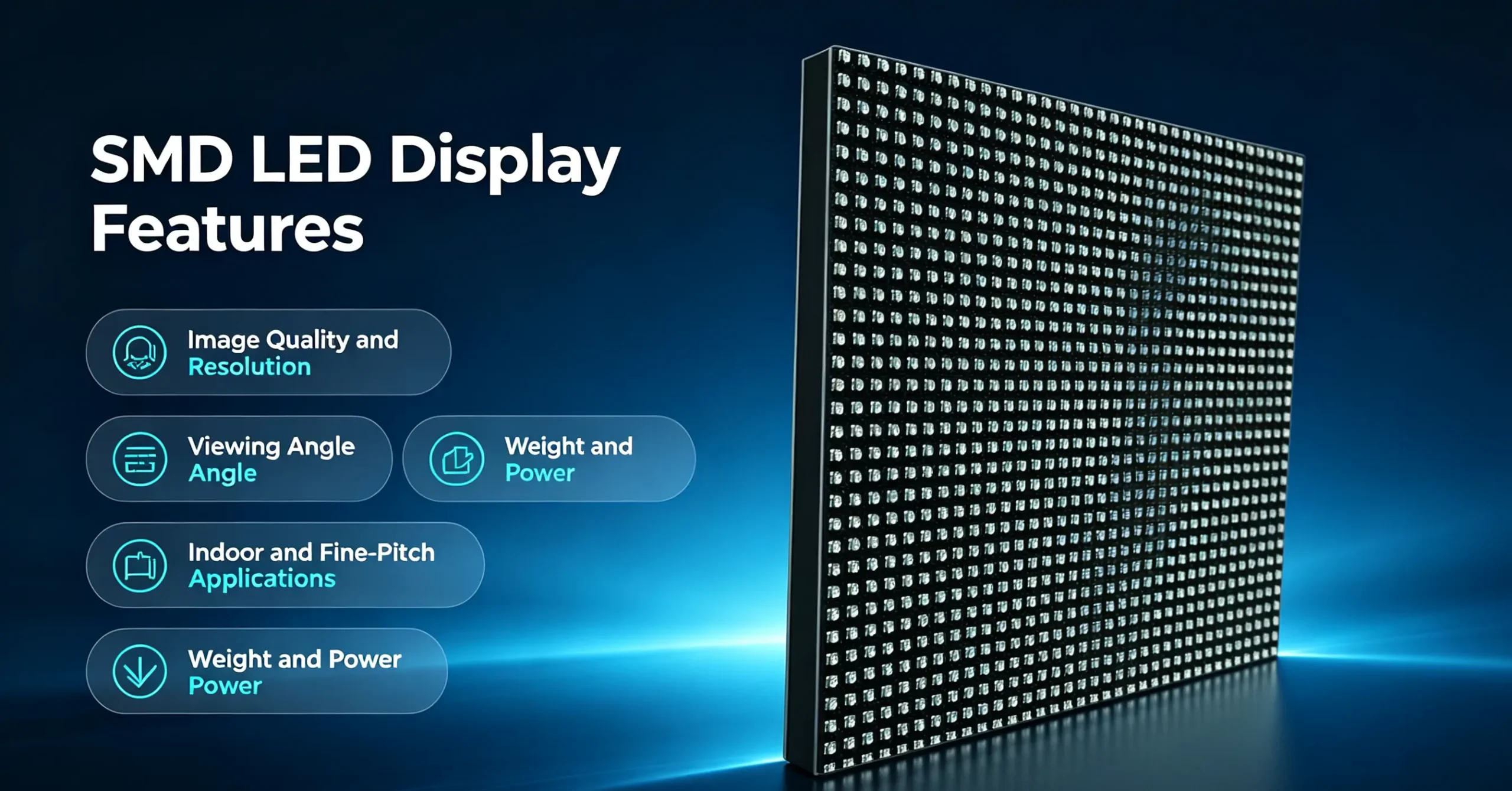
4.1 Image quality and resolution
Combining RGB emitters in a compact SMD package can help color blending at short distances and enables finer pixel spacing. It does not eliminate visible pixels, color variation or gaps at every distance. Pitch, package layout, calibration and cabinet alignment all affect the result.
At the same physical dimensions and pitch, DIP and SMD screens have the same nominal pixel count. Compare a sample showing fine text, gradients and low-brightness video, rather than assuming that packaging alone changes resolution.
4.2 Viewing angle
Many SMD video-display packages provide a broad viewing distribution, useful for an indoor LED wall seen from multiple seats. However, beam angle is an optical-design choice, not a fixed DIP/SMD rule. Cree LED’s TripleBeam SMD technology is an example with directional optics.
Compare horizontal and vertical brightness and color behavior at your most oblique viewing positions. Ask how the quoted viewing angle is defined; it does not mean identical image quality everywhere inside that angle.
4.3 Indoor and fine-pitch applications
SMD is a practical option for many fine-pitch indoor projects, but it is not the only one: COB and other packaging approaches also serve this market. Choose by the smallest content, screen dimensions and nearest viewer rather than a blanket “under five meters” rule.
A P2.5 display is not automatically 1080p. Native 1920 × 1080 at 2.5 mm pitch requires an active area of 4.8 × 2.7 m before cabinet constraints. Our LED display size calculation guide explains the relationship. Whether its pixels look smooth at two meters requires a viewing test.
4.4 Weight and power
Smaller emitters can support compact modules, but cabinet material, cooling, protective layers and mounting hardware determine installed weight. Compare kilograms per square meter for complete systems, including the support structure.
There is no general 30–40% energy saving attributable to SMD alone. Compare average power at matched brightness, area and content, and use maximum power for electrical planning. For an estimate, energy in kWh equals average kW × operating hours. State the assumed brightness and schedule alongside any cost calculation.
5. DIP vs SMD: Viewing Distance Factor
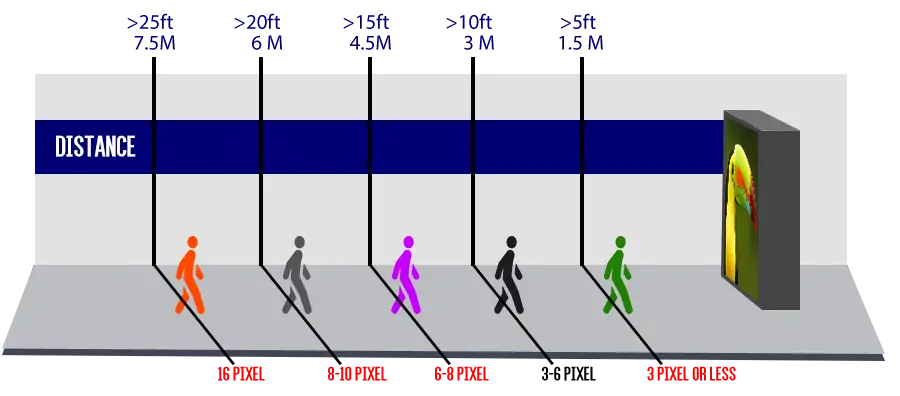
Viewing distance helps set the largest acceptable pixel pitch, alongside text size and content detail. A smaller pitch gives more pixels within the same area. The distance bands below are planning categories, not engineering thresholds or guarantees that pixels become invisible.
5.1 Close range: under 5 meters
At close range, shortlist fine-pitch products and test the smallest text and graphics from the nearest and farthest seats. SMD is one option; compare other fine-pitch designs where handling protection or service requirements matter. Avoid choosing solely from a pitch-to-distance shortcut.
Bring actual presentation slides or signage artwork to the demonstration. Check low-brightness uniformity and whether individual pixels distract viewers at their normal positions.
5.2 Medium range: 5 to 20 meters
At 5–20 meters, both package types may be candidates if suitable products are available. Equal pitch gives equal pixel density, but color blending, optical distribution and contrast can still differ. DIP is not automatically brighter or cheaper at every pitch.
For text-only signage, assess the smallest characters and reading time. For video or detailed branding, compare motion, gradients and off-axis color. A demonstration at the intended distance is more useful than declaring P10 or P16 adequate without knowing the screen size.
5.3 Long range: beyond 20 meters
Longer viewing distances may permit coarser pitches, but they do not remove the need for enough pixels to render the content. Check the whole audience area: a stadium or public square can still require wide horizontal coverage. Both DIP and outdoor SMD can be considered.
The existing graphic below pairs “16 PIXEL” with >25 ft (7.5 m), “8–10 PIXEL” with >20 ft (6 m), “6–8 PIXEL” with >15 ft (4.5 m), “3–6 PIXEL” with >10 ft (3 m), and “3 PIXEL OR LESS” with >5 ft (1.5 m). These are the image’s labels, with rounded metric conversions. It does not define pitch units or an acuity criterion, so do not use it as a sizing specification or a promise of seamless viewing.
6. DIP vs SMD: Environment Factor
6.1 Full outdoor exposure
Specify the complete system for its real exposure: rain, dust, humidity, condensation, temperature and sunlight. Confirm front and rear ingress ratings and the conditions under which they apply. An IP rating does not by itself establish resistance to every outdoor stress.
Some SMD components are water-resistant. Cree LED’s CLY6D-FKC datasheet specifies IPx8 protection but explicitly excludes the leads area and requires moisture insulation for outdoor use. This illustrates why component protection cannot substitute for a properly designed module and cabinet.
For either package type, inspect drainage, seals, cable entries, cooling and service procedures. Obtain a written warranty for the intended installation; neither packaging label promises a decade of service.
6.2 Indoor and semi-protected
Indoor fine-pitch SMD is often suitable for offices, retail and events, but indoor installations still have requirements for impact protection, dust, humidity, heat and glare. A bright shop window differs from a controlled-light meeting room.
An awning or roof does not turn an outdoor space into an indoor environment. Wind-driven rain and condensation may still occur. Use equipment rated for the actual conditions, and have any protective enclosure assessed for ventilation and moisture management. Do not put an ordinary indoor screen outdoors based only on shade.
7. DIP vs SMD by Application
| Application | Recommended | Why |
|---|---|---|
| Highway billboard (30 m+ viewing) | DIP or outdoor SMD; pitch from content | Directional brightness, text size and service access |
| Stadium perimeter display | Purpose-built outdoor display; compare both | Impact protection, camera performance and sightlines |
| Building facade (outdoor) | DIP or outdoor SMD | Pitch, viewing angles, weather and structure |
| Outdoor digital signage (close) | Fine-pitch outdoor SMD or another rated design | Check nearest viewers and daytime contrast |
| Conference room | Fine-pitch SMD or another indoor fine-pitch design | Test small text, resolution and seating angles |
| Retail window display | Product matched to glare and viewing distance | Brightness, thermal conditions and close viewing |
| Trade show booth | Serviceable rental SMD or suitable alternative | Handling protection, weight and fast setup |
| Broadcast studio | Camera-tested fine-pitch system | Check moiré, scan behavior and color on camera |
| Control room / NOC | Fine-pitch product rated for intended runtime | Readability, redundancy and service support |
| Rental stage (indoor) | Rental product matched to audience distance | Weight, alignment and repeat assembly |
| Outdoor concert/event | Outdoor-rated rental display | Weather protection, video and audience coverage |
Use this as a shortlist guide, not a fixed pitch schedule. Validate each option with the actual content, viewing positions and installation conditions.
8. DIP vs SMD: Cost Breakdown
Compare DIP vs SMD using matched quotations rather than fixed percentage discounts. Packaging alone cannot establish a 30–50% saving, a six-figure difference, or half the installed cost.
Initial cost: compare the same active area, pixel count, calibrated brightness, protection and control system. Itemize modules, cabinets, structure, power distribution, installation and commissioning. A cheaper coarse-pitch screen may simply contain fewer pixels than the alternative.
Operating cost: use measured or stated average power under comparable conditions, daily operating hours and your electricity rate. Include cooling and planned cleaning. At fine pitches, compare suitable SMD and other package designs on the same requirements.
Maintenance: confirm spare-module availability, repair turnaround, access equipment and recalibration after replacement. Individual lamp or SMD replacement needs suitable tools and trained technicians; it is not always a quick on-site task. For an outdoor advertising cabinet, check protection and access as part of the service plan. Water ingress can damage either type of system.
9. DIP vs SMD FAQs
10. Conclusion
DIP vs SMD is a comparison of packaging approaches, not a universal ranking of brightness, price or lifetime. Traditional DIP can be useful for directional signage at suitable pitches. SMD supports many indoor fine-pitch displays and demanding outdoor applications, with product-specific optical and protection options.
Choose the required pitch and resolution first, then verify brightness, viewing angles, environmental ratings, serviceability and matched costs. Use samples and written specifications to resolve the tradeoffs. This gives you a practical decision based on the installation rather than unsupported rules about which technology owns a market.
 Direct LED vs Edge LED: Which Backlight Technology Should You Choose?
 MIP vs SMD vs COB: LED Packaging Technology Guide
Related Posts
Fill In Your Needs In Detail
Fill in the screen usage scene and size you need in “Content”.You will get a quote.