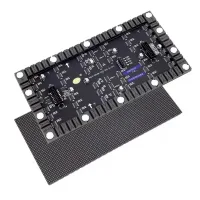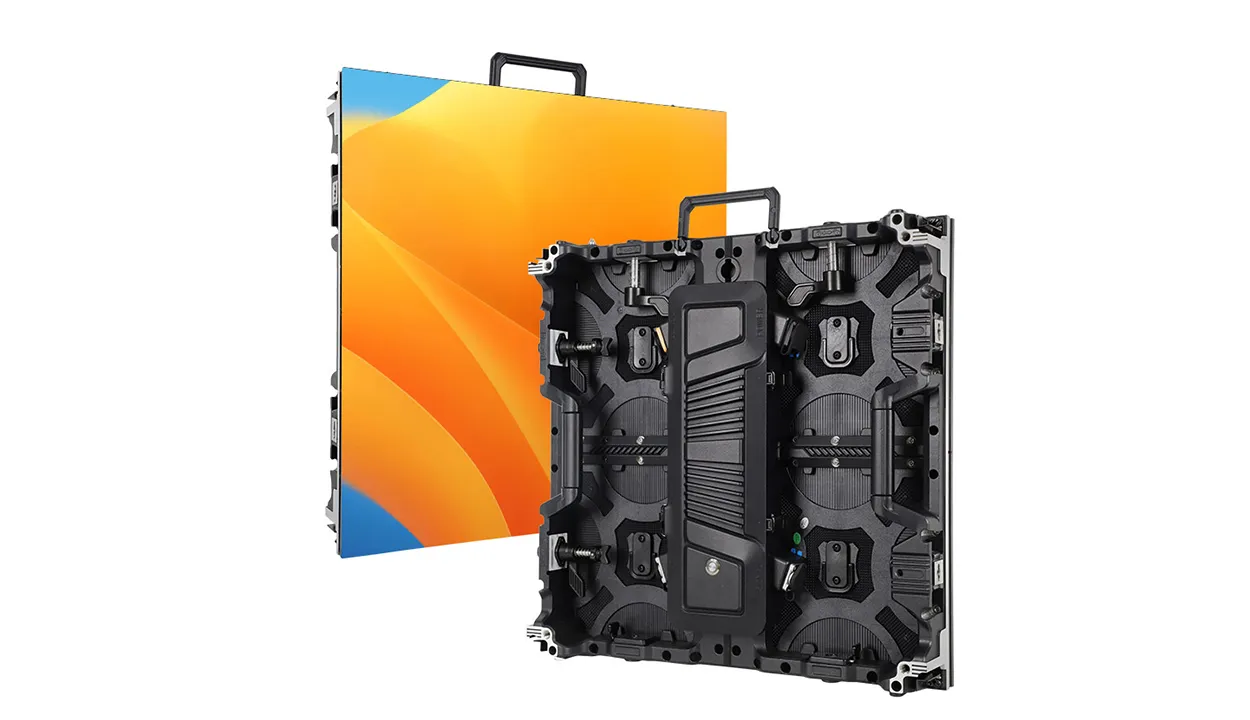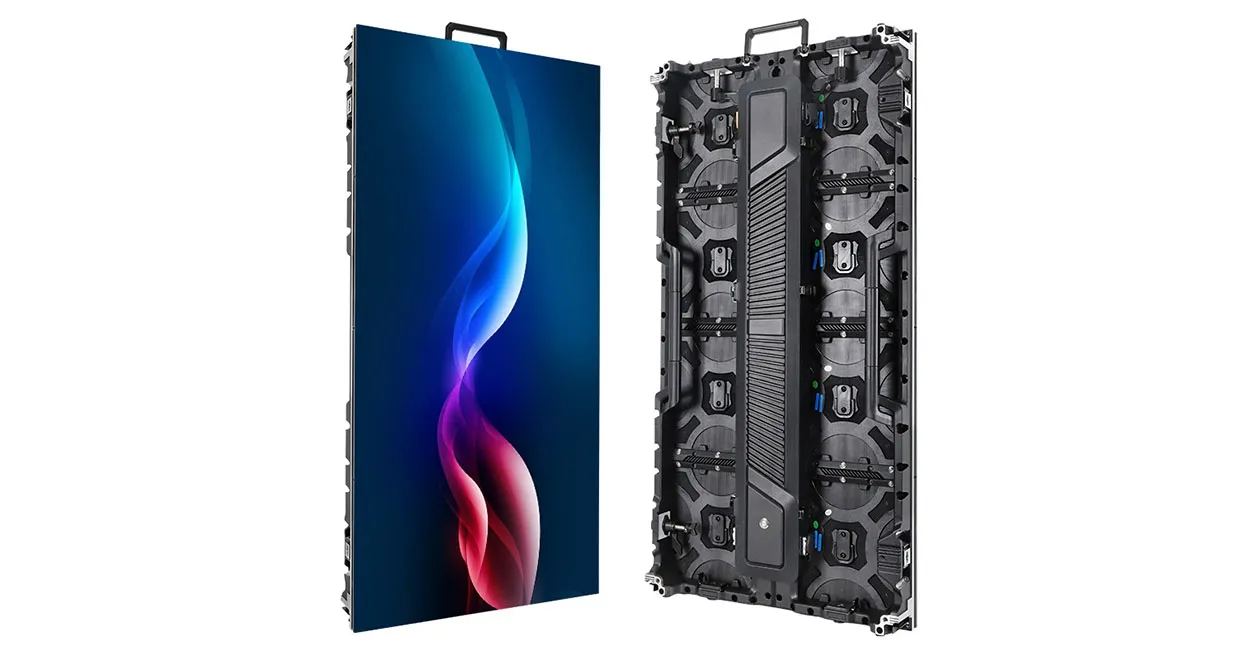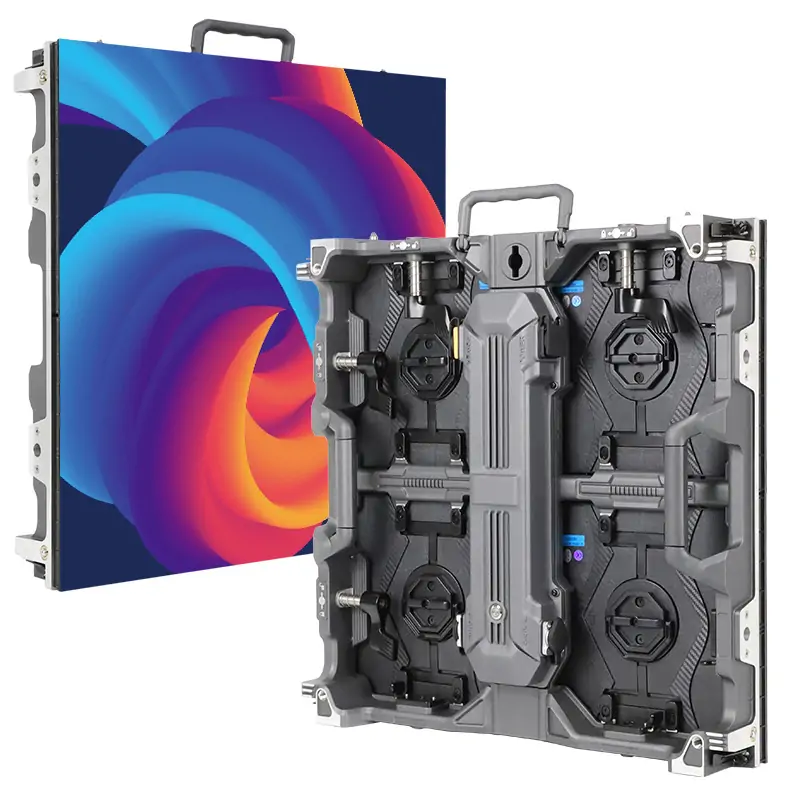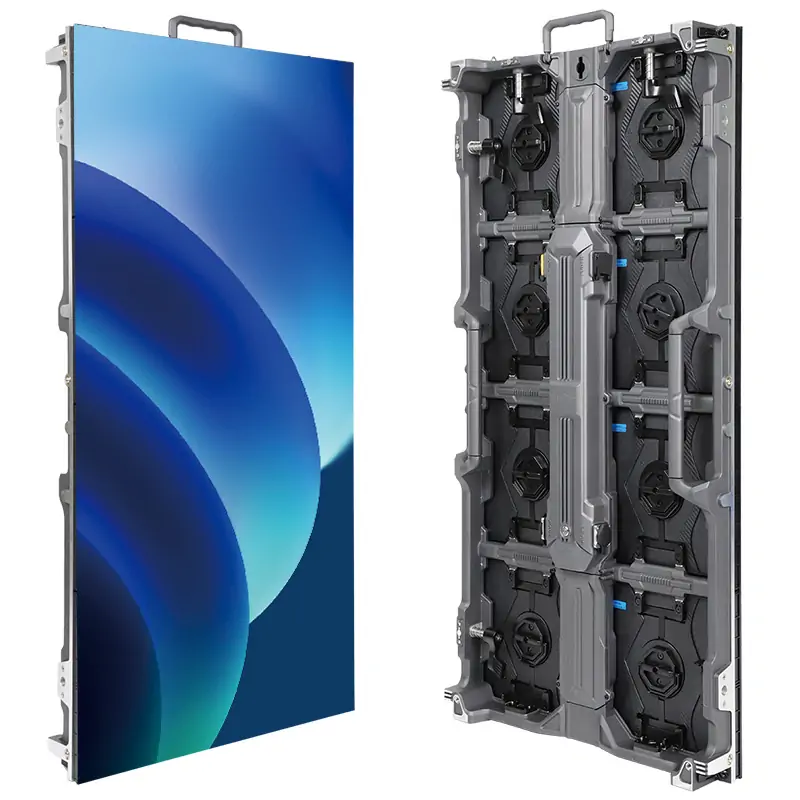
A MiP LED screen is a direct-view display made with tiny LED chips assembled into packages before they are mounted onto a display circuit board. MiP means Micro LED in Package; some manufacturers use Mini/Micro LED in Package. It offers a route to fine-pitch video walls, but brightness, protection, repairability and price depend on the finished product.
MiP, COB and conventional SMD describe different approaches to building LED displays. GOB adds a protective coating and is not a separate light-emitting technology. For a permanent wall or rental LED display, compare the actual cabinet specification, viewing distance and service plan before choosing a package type.
This guide explains MiP packaging, compares its tradeoffs with COB and SMD, and covers applications, cost planning, maintenance and emerging developments. Product examples are attributed to their manufacturers; estimates and purchasing checks are identified separately.
1. What is MIP LED Screen?
MiP describes how LED chips are packaged for assembly. A finished MiP LED screen combines many packages on modules, with cabinets, power supplies and a control system. A package, a module and a complete video wall are different levels of the product.
In a typical MiP process, chips are bonded to a carrier, encapsulated, separated into packages and tested before surface mounting. Nationstar’s manufacturing explanation describes single-pixel and multi-pixel devices, followed by binning, color mixing and SMT assembly. Designs vary by supplier.
MiP and Micro LED are related terms, not mutually exclusive display categories. Micro LED describes the emitters; MiP describes a packaging route. A product can use both. Also check the context of “MIP monitor”: this article concerns direct-view LED video walls, rather than other display technologies using similar abbreviations.
Micro LED display: Uses very small, self-emissive LED chips. Chip size alone does not specify the screen’s resolution, brightness or mounting method. The illustration below shows miniaturization and chip transfer; its size comparison is schematic, not a universal dimensional rule.
MiP LED display: Uses packaged emitters mounted onto a display board. Pixel pitch is the distance between neighboring pixel centers, usually stated in millimeters. It is different from chip size and package dimensions.
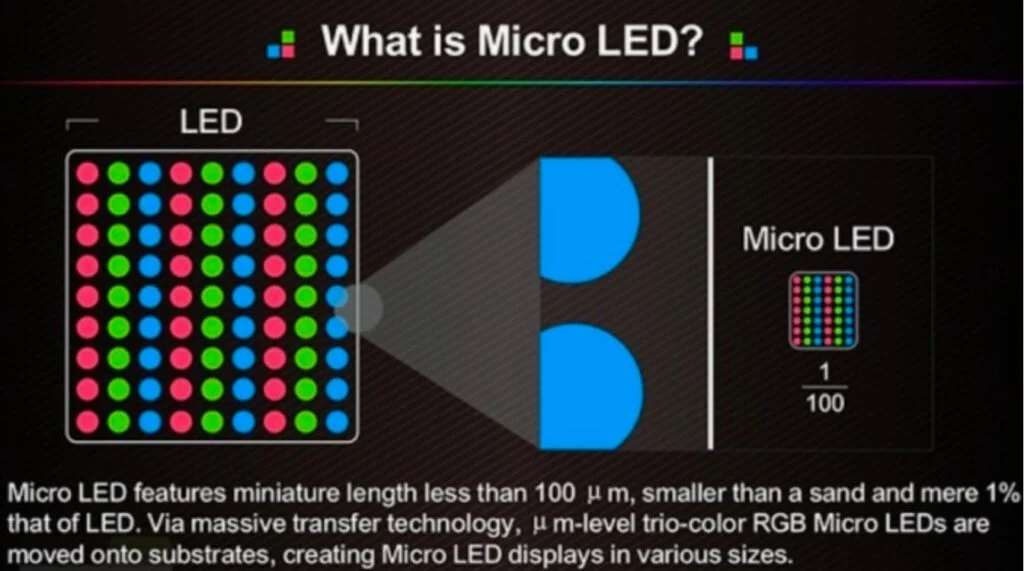
Key takeaways:
- MiP is a packaging approach used in Mini/Micro LED displays.
- Smaller physical pixel pitch puts more pixels into a given screen area; it does not remove the spacing between pixels.
- Check native resolution, package type and service requirements rather than assuming every MiP product has the same performance.
2. How Does MIP LED Technology Work?
A MiP LED screen has two connected processes: manufacturing the display modules and driving their pixels during use. Understanding the difference helps you read a supplier’s specification and identify which components affect image quality or maintenance.
2.1 The Basic Structure of a MIP LED Module
- LED chips: Red, green and blue emitters produce the image in a typical RGB package.
- Substrate: The package carrier supports the chips; the module PCB connects packages and other components.
- Protective layer: Encapsulation protects components. Additional surface treatment may be offered, but does not automatically make a cabinet waterproof.
- Driver ICs: Control LED current and timing. Conventional designs use separate drivers; some active-matrix MiP designs integrate a driver within the package.
- Power and signal connections: Supply electricity and image data through the module and cabinet.
- Solder pads: Connect the package electrically and mechanically to the PCB. Their layout determines assembly and repair requirements.
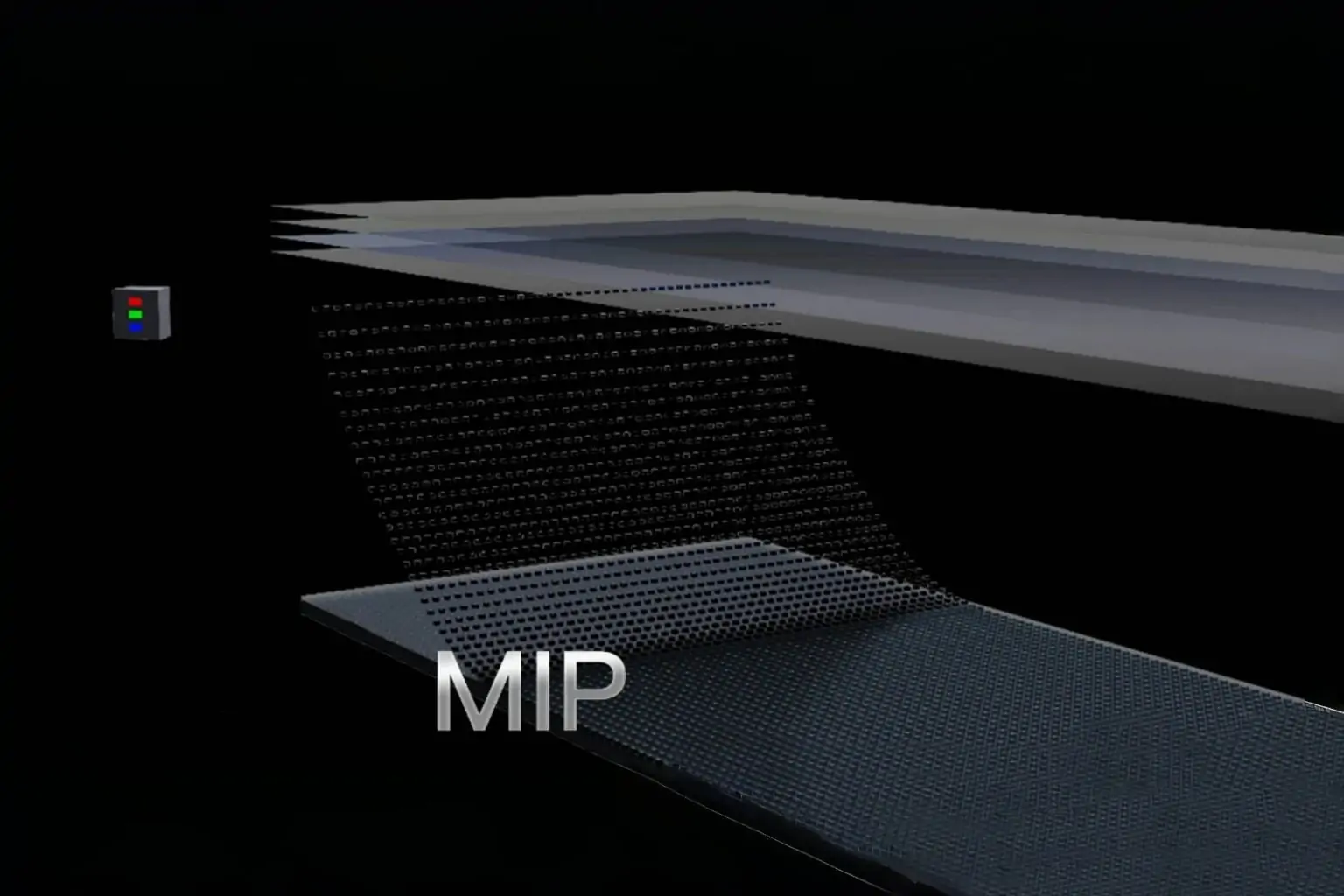
2.2 Step-by-Step MIP LED Technology Process
The manufacturing sequence below is a simplified guide. Exact materials, transfer methods and test procedures depend on the package manufacturer.
- Chip preparation: Produce and select suitable LED emitters.
- Chip transfer and bonding: Place chips on a package carrier and make electrical connections. Nationstar’s cited process uses flip-chip bonding without bond wires.
- Encapsulation and separation: Protect the chips and divide the processed carrier into individual devices.
- Inspection and binning: Test packages and sort them by optical and electrical characteristics.
- SMT assembly: Mount the selected packages onto the module PCB; add surface treatment if specified.
- Driving and calibration: Configure drivers and receiving cards, then calibrate brightness and color.
- Cabinet integration: Assemble modules, power and control hardware; test the complete wall.
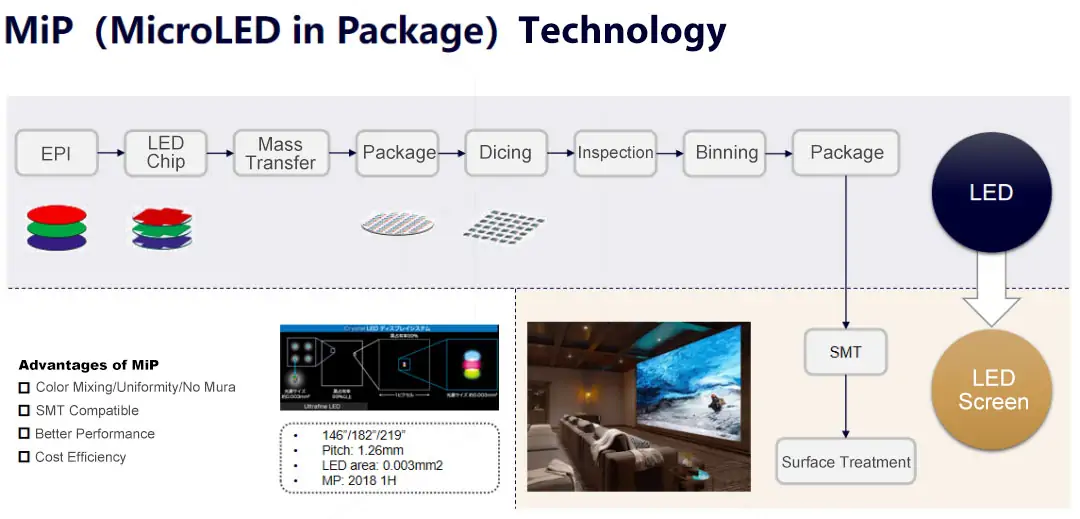
The process graphic summarizes chip production, mass transfer, packaging, dicing, inspection, binning and SMT. Its older example dimensions are not a current product specification. During operation, the controller sends image data to the receiving cards and drivers; calibration helps neighboring modules display consistent color and brightness.
3. MIP LED vs COB LED vs SMD LED: Which is Better?
No packaging method is best for every project. Compare MiP with COB LED displays and conventional SMD at the same physical pitch, brightness and installation conditions. Surface coating, driver design and calibration can matter as much as the package label.
3.1 Definition & Technological Differences
1. MiP LED (Micro LED in Package)
Small LED chips are packaged before board assembly. Testing and sorting at package level can help control consistency. MiP packages are surface mounted, so “MiP versus SMD” usually compares MiP with conventional SMD LED packages rather than two entirely separate assembly methods.
2. COB LED (Chip on Board)
Bare chips are bonded directly to the display substrate and protected by an encapsulating layer. A continuous surface can provide useful protection for close-view installations. Impact resistance, reflectivity and repair procedures vary with the coating and module design.
3. SMD LED (Surface-Mounted Device)
Conventional SMD displays use pre-packaged LEDs soldered to a PCB. They are widely available in indoor and outdoor configurations. Package size affects achievable pitch, but a particular minimum pitch, brightness or lifespan cannot be assigned to all SMD products.
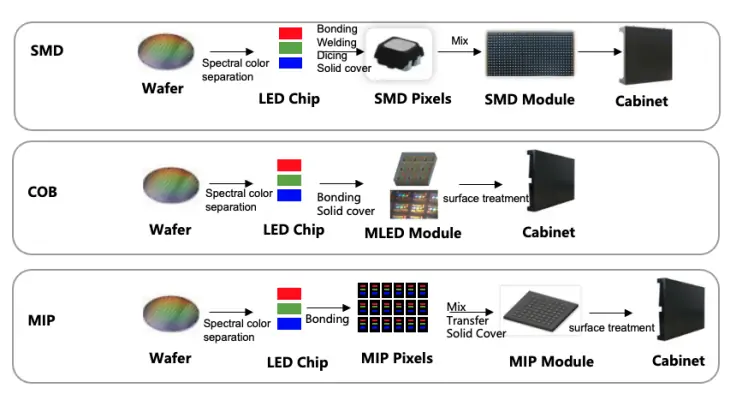
3.2 Pros and Cons Comparison Between MIP LED, COB LED and SMD LED
The diagram above contrasts package-first assembly for SMD and MiP with direct chip assembly for COB. Use the following advantages and limitations as purchasing questions, not guaranteed rankings.
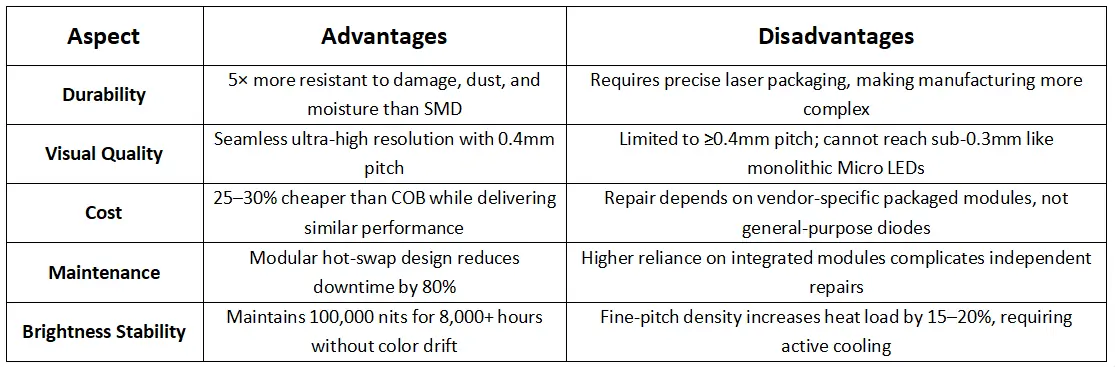
3.2.1 MIP LED
Advantages of MiP LED technology:
- Package-level inspection: Devices can be screened before module assembly, helping manufacturers manage defective components.
- Fine-pitch options: Small packages support dense pixel layouts. Confirm the quoted native pitch and resolution.
- Assembly compatibility: Using SMT equipment can simplify adoption, although it does not establish a fixed price advantage.
- Service options: Depending on the design, trained technicians can replace a package or exchange a module.
- Color consistency: Sorting and mixing packages, followed by screen calibration, can improve uniformity.
Limitations of MiP LED technology:
- Manufacturing precision: Small devices demand accurate placement, bonding and inspection.
- Spare-part compatibility: Package dimensions, driver settings and calibration must match the installed system.
- Thermal design: Cooling depends on cabinet power and ventilation; fine pitch alone does not require fans.
- Product-specific limits: Compare demonstrated physical pitch, operating conditions and repair support.
Correction to the retained graphic below: Its 5× durability, 25–30% savings, 80% downtime reduction, 100,000-nit brightness and 15–20% heat claims lack supporting test evidence. They should not be used as specifications; the text above replaces those generalizations.
3.2.2 COB LED
Pros of COB LED:
- Fine-pitch construction: Direct chip mounting can support closely spaced pixels.
- Surface protection: Encapsulation can protect the emitting surface from handling and contamination.
- Visual uniformity: Suitable surface treatments and calibration help control reflections and color differences.
- Integrated design: The board, chips and coating can be engineered together for the intended thermal load.
Cons of COB LED:
- Repair process: Chip-level rework may require specialist equipment; field service may use module exchange.
- Surface matching: Replacement modules should match the original coating and calibration.
- Quote variability: Price depends on pitch, yield, volume and specification. COB is not invariably more expensive than MiP.
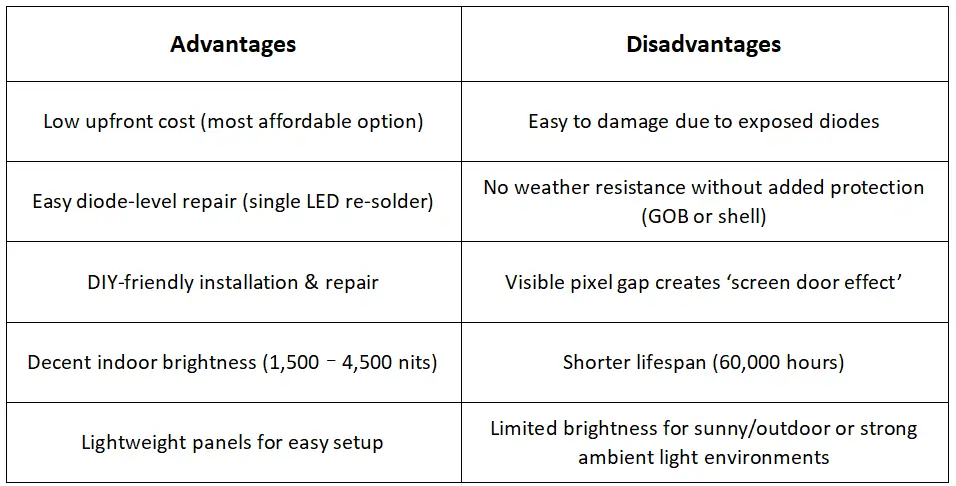
3.2.3 SMD LED
Pros of SMD LED:
- Broad availability: Many suppliers offer established indoor, outdoor and rental products.
- Service ecosystem: Trained technicians may replace individual LED packages using appropriate rework equipment.
- Budget flexibility: Larger-pitch products can suit projects that do not need close viewing.
- Application choice: Cabinet options include high-brightness outdoor models and indoor displays designed for comfortable viewing.
Cons of SMD LED:
- Handling exposure: Protruding packages need suitable protection during installation and transport.
- Close-view appearance: Visible pixel spacing depends on pitch and viewing distance.
- Environmental suitability: Verify the complete cabinet’s ingress rating and operating limits.
- Repair quality: Poor soldering or mismatched replacement LEDs can cause failures or color differences.
- Product variation: Lifespan and brightness depend on components and operating conditions.
Correction to the retained graphic: SMD is not inherently unsuitable outdoors, DIY-safe or limited to 60,000 hours. Its brightness range and panel weight are not universal.
3.3 When to Pick MIP LED, COB LED or SMD LED
- Consider MiP when a fine-pitch product meets your uniformity, service and budget requirements.
- Consider COB when a protected emitting surface and close viewing are priorities, with an acceptable repair plan.
- Consider SMD when product availability, rental handling, outdoor options or purchase cost dominate.
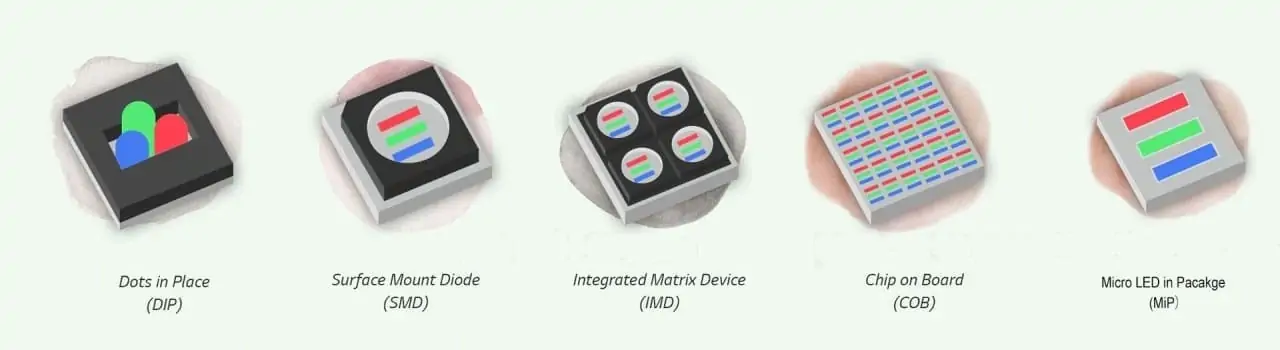
Request side-by-side demonstrations at the intended brightness, including small text, low-gray gradients and solid colors. The illustration below compares DIP, SMD, IMD, COB and MiP package arrangements; it does not establish which finished screen is best. For an indoor project, review the available indoor LED screen options alongside the technical requirements.
4. 9 Key Features of MIP LED Screens You Must Know
These nine features are useful evaluation criteria for a MiP LED screen. Treat each as something to verify in the datasheet and demonstration, rather than a benefit guaranteed by the MiP name.
4.1 High Brightness
Select brightness for the room and content. Excessive brightness can be uncomfortable at close range. Ask for calibrated full-screen luminance in nits, dimming behavior and performance at the intended setting. Outdoor use additionally requires an outdoor-rated product and suitable environmental protection.
4.2 Compatible with Multiple Substrates
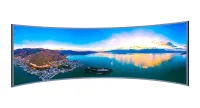
Package and substrate choices give manufacturers design flexibility. They do not mean that a finished cabinet can bend or fit any structure. Confirm cabinet dimensions, mounting tolerances and permitted curvature before planning a curved installation.
4.3 Energy Efficiency
Compare average and maximum input power at the same brightness and test content. Energy use equals average kilowatts multiplied by operating hours. Include processors and cooling in the operating budget; the package type alone cannot predict your electricity bill.
4.4 Excellent Heat Dissipation
Check operating temperature, ventilation clearance and the supplier’s thermal test conditions. A wall recess or enclosed structure can restrict heat removal. Ask whether the cabinet uses passive cooling or fans and whether its noise level is acceptable for meeting rooms or studios.
4.5 High Contrast Ratio
Black package materials and surface treatments influence perceived contrast. Compare screens under your room lighting because reflections can reduce dark-scene detail. Ask whether a quoted contrast ratio was measured in darkness or ambient light, and inspect low-gray content rather than relying on the largest number.
4.6 Durability and Longevity
Distinguish an LED lifetime estimate from a complete-system warranty. Request the brightness-retention criterion, operating temperature and duty cycle behind any lifetime claim. Power supplies, connectors and control components also affect service life; MiP does not guarantee ten years of unchanged brightness.
4.7 Easier Maintenance
Confirm front or rear service access, required tools and spare-module availability. Keep compatible spares and calibration files. Follow the manufacturer’s isolation procedure before maintenance; do not assume a removable module is safe to hot-swap. Ask for a demonstrated replacement workflow and realistic repair turnaround.
4.8 Cost-Effectiveness
Compare total installed and operating cost over the intended ownership period. Include processors, structure, electrical work, spares, energy, labor and warranty coverage. A cheaper panel can cost more to operate or service, while a premium package does not by itself guarantee a better return.
4.9 Better Color Consistency
Evaluate white balance, low-gray uniformity and color shifts at side angles. Unilumin’s Upanel II MiP specification describes pixel-level bin mixing and lists P0.9, P1.2 and P1.5 models. These are examples from one range, not a universal MiP specification or evidence that every screen covers the same color gamut.
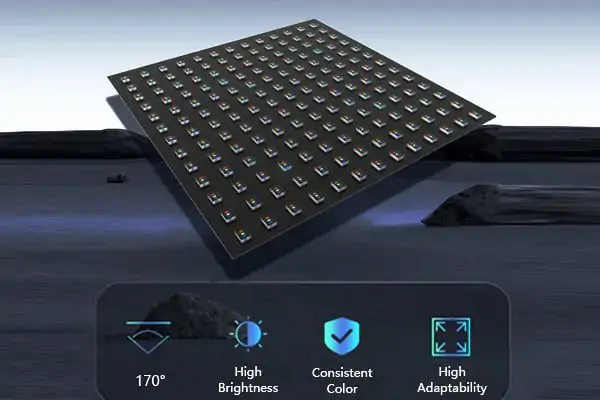
The feature graphic highlights viewing angle, brightness, color consistency and adaptability. Its 170° label is illustrative unless confirmed for the selected model. Record acceptance criteria in the order: native resolution, calibrated brightness, uniformity, power, service access and the conditions used for testing.
5. Where Are Fine-Pitch MIP LED Screens Used?
Fine pitch is most useful when people view detailed content from nearby. It increases pixel density at a fixed screen size, but source quality and processing still matter. Typical opportunities include meeting rooms, retail spaces and control rooms; suitability depends on the individual product.
1. Virtual film studios: Test the wall with the intended cameras, lenses, shutter settings and lighting. Synchronization, scan behavior, moiré and color calibration matter more than a generic brightness claim. See our LED wall for virtual production guidance.
2. Boardrooms: Size the wall and native resolution for the smallest text viewers need to read. Test spreadsheets from the nearest and farthest seats, including video-conference layouts.
3. Retail and showrooms: Balance viewing distance, ambient light and cleaning needs. Interactive functions require additional software and sensors; they are not built into MiP packaging.
4. Control rooms: Prioritize readable dashboards, continuous-operation specifications, redundancy and service access. Confirm the signal processor can handle all required sources.
5. Healthcare environments: A general MiP wall may suit training or information display. Surgical or diagnostic use requires a product specifically validated for that purpose; neither clinical accuracy nor disinfectant compatibility follows from MiP packaging.
6. Exhibition and event spaces: Check transport protection, rigging, setup tolerances and spare-module support. Compare rental cabinets with fixed-installation designs before specifying an event wall.
As a planning calculation, horizontal pixels equal screen width in millimeters divided by physical pitch. A 3,840 mm-wide wall at 1.0 mm pitch has 3,840 horizontal pixels. Cabinet dimensions constrain the final size, so confirm the actual pixel matrix before ordering a “4K” wall.
6. How Much Does MIP LED Display Cost?
MiP LED screen cost requires a project-specific quote. There is no single reliable price per square meter for every pitch and cabinet. Compare quotations with the same screen dimensions, native resolution, brightness, warranty and included equipment.
6.1 Key Factors That Affect the Price
1. LED chip and package: Ask for the package manufacturer, model and quality specification. Similar marketing labels can describe different component choices.
2. Driving technology: Driver ICs, scanning architecture and active-matrix options affect the design. Request a priced option comparison instead of assuming a standard AMiP premium.
3. Pixel pitch: Smaller pitch means more pixels per square meter and can raise cost. Verify physical pitch separately from any virtual-pixel claim.
4. Brightness: Specify the calibrated brightness actually needed. Do not pay for an outdoor brightness target when the application is a controlled indoor room.
5. Screen size: Area drives hardware quantity. An advertising LED screen quote also needs its location, duty cycle and environmental requirements.
6. Installation: Include structure, access, power distribution, processing, commissioning, shipping and local charges. Clarify what each quotation excludes.
6.2 MIP LED Screen Cost Overview
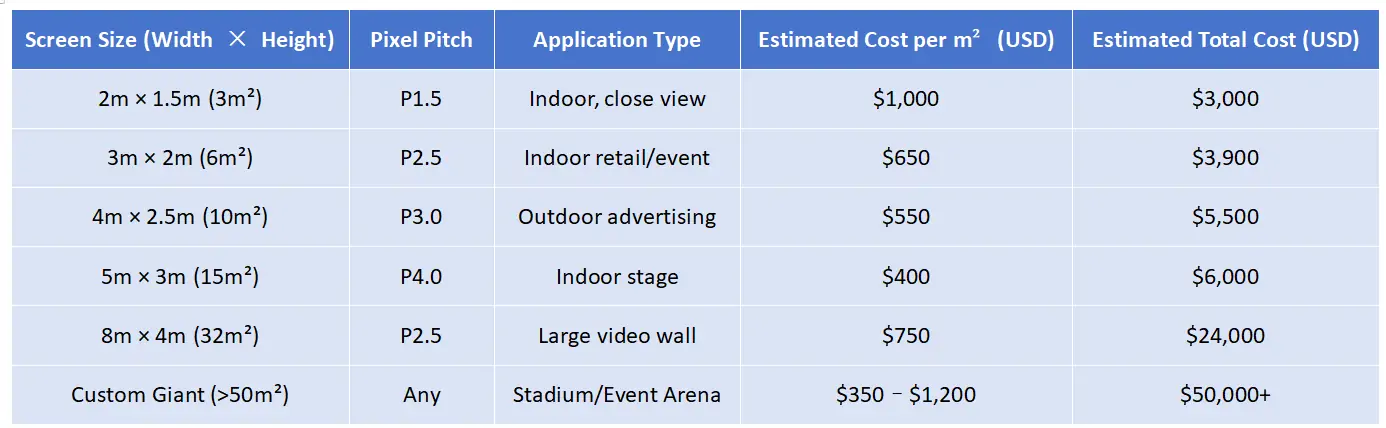
About the original cost graphic: The figures below are an accessible transcription of the retained illustration, not verified current MiP prices or an EagerLED quotation. Its date, supplier basis and inclusions are unspecified; pitch and application labels do not confirm product suitability.
| Size and area | Pitch | Illustrated application | USD/m² | Illustrated total |
|---|---|---|---|---|
| 2 × 1.5 m; 3 m² | P1.5 | Indoor, close view | $1,000 | $3,000 |
| 3 × 2 m; 6 m² | P2.5 | Indoor retail/event | $650 | $3,900 |
| 4 × 2.5 m; 10 m² | P3.0 | Outdoor advertising | $550 | $5,500 |
| 5 × 3 m; 15 m² | P4.0 | Indoor stage | $400 | $6,000 |
| 8 × 4 m; 32 m² | P2.5 | Large video wall | $750 | $24,000 |
| Custom; over 50 m² | Any | Stadium/event arena | $350–$1,200 | $50,000+ |
For a usable budget, calculate panel area × the supplier’s quoted unit price, then add itemized system and installation costs. The graphic’s totals should not be read as complete installed costs. Request a dated bill of materials, spare quantities, delivery terms and warranty exclusions before comparing offers.
7. Future Trends in MIP LED Display Technology
MiP development is moving toward smaller packages, improved manufacturing yield and more integrated driving. Announced demonstrations and commercial products should be distinguished from forecasts. The following trends are directions to watch, not promises about availability or future prices.
7.1 Two Main Trends in MIP LED Display
1. Wider adoption of fine pixel pitch
Smaller packages can support closer viewing and higher pixel density. However, the best pitch still depends on room geometry and content. Ask suppliers to distinguish physical pixels from virtual-pixel processing and to demonstrate native-resolution test patterns.
2. Broader application choices
MiP is not confined to a single ultra-fine pitch range. For example, Unilumin lists MiP options from P1.2 to P2.5 for Uslim III. This illustrates product variety, not a market-wide standard. New applications need their own optical, mechanical and environmental validation.
7.2 Core Advancement in MIP LED Technology
AMiP integrates active driving with Micro LED packaging. The ISLE 2025 exhibitor description for Hubei AMiP explains “AM IC & Micro LED in Package”: an active driver IC and Micro LEDs share one package. Its intended benefits include simpler board routing and controlled pixel driving. Verify power and image-quality claims on the finished screen.
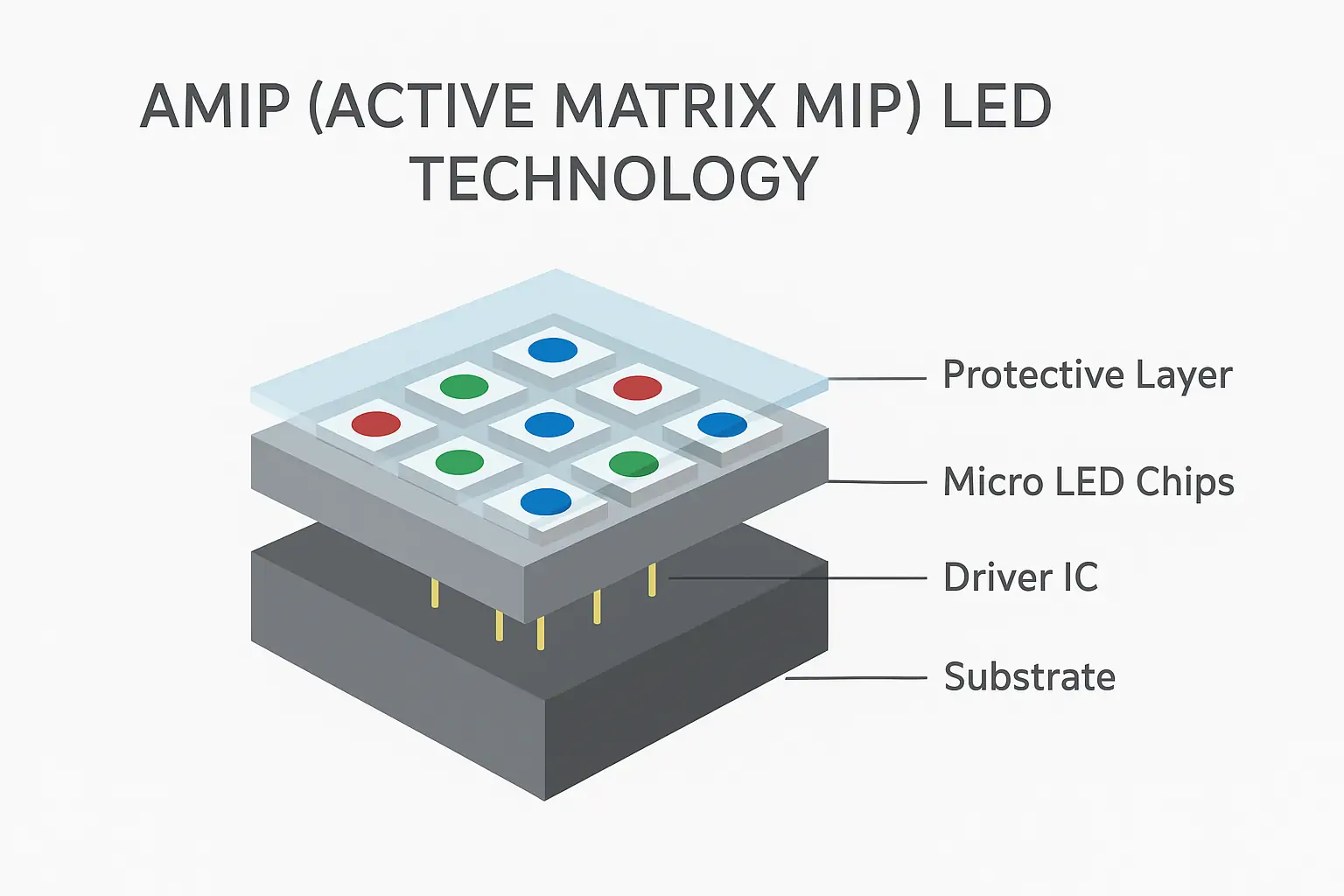
Flexible or glass-based substrates: These are design choices, not standard MiP capabilities. The AMiP illustration identifies a protective layer, LED chips, driver IC and substrate; it is schematic. Confirm bending limits, mounting requirements and repair methods for any proposed flexible or glass-based product.
Advanced LED chips: Smaller emitters and improved transfer processes may improve density and manufacturing yield. Efficiency must still be measured at the required brightness; all operating LED screens consume electricity.
Transparent MiP technology: Unilumin reported a transparent MiP display at ISLE 2026. This is a specific manufacturer development, not a feature of ordinary MiP cabinets. Compare transparency, pixel density, installation and visibility against the project’s needs.
AI-powered content: Content generation and scheduling belong to software connected to the display. MiP packaging does not recognize an audience or choose media by itself. Evaluate content workflows, input compatibility and any sensor requirements separately from the LED hardware.
For procurement, favor demonstrated performance, documented support and compatible spares over a roadmap. A newer packaging term is useful only when the resulting product solves the project’s viewing, installation or operating requirements.
8. FAQs
9. Conclusion
A MiP LED screen uses packaged LED emitters as building blocks for a direct-view display. Its main appeal is a practical assembly route for small emitters, with opportunities for package-level testing and color sorting. It does not automatically outperform COB or SMD on cost, durability or brightness.
Choose the finished system by viewing distance, native resolution, calibrated image quality, environment and service support. To request a MiP LED screen quote, provide the screen dimensions, installation location, closest viewing distance, content type and operating hours. Ask for a model-specific datasheet and an itemized quotation.
 Biggest LED Screens in the World: Sizes and Locations
 HD Screen Resolution for LED: Types, Applications & Comparison
Related Posts
Fill In Your Needs In Detail
Fill in the screen usage scene and size you need in “Content”.You will get a quote.