The biggest LED screen depends on what is being measured. Sphere in Las Vegas has a 580,000-square-foot exterior LED surface, approximately 53,884 m². Its indoor display is a separate 160,000-square-foot installation. These are Sphere’s published specifications, not the size of a flat cinema screen.
This guide compares the biggest LED screens in the world by location, display type and documented dimensions. LED façades, suspended stadium video boards and projected IMAX screens serve different purposes, so their sizes should not be combined into a single ranking.
The original ten examples and category lists below are retained for comparison. Figures were checked on 23 September 2026; source dates and unresolved measurements are identified where relevant. Approximate metric conversions use 1 ft² = 0.09290304 m². Screen area is different from building floor area, resolution or audience capacity.
1. Ten of the Biggest LED Screen Installations
These ten installations illustrate different large-screen designs. Their numbering follows the existing guide and does not represent a verified global ranking. Compare like-for-like surfaces: one display face, both faces of a video board, a curved canopy or a media façade.
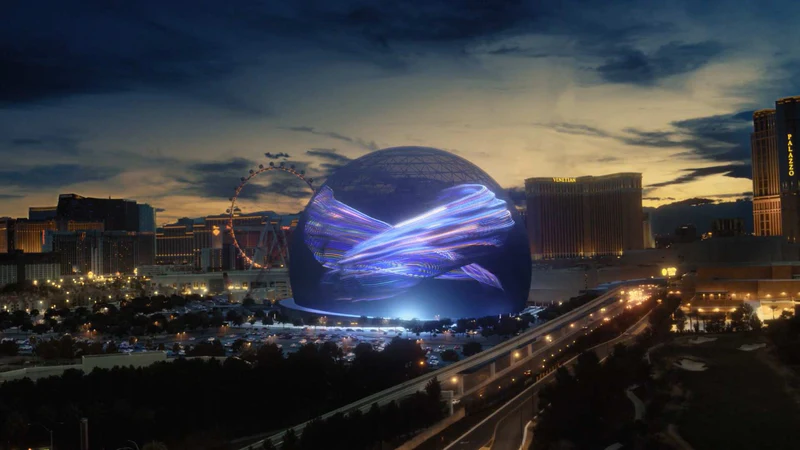
1.1 The Sphere – Exterior and Interior LED Screens
Sphere, Las Vegas, combines an exterior LED canvas with a separate immersive screen inside the venue. The Exosphere covers 580,000 ft² (about 53,884 m²); the interior LED display covers 160,000 ft² (about 14,864 m²). The operator’s technical overview documents both. Use the exterior figure when comparing façades and the interior figure when comparing indoor displays.
1.2 Resorts World
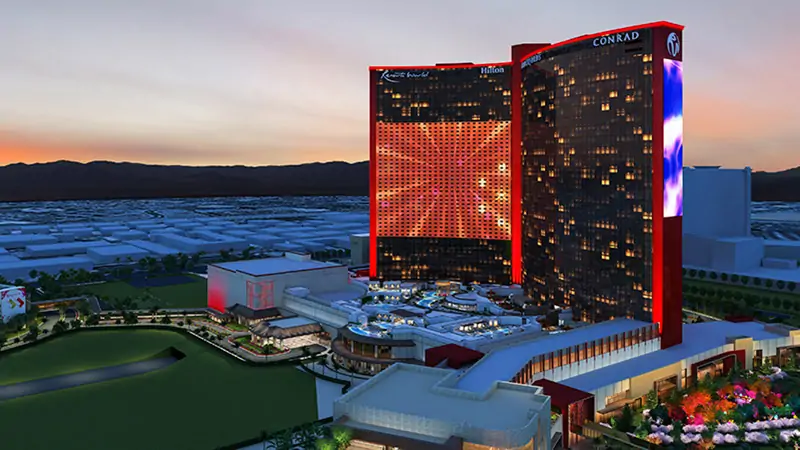
Resorts World Las Vegas lists a 100,000 ft² LED screen (about 9,290 m²) among its venue features. This figure describes the screen, not the resort’s land or floor area. Resorts World’s venue information supports the measurement; it does not establish a current second-place global ranking.
1.3 Mall Taman Anggrek
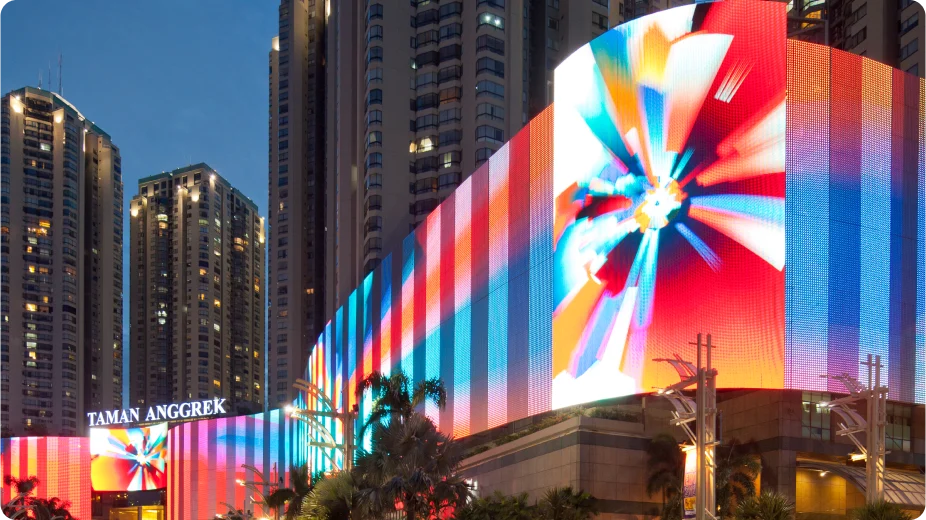
Mall Taman Anggrek in Jakarta, Indonesia, uses a media façade that follows the shopping centre’s exterior. The Media Architecture Biennale project entry describes a 354 m-long, 25 m-high installation designed by StandardVision. Those dimensions describe the façade envelope; they should not be treated as a verified solid rectangular display area.
Façades may contain gaps, curves and sections with different pixel spacing. For an equivalent commercial project, request the active LED area and pixel layout separately from the building dimensions. The mall’s total floor area is not a screen-size specification.
1.4 The Place
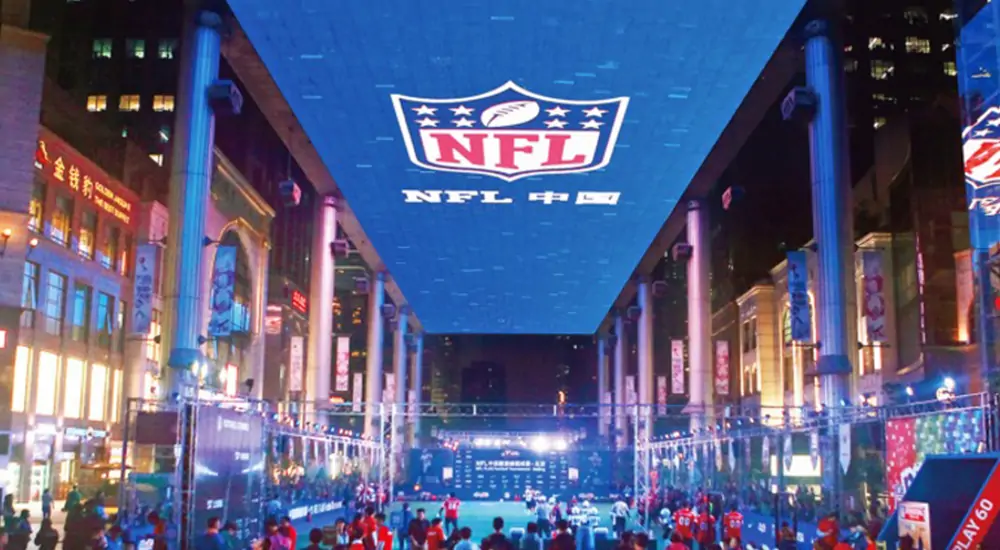
The Place in Beijing has an overhead LED sky screen above its pedestrian shopping area. Beijing’s official visitor guide gives dimensions of 250 m long by 30 m wide, equivalent to a rectangular footprint of approximately 7,500 m² (calculated). The shopping centre is on Guanghua Road in Chaoyang District.
This is a canopy viewed from below. Its length and visitor experience are useful comparisons for public-space projects, but its footprint does not describe the resolution, brightness or operating cost.
1.5 Infinity Screen
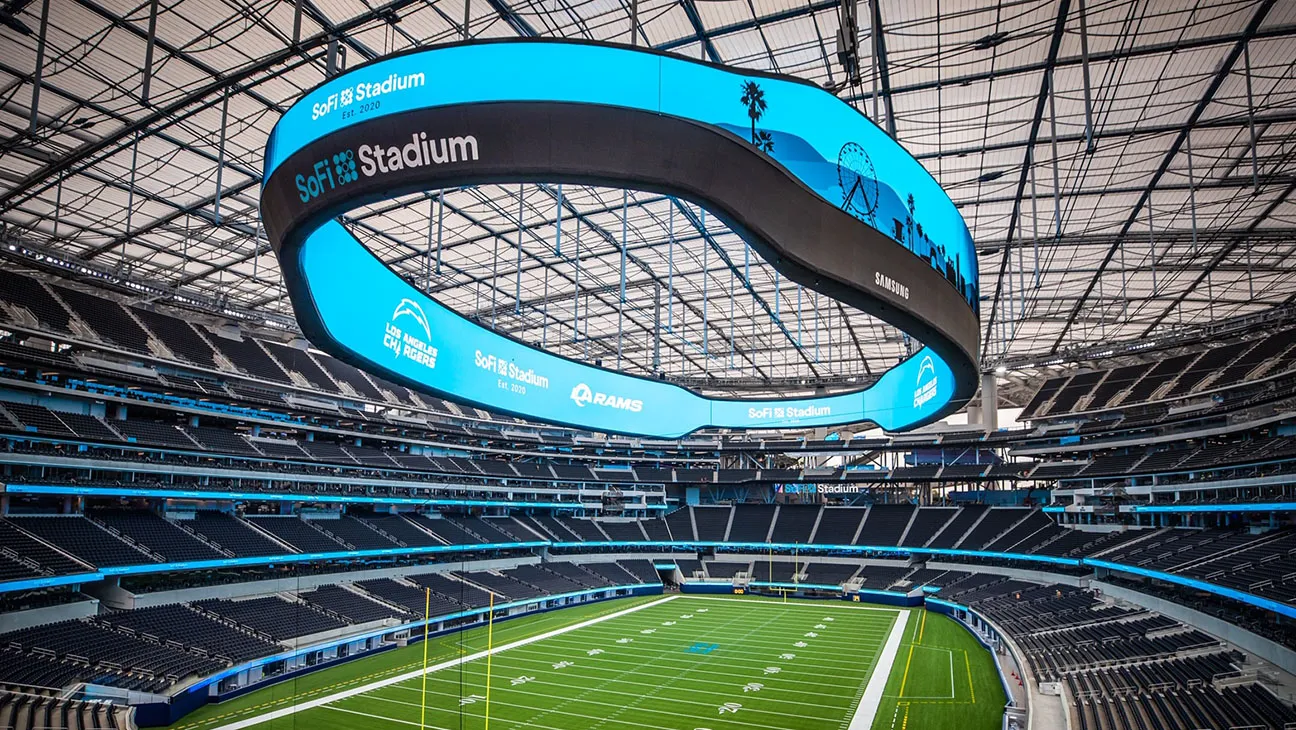
The Infinity Screen by Samsung hangs above the field at SoFi Stadium in Inglewood, California. Samsung reports 70,000 ft² (about 6,503 m²) for its dual-sided video board. The total includes both viewing surfaces; it is not one flat 70,000 ft² picture. Samsung’s July 2021 announcement identifies the display and measurement.
Its oval configuration provides different viewing surfaces for different seating areas. For a stadium comparison, ask whether a quoted area includes multiple faces and whether each seat can see the full image. The earlier 120,000 ft² figure in the comparison graphics below is not supported by Samsung’s specification.
1.6 Citigroup Tower, Shanghai
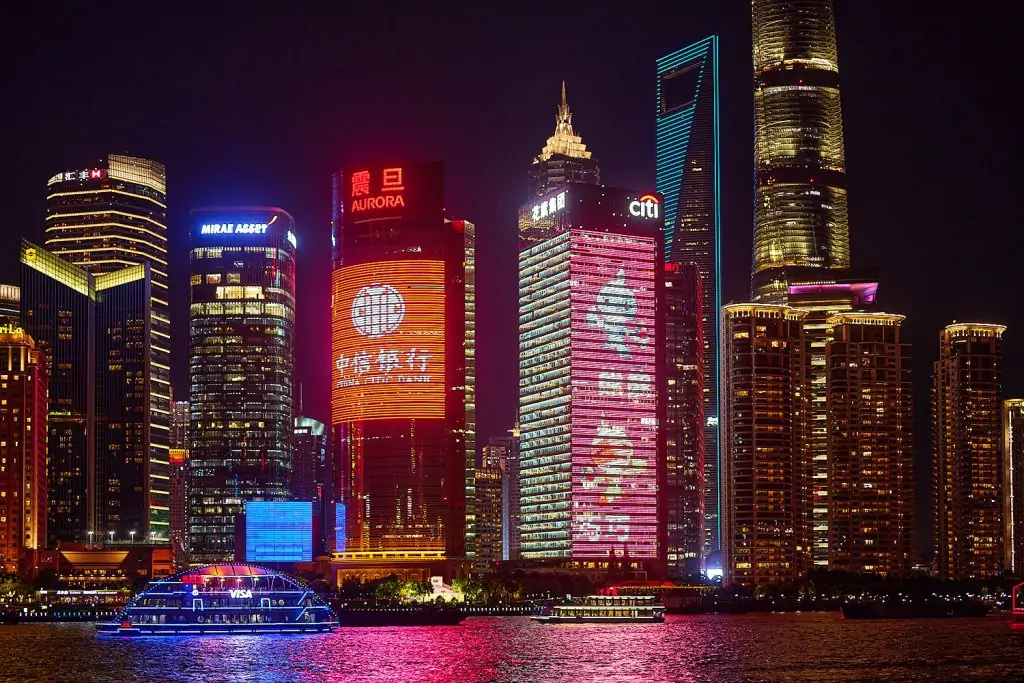
Citigroup Tower in Shanghai’s Lujiazui district carries a large exterior media display. A December 2023 media-owner listing specifies 139.6 m × 43.2 m, or about 6,031 m² when multiplied. This is a supplier-reported figure, not an independently certified world record. The tower should not be confused with other illuminated façades nearby.
1.7 Tauron Arena Krakow
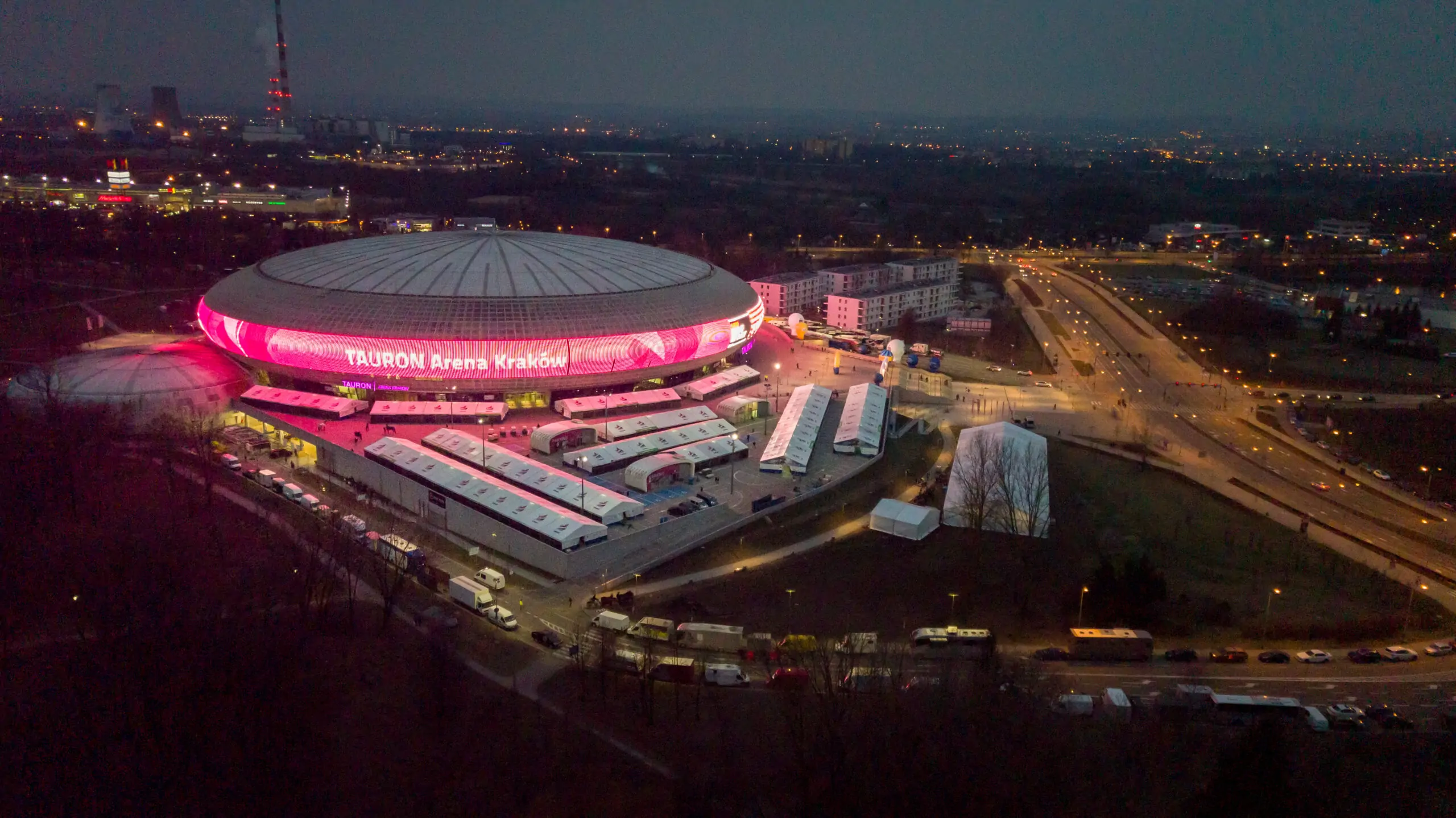
TAURON Arena Kraków in Poland lists a 5,100 m² LED screen in its official venue information. The large wraparound installation is on the building exterior. Its façade area should not be described as an indoor arena video-board record or confused with the smaller screens used inside.
1.8 Mexico City Arena
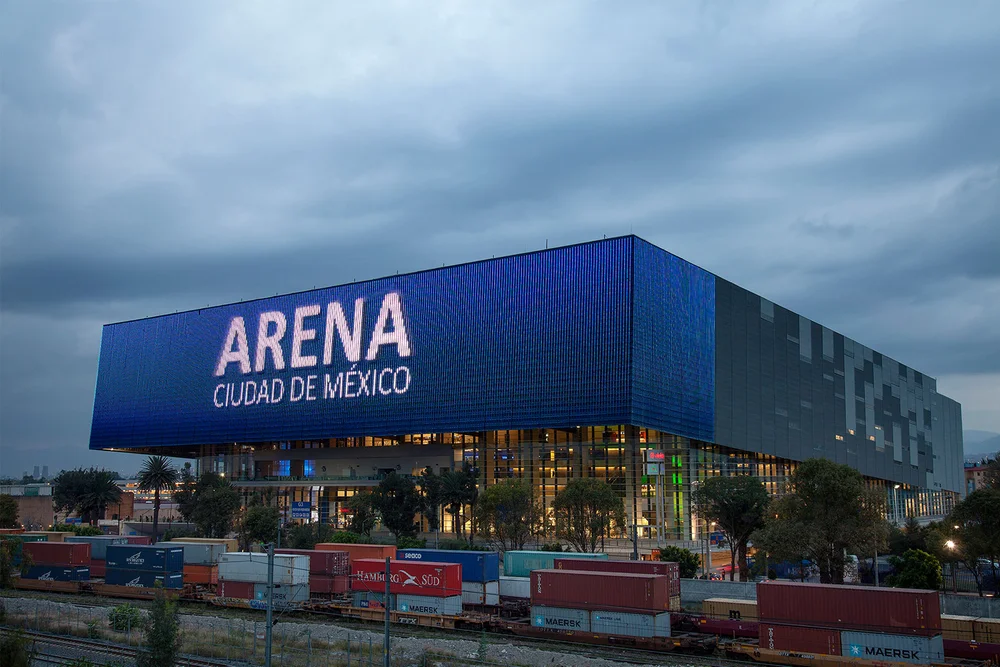
Arena Ciudad de México has both exterior and interior LED systems. Daktronics’ account of the installation identifies a 64,000 ft² freeform exterior display (about 5,946 m²). The company separately describes about 3,500 ft² of indoor displays installed for the venue’s 2012 opening. These figures refer to different systems and should not be added together as one screen.
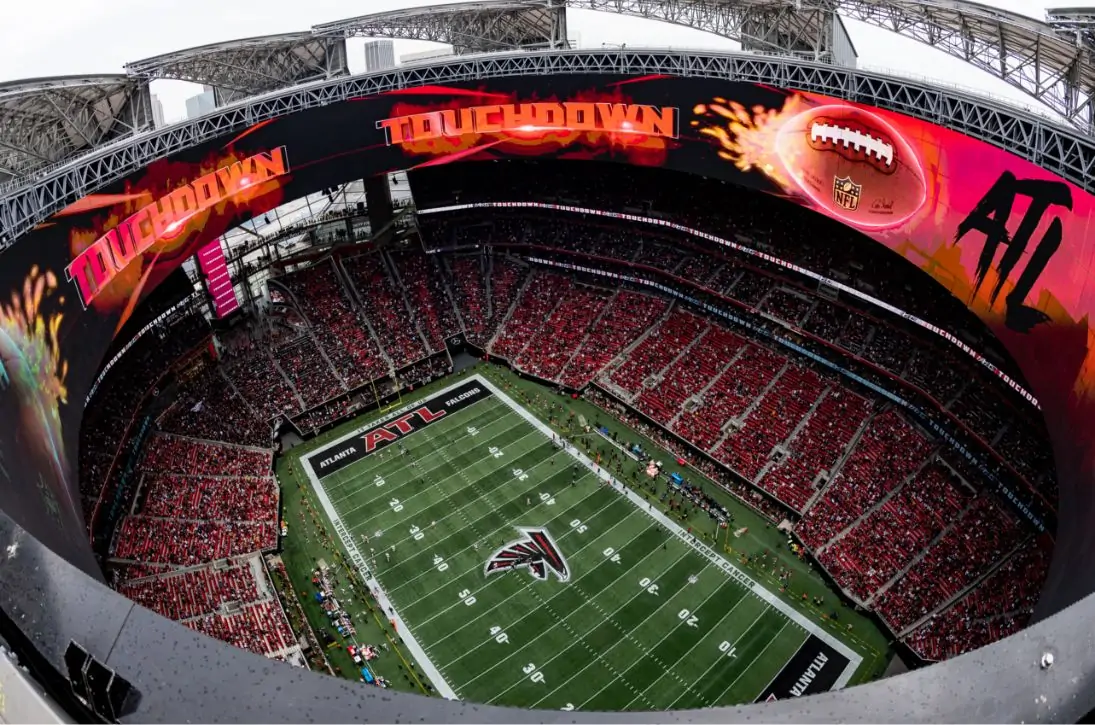
1.9 Mercedes-Benz Stadium
Mercedes-Benz Stadium in Atlanta uses a ring-shaped Halo display beneath the roof. Daktronics’ November 2016 project announcement reports 61,900 ft² (about 5,751 m²) for the Halo. Daktronics engineered the display; the earlier graphic’s Samsung attribution and 63,800 ft² figure are incorrect. The reported area covers the wraparound display, not a conventional rectangular scoreboard.
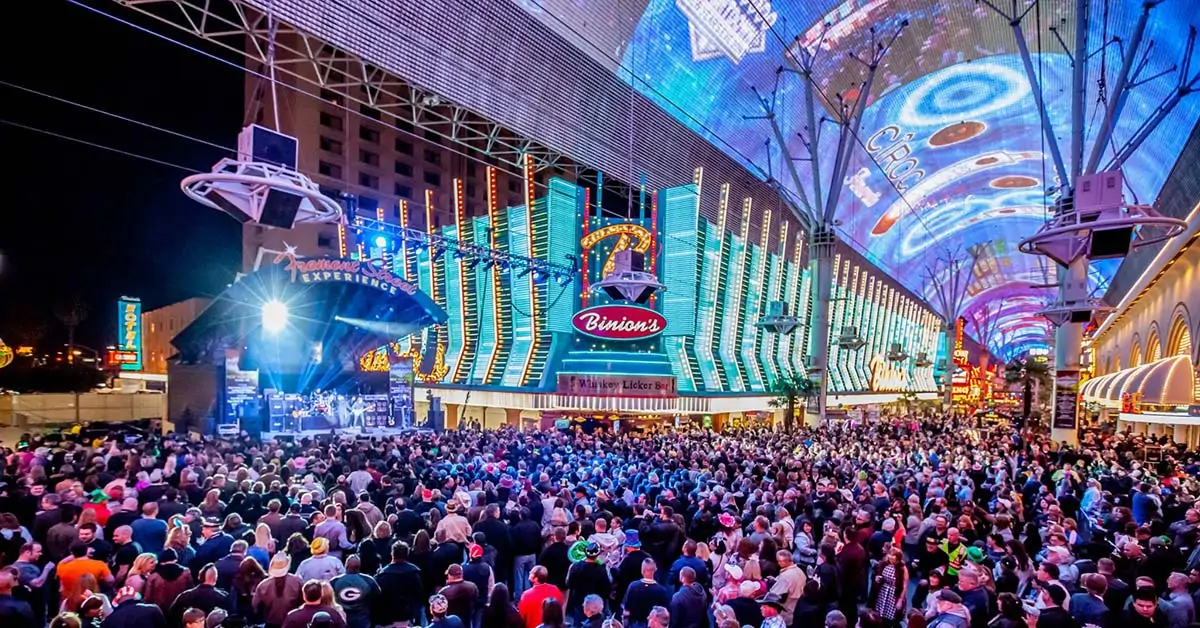
1.10 Fremont Street Experience
Viva Vision at the Fremont Street Experience in downtown Las Vegas is an LED canopy over a pedestrian street. The operator’s Viva Vision information describes it as 1,375 ft long and 90 ft wide, suspended about 90 ft above the street. Length, width and mounting height are separate measurements. The canopy’s curved viewing surface should not be compared directly with a single flat cinema screen.
2. Biggest Screen Comparisons by Category
The following sections retain the original cinema, stadium, indoor, IMAX and NFL categories. The existing image charts contain legacy errors. Use the accompanying HTML tables for sourced corrections. Unverified entries remain named to preserve the original comparisons, but their sizes and rankings are not asserted. Dimensions are width × height unless stated otherwise.
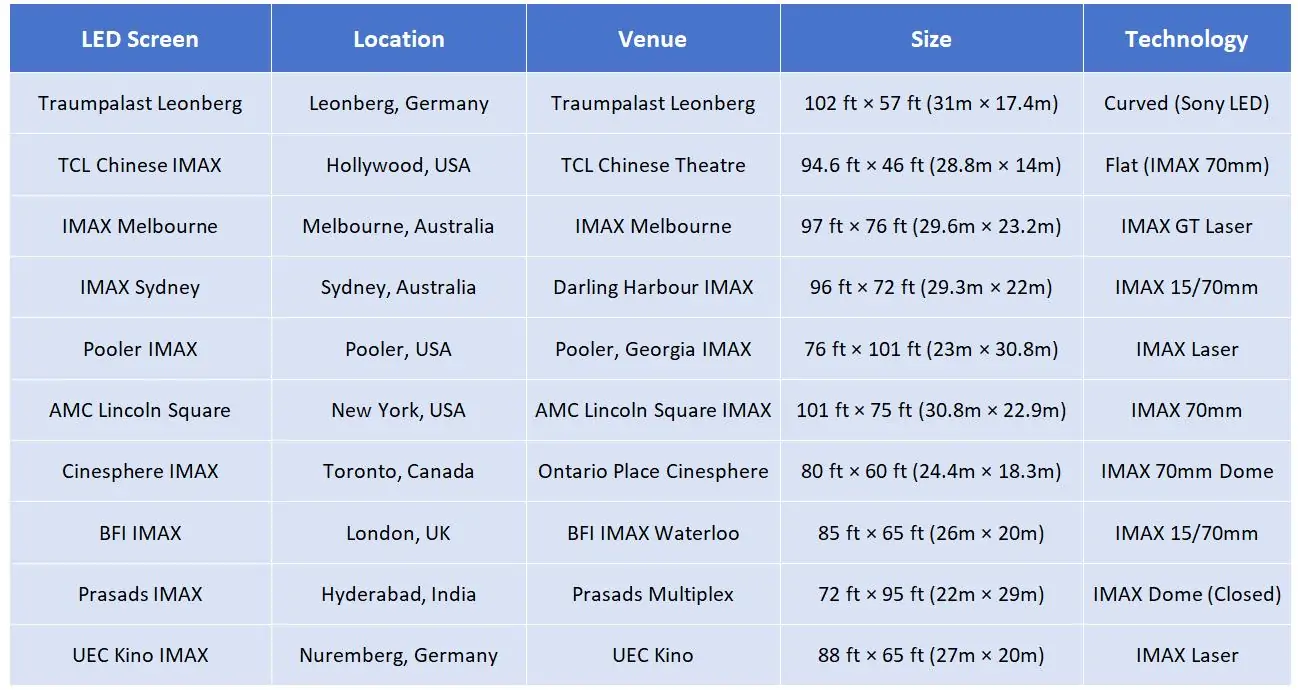
2.1 Largest Cinema Screens: Ten-Venue Comparison
Cinema screens usually display a projected image; they are not automatically direct-view LED screens. Guinness World Records verified the Leonberg screen at 38.8 m × 21 m (814.8 m²) on 6 December 2022. That is a dated record, not evidence that every venue below occupies a current global top-ten position. See the record and measurement date.
| Venue / location | Documented size | Source / qualification |
|---|---|---|
| Traumpalast IMAX, Leonberg, Germany | 38.8 × 21 m; 814.8 m² | Guinness record verified 6 December 2022; projection, not a Sony LED wall. |
| TCL Chinese Theatre IMAX, Hollywood, USA | Not verified | Current dimensions and configuration not established from a primary source in this review. |
| IMAX Melbourne, Australia | 32 × 23 m | Operator specification; projected cinema screen. |
| IMAX Sydney, Australia | 692 m² | Operator specification; IMAX with Laser. |
| Royal Cinemas IMAX, Pooler, USA | Not verified | Current dimensions and configuration not established from a primary source in this review. |
| AMC Lincoln Square IMAX, New York, USA | Not verified | Current dimensions and configuration not established from a primary source in this review. |
| Cinesphere, Toronto, Canada | Not verified | Current dimensions and configuration not established from a primary source in this review. |
| BFI IMAX, London, UK | 26 × 20 m | BFI specification; projected cinema screen. |
| Prasads, Hyderabad, India | Not verified | The graphic’s “IMAX Dome (Closed)” description is not verified; do not use it to establish present format or operating status. |
| “UEC Kino IMAX”, Nuremberg, Germany | Not verified | The venue identity in the original graphic could not be established; no rank assigned. |
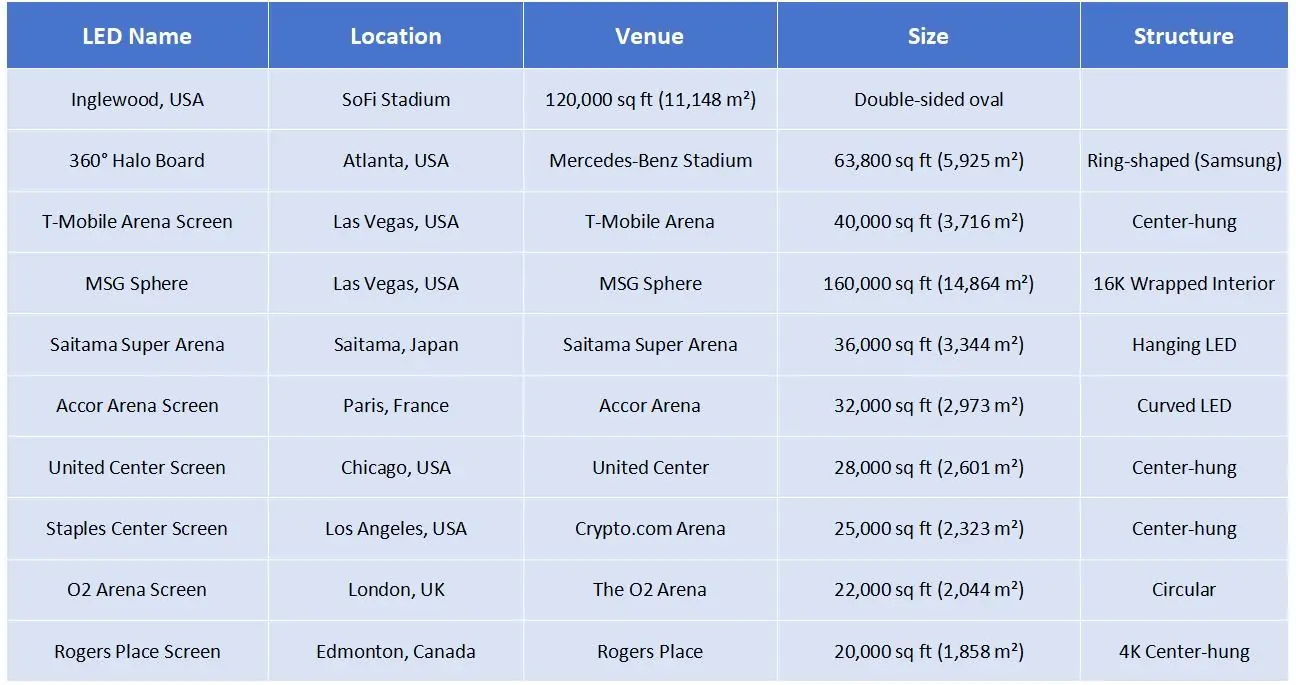
Graphic correction: the retained image below contains older or unverified figures. Refer to the accessible table above; “not verified” does not mean zero or that the venue has no screen.
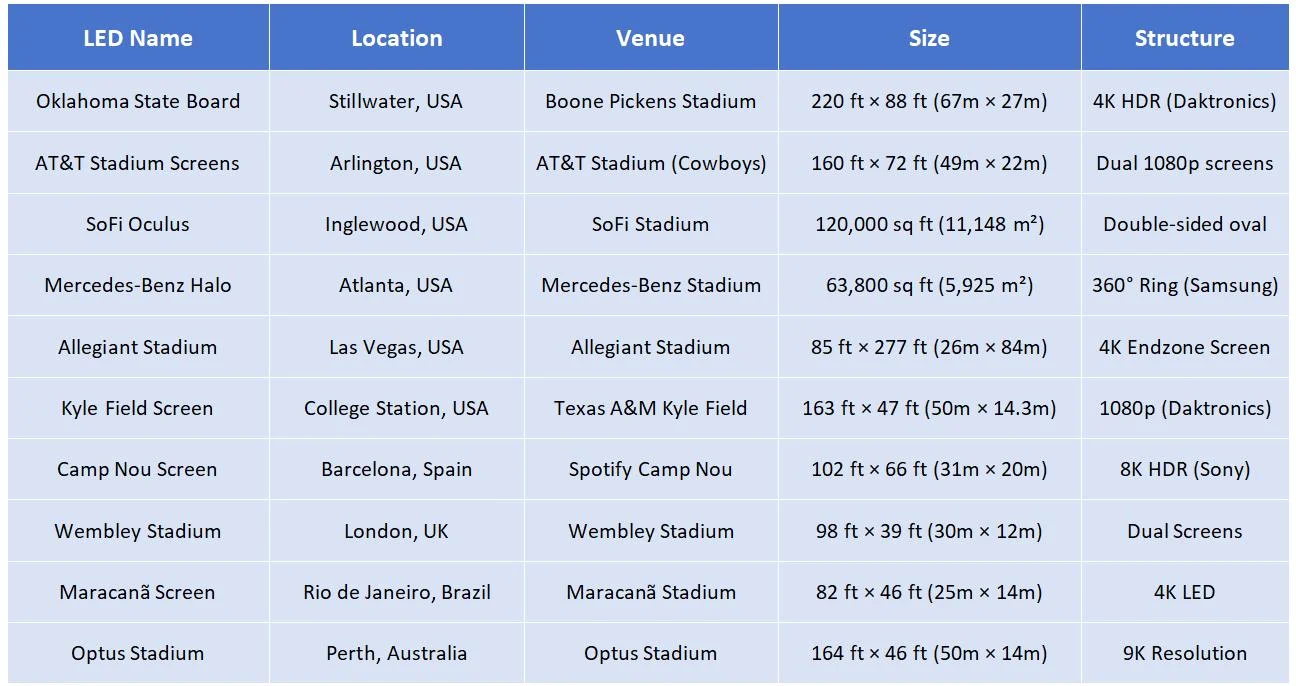
2.2 Largest Stadium Screens: Ten-Venue Comparison
Stadium screen comparisons require the area of a single face or a clearly labeled total. SoFi’s dual-sided board and Atlanta’s Halo are different configurations from an end-zone screen. The table keeps the graphic’s venues and distinguishes confirmed specifications from figures that could not be verified.
| Venue / location | Documented size | Source / qualification |
|---|---|---|
| Boone Pickens Stadium, Stillwater, USA | Not verified | Current dimensions and configuration not established from a primary source in this review. |
| AT&T Stadium, Arlington, USA | 160 × 72 ft main face | Cowboys venue guide; historical installation specification, not a current record claim. |
| SoFi Stadium, Inglewood, USA | 70,000 ft² total | Samsung, 2021; dual-sided Infinity Screen. |
| Mercedes-Benz Stadium, Atlanta, USA | 61,900 ft² | Daktronics, 2016; Halo ring display. |
| Allegiant Stadium, Las Vegas, USA | Not verified | Current dimensions and configuration not established from a primary source in this review. |
| Kyle Field, College Station, USA | Not verified | Current dimensions and configuration not established from a primary source in this review. |
| Camp Nou, Barcelona, Spain | Not verified | Current dimensions and configuration not established from a primary source in this review. |
| Wembley Stadium, London, UK | Not verified | Current dimensions and configuration not established from a primary source in this review. |
| Maracanã, Rio de Janeiro, Brazil | Not verified | Current dimensions and configuration not established from a primary source in this review. |
| Optus Stadium, Perth, Australia | Not verified | Current dimensions and configuration not established from a primary source in this review. |
Graphic correction: the retained image below contains older or unverified figures. Refer to the accessible table above; “not verified” does not mean zero or that the venue has no screen.
2.3 Large Indoor LED Screens: Ten-Venue Comparison
Indoor displays include immersive surfaces and multi-face scoreboards. Sphere’s indoor LED screen measures 160,000 ft², while the retained graphic incorrectly assigns very large totals to several arena scoreboards. Covered stadiums are retained here as in the original comparison; they should not be treated as a uniform indoor-arena category.
| Venue / location | Documented size | Source / qualification |
|---|---|---|
| SoFi Stadium, Inglewood, USA | 70,000 ft² total | Samsung, 2021; dual-sided Infinity Screen. |
| Mercedes-Benz Stadium, Atlanta, USA | 61,900 ft² | Daktronics, 2016; Halo ring display. |
| T-Mobile Arena, Las Vegas, USA | 36 × 21 ft each main side face | Daktronics, 2016; part of a multi-face scoreboard, not a 40,000 ft² single screen. |
| Sphere interior, Las Vegas, USA | 160,000 ft² | Operator specification; separate from the Exosphere. |
| Saitama Super Arena, Japan | Not verified | Current dimensions and configuration not established from a primary source in this review. |
| Accor Arena, Paris, France | Not verified | Current dimensions and configuration not established from a primary source in this review. |
| United Center, Chicago, USA | Not verified | Current dimensions and configuration not established from a primary source in this review. |
| Crypto.com Arena (formerly Staples Center), Los Angeles, USA | Not verified | Current dimensions and configuration not established from a primary source in this review. |
| The O2, London, UK | Not verified | Current dimensions and configuration not established from a primary source in this review. |
| Rogers Place, Edmonton, Canada | Not verified | Current dimensions and configuration not established from a primary source in this review. |
Graphic correction: the retained image below contains older or unverified figures. Refer to the accessible table above; “not verified” does not mean zero or that the venue has no screen.
2.4 Biggest IMAX Screens: Ten-Venue Comparison
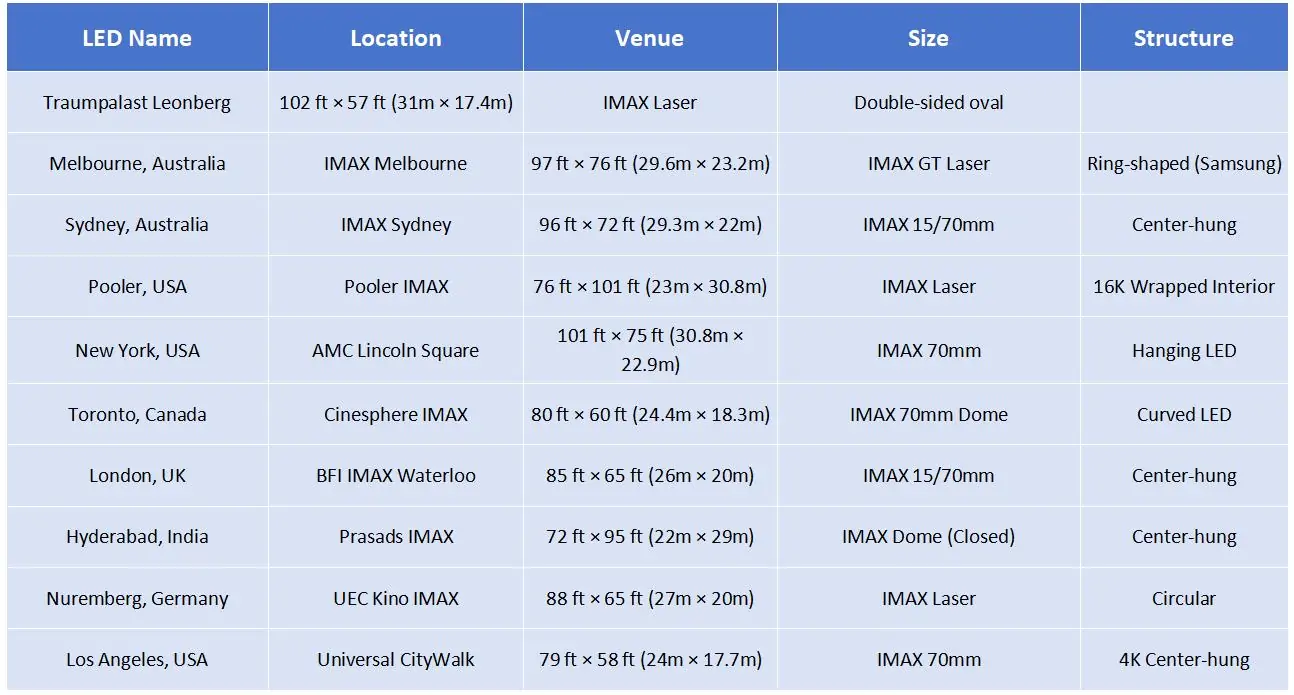
An IMAX screen is part of a cinema presentation system, rather than a synonym for an LED wall. Compare screen dimensions, projection format and the image area used for the particular film. This table corrects the original graphic’s misaligned columns and does not repeat its unsupported screen-shape labels.
| Venue / location | Documented size | Source / qualification |
|---|---|---|
| Traumpalast IMAX, Leonberg, Germany | 38.8 × 21 m; 814.8 m² | Guinness record verified 6 December 2022; projection, not a Sony LED wall. |
| IMAX Melbourne, Australia | 32 × 23 m | Operator specification; projected cinema screen. |
| IMAX Sydney, Australia | 692 m² | Operator specification; IMAX with Laser. |
| Royal Cinemas IMAX, Pooler, USA | Not verified | Current dimensions and configuration not established from a primary source in this review. |
| AMC Lincoln Square IMAX, New York, USA | Not verified | Current dimensions and configuration not established from a primary source in this review. |
| Cinesphere, Toronto, Canada | Not verified | Current dimensions and configuration not established from a primary source in this review. |
| BFI IMAX, London, UK | 26 × 20 m | BFI specification; projected cinema screen. |
| Prasads, Hyderabad, India | Not verified | The graphic’s “IMAX Dome (Closed)” description is not verified; do not use it to establish present format or operating status. |
| “UEC Kino IMAX”, Nuremberg, Germany | Not verified | The venue identity in the original graphic could not be established; no rank assigned. |
| Universal CityWalk IMAX, Los Angeles, USA | Not verified | Current dimensions and configuration not established from a primary source in this review. |
Graphic correction: the retained image below contains older or unverified figures. Refer to the accessible table above; “not verified” does not mean zero or that the venue has no screen.
2.5 Large NFL Jumbotrons: Ten-Venue Comparison
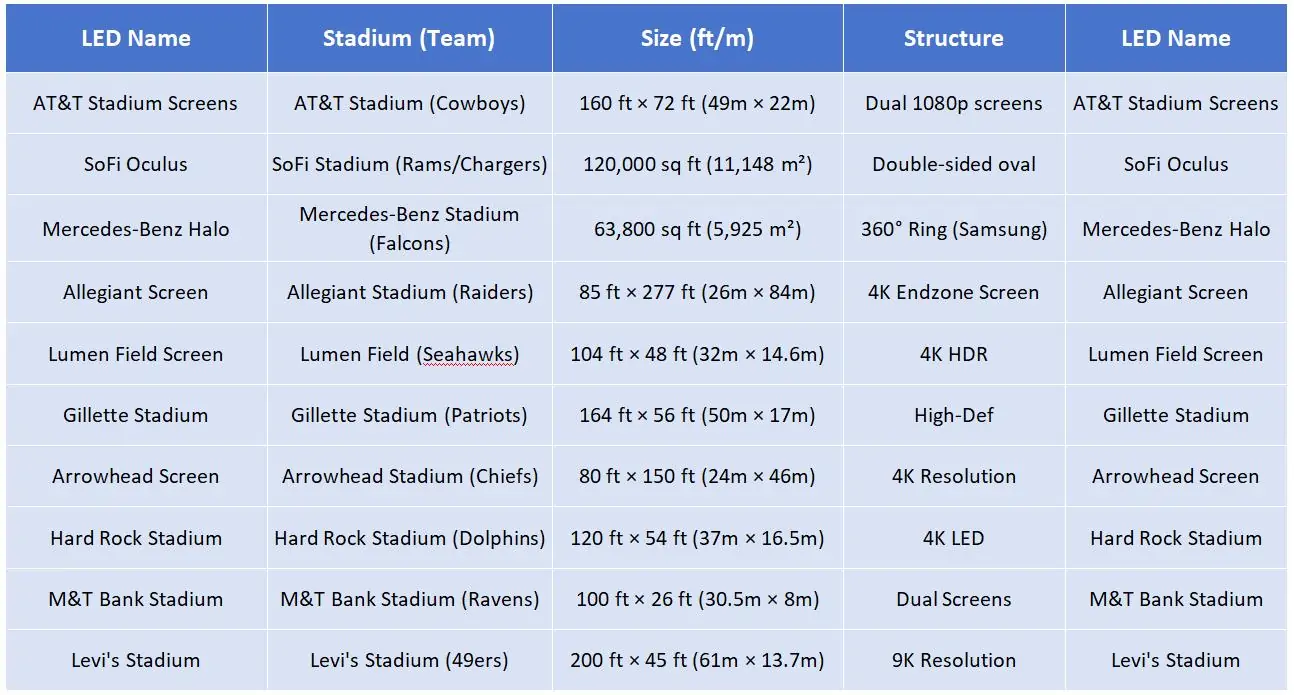
“Jumbotron” is commonly used for a stadium video board. A largest-NFL comparison must distinguish a dual-sided board, a roof ring and a single end-zone face. Gillette Stadium’s 2023 display is an example of why older size lists become outdated. The following entries remain in the original order, not size order.
| Venue / location | Documented size | Source / qualification |
|---|---|---|
| AT&T Stadium, Arlington, USA | 160 × 72 ft main face | Cowboys venue guide; historical installation specification, not a current record claim. |
| SoFi Stadium, Inglewood, USA | 70,000 ft² total | Samsung, 2021; dual-sided Infinity Screen. |
| Mercedes-Benz Stadium, Atlanta, USA | 61,900 ft² | Daktronics, 2016; Halo ring display. |
| Allegiant Stadium, Las Vegas, USA | Not verified | Current dimensions and configuration not established from a primary source in this review. |
| Lumen Field, Seattle, USA | Not verified | Current dimensions and configuration not established from a primary source in this review. |
| Gillette Stadium, Foxborough, USA | 370 × 60 ft | Daktronics, 2023; single end-zone display; 22,200 ft² calculated. |
| Arrowhead Stadium, Kansas City, USA | Not verified | Current dimensions and configuration not established from a primary source in this review. |
| Hard Rock Stadium, Miami Gardens, USA | Not verified | Current dimensions and configuration not established from a primary source in this review. |
| M&T Bank Stadium, Baltimore, USA | Not verified | Current dimensions and configuration not established from a primary source in this review. |
| Levi’s Stadium, Santa Clara, USA | Not verified | Current dimensions and configuration not established from a primary source in this review. |
Graphic correction: the retained image below contains older or unverified figures. Refer to the accessible table above; “not verified” does not mean zero or that the venue has no screen.
3. Overview of the Biggest Screen Technology
A direct-view LED screen creates the image using light-emitting pixels across modular panels. A projected cinema screen reflects light from a projector. Both can be large, but their resolution, brightness and service requirements are specified differently. For commercial outdoor applications, see our advertising LED screen guide.
3.1 How Have the Biggest Screens Evolved?
Large displays have expanded from conventional scoreboards and projection screens to modular LED walls, architectural façades and curved immersive surfaces. The examples above show this range. A larger surface does not necessarily provide more detail: pixel count and pixel spacing determine how much image information fits across it.
3.2 Impact of Large-Screen Technology
Large-screen technology can change how a venue presents information and sells advertising space. Its value depends on sightlines, content quality and audience needs. Bigger dimensions alone do not demonstrate better engagement, more sales or a profitable investment.
3.2.1 Visibility and Audience Engagement
A visible screen can make scores, directions and live action easier to follow. Design for the furthest relevant viewer: test text size, contrast and the amount of information on each frame. A detailed layout that works on a laptop may be unreadable across a stadium.
3.2.2 Advertising and Marketing
LED displays allow advertisers to schedule different creative messages without replacing printed artwork. Assess a location through measured audience exposure, visibility and campaign results. Do not infer advertising reach or sales uplift from screen area alone.
3.2.3 Entertainment
Concerts and immersive venues can combine live camera feeds with animation and scenic content. Curved screens and unusual aspect ratios require content designed for their surface. Standard video may need cropping, scaling or separate viewing zones.
4. Benefits Of the Biggest Screens
4.1 High Visibility & Clarity
A large display can improve visibility when pixel pitch, brightness and content match the viewing distance. Ask for the native pixel dimensions as well as the physical size. “4K” describes image resolution; it does not specify the area or ensure that small text will be readable from every seat.
4.2 Cost and Energy Considerations
Remote content changes can reduce the recurring work of replacing printed signs. Energy use and total cost still depend on display area, operating brightness, hours, cooling and maintenance. Compare supplier quotes on the same assumptions; there is no verified universal savings percentage for the installations in this article.
4.3 Weather Resistance
Outdoor displays need protection suited to rain, dust, temperature and the installation site. Check the model’s documented enclosure protection, structural design and service access. An outdoor façade specification should not be assumed to apply to indoor panels or temporary event screens.
4.4 Customization
Modular panels can support wide, curved or multi-face designs. Check cabinet geometry, supported curvature, seams and access before selecting a shape. The design should follow the venue’s viewing needs and support structure, rather than a target size alone.
4.5 Dynamic Content
Schedules and content-management systems allow screens to switch between live feeds, announcements and advertising. Plan operator permissions, emergency messaging and a fallback image if a video source fails. Test the content workflow before the first public event.
5. Applications of the Biggest Screens
The biggest screens share a need for clear sightlines and reliable operation, but each application has different priorities. Use the following examples to define the audience, content and installation environment before comparing products.
5.1 Sports Stadiums
Stadiums use displays for live video, replays, scores and sponsor messages. Check visibility from obstructed and nearby seats as well as distant ones. Our stadium screen guide covers this application in more detail.
5.2 Concerts & Music Festivals
Concert and festival screens relay performers to distant audiences and provide visual staging. Temporary projects also need transport, rigging and weather planning. See our rental LED display options when the installation must move between events.
5.3 Public Events
Public-event displays can show live coverage, programme information and wayfinding.
- Use readable messages that can be understood quickly.
- Plan sightlines and brightness for the actual event location.
- Reserve a clear operating procedure for urgent announcements.
5.4 Branding & Advertising
For branding and advertising, specify the viewing conditions before selecting the screen.
- Match creative dimensions to the active display canvas.
- Use location-specific audience evidence when evaluating a media buy.
- Agree on playback reporting and campaign measurement in advance.
5.5 Other Applications
- Retail and shopping centres: promotions and architectural media.
- Transport hubs: departures, directions and service information.
- Exhibitions and visitor attractions: demonstrations and immersive storytelling.
In each setting, prioritize information that serves the audience and can be maintained by the operating team.
6. Challenges of Biggest LED Screens
Budget and infrastructure: price the complete installation, including the display, structure, power distribution, controllers, cabling, installation and service access. No comparable verified project-price dataset was found for this guide, so no generic per-square-metre price or investment return is asserted.
Power and maintenance: request average and maximum power under stated operating conditions. A budgeting estimate can use average kW × operating hours × the local electricity tariff, with cooling and other loads added separately. Keep spare-module availability and colour calibration in the maintenance plan.
Image quality and operation: confirm native resolution, viewing distance, camera compatibility and the required content format. For a hypothetical 10 m-wide LED wall at 5 mm pixel pitch, the width is 10,000 ÷ 5 = 2,000 pixels. This calculated example explains why physical size alone does not determine resolution; it is not a specification for any venue above.
7. FAQs
8. Conclusion
The biggest LED screens in the world demonstrate different ways to use façades, canopies and stadium video boards. Compare documented active area, display type, resolution and viewing conditions before drawing conclusions from size. The same approach helps buyers specify a practical screen without relying on an unsupported global ranking.
For a project discussion, contact EagerLED with your location, proposed dimensions, viewing distances and operating schedule. For a smaller multi-face display, read our mini jumbotron guide.
 LED Display: The Backbone of Smart Cities and Urban Innovation
 What Is a MiP LED Screen? Technology, Price & Trends
Related Posts
Fill In Your Needs In Detail
Fill in the screen usage scene and size you need in “Content”.You will get a quote.