Choosing an LED screen factory comes down to six verifiable facts rather than a brochure: a real manufacturing address, a production line you can inspect, certifications that match your destination market, documented quality-control data, transparent total cost of ownership, and after-sales support that still answers in year three. This guide shows how to verify each one before you pay a deposit — and which claims to distrust.
1. LED Screen Factory vs Trading Company: What You Are Really Buying
01 Three supply models, three very different risk profiles
Nearly every LED display quotation comes from one of three sources: a direct LED screen factory that owns its production line, a trading company reselling another factory’s output, or an agent paid a commission on whichever supplier closes the deal. The cabinets can look identical in a render. What differs is who controls the bill of materials, who approves a custom cabinet drawing, who honours the warranty in year three, and who answers the phone when modules fail a week before your event. For one indoor poster screen that hardly matters. For a stadium perimeter or a 200 m² rental fleet, it decides whether the project lands on time.
A direct LED screen factory carries the cost of SMT lines, aging racks and engineers, so it competes on capability. A trading company carries little of that cost, so it competes on responsiveness. Neither model is dishonest — the problem is paying factory-direct prices for trading-company accountability.
02 How to identify a real LED screen factory in ten minutes
You do not need to fly to Shenzhen to tell a factory from a reseller. Three checks settle most cases:
- Business licence and registered scope. Ask for the licence and confirm the scope covers manufacture of LED display products, not only sales or import/export.
- Unannounced live video walkthrough. Ask to see the SMT line, aging racks, cabinet assembly area and finished-goods warehouse in real time. A reseller will steer you to a showroom.
- Bill of materials with part numbers. A genuine LED screen factory answers with the LED lamp brand and bin, driver IC, power supply, receiving card and control system. A middleman answers with brand names only.
If a supplier passes those three tests, the rest is commercial negotiation. If it fails one, treat every other claim with suspicion.
| Decision factor | Direct LED screen factory | Trading company | Independent agent |
|---|---|---|---|
| Owns production line | Yes — SMT, aging, assembly | No | No |
| Controls the bill of materials | Fully, including lamp bins and IC brands | Partly / by request | No |
| Typical price level | Baseline | Commonly 15–40% above factory-direct | Commission loaded onto factory price |
| Custom cabinet tooling | Possible | Rarely | No |
| Access to QC data | Full test reports | Summaries only | None |
| Warranty execution | Direct, factory-backed | Passed through a third party | Weak or informal |
| Lead-time control | Direct scheduling | Depends on factory queue | Depends on factory queue |
| Best suited to | Custom, large or long-life projects | Small standard orders, fast sourcing | Buyers with no sourcing resource |
2. The 5-Step LED Screen Factory Vetting Process
01 Step 1 — Verify the legal entity and the manufacturing address
Match the company name on the quotation, the bank account and the business licence. They must be the same legal entity. Ask for the factory address and confirm it with a map and a live video call from that location. A supplier that insists on payment to a third-party or personal account has told you everything you need to know.
02 Step 2 — Audit production capability, not the showroom
Request the number of SMT lines, monthly output in square metres, aging-rack capacity and the number of QC staff. Then ask what happens when your order conflicts with a larger one in the queue. Capacity claims are easy to make and hard to disprove, so tie your question to scheduling rather than totals.
03 Step 3 — Demand test data, not assurances
Ask for aging-test reports, dead-pixel statistics, brightness and colour-uniformity measurements, and the flatness figure for the cabinet type you are buying. A factory that runs these tests can produce the numbers within a day. A factory that cannot has either no test process or no records.
04 Step 4 — Compare total cost of ownership, not unit price
Unit price per square metre hides the variables that decide your five-year cost: power consumption, spare-part pricing, failure rate, service access (front or rear), and freight volume. Two quotes that differ by 20% on paper often invert once total cost of ownership is modelled.
05 Step 5 — Stress-test communication and after-sales
Send a technical question at the start of the Chinese working day and time the response. Ask which engineer will support your installation, how replacement modules ship, and what the RMA process looks like. The quality of that exchange before money changes hands is the best predictor of what you get afterwards.
| Step | What to verify | Evidence to request | Pass signal |
|---|---|---|---|
| 1. Legal entity | Company name matches licence, invoice and bank account | Business licence; bank details on company letterhead | All three match the same legal entity |
| 2. Production | Real lines and capacity, not a showroom | Live video walkthrough; SMT and aging capacity figures | Live walkthrough granted without rehearsed scripting |
| 3. Test data | Documented quality control | Aging report, dead-pixel rate, brightness and flatness data | Reports supplied within 24 hours |
| 4. Total cost | Five-year cost, not unit price | Power figures, spare-part price list, freight volume | Willing to quote spares and freight separately |
| 5. After-sales | Named support and RMA path | Named engineer; written RMA procedure | Fast, specific, technical answers |
3. Certifications an LED Screen Factory Must Prove
Certificates are the easiest claim to fake and the easiest to verify, which makes them a useful filter. Treat every certificate as a claim until you have checked the number against the issuing body.
01 Mandatory approvals by destination market
For the European Union and the United Kingdom, CE or UKCA marking plus RoHS and REACH compliance is the baseline. For the United States, expect FCC for electromagnetic emissions and UL or ETL listing for the power and control components. Australia and New Zealand require RCM. If your supplier claims global approval but can only produce one generic CE document, ask which directive it covers.
02 Management-system certificates
ISO 9001 covers quality management, ISO 14001 environmental management and ISO 45001 occupational health and safety. These matter because they describe process discipline rather than a single product batch. Check the certificate's scope statement: a factory certified for "electronic assembly" may not be certified for LED display manufacture.
03 Certificates that are easy to fake
CE is often a self-declaration, so it proves intent rather than independent testing. ISO certificates expire and can be withdrawn. Third-party test reports can be edited. Always verify the certificate number, the issuing body, the expiry date and the scope — and prefer factories that volunteer the verification link rather than waiting to be asked.
| Certification | What it covers | Where it matters | Priority |
|---|---|---|---|
| CE / UKCA | Health, safety and electromagnetic compliance | EU and UK import | Mandatory |
| RoHS | Restricted hazardous substances | EU, UK and most export markets | Mandatory |
| REACH | Chemical substance registration | EU | Mandatory |
| FCC | Electromagnetic interference limits | United States | Mandatory |
| UL / ETL | Electrical safety of components | North America, specified projects | High |
| RCM | Electrical and EMC compliance | Australia and New Zealand | Mandatory |
| ISO 9001 | Quality management system | Global, tender requirements | High |
| ISO 14001 / 45001 | Environmental and safety management | Corporate and public procurement | Medium |
| IP54 / IP65 / IP66 | Ingress protection rating | Outdoor and rental applications | High |
4. Twelve Red Flags of an Unreliable LED Screen Factory
Most failed LED display orders announce themselves long before the deposit. These are the warning signs that recur most often, grouped by whether they surface in the commercial process or in the technical detail.
01 Commercial red flags
Watch for a refusal to grant an unannounced video tour, a bank account in a different name from the supplier, pressure to pay 100% upfront, and a price far below every competing LED screen factory quotation. A quote that undercuts the market by 30% is not a bargain; it is a different bill of materials waiting to be found. Equally telling is a warranty described only in conversation and never in the contract.
02 Technical red flags
On the technical side, be cautious when a supplier cannot name the LED lamp bin, refuses to share driver IC part numbers, has no aging-test process, or quotes brightness without specifying the measurement condition. Vague answers about pixel pitch tolerance, flatness or refresh rate usually mean the specification is aspirational rather than measured.
| Warning sign | What it usually means | What to do |
|---|---|---|
| Refuses an unannounced video tour | Not a factory, or not their factory | Request a scheduled third-party inspection instead |
| Bank account name differs from the supplier | Intermediary or payment risk | Do not pay until names match |
| Price 30%+ below competing quotes | Downgraded LEDs, ICs or power supplies | Request the full bill of materials with part numbers |
| Cannot state the LED lamp bin | No control over incoming components | Ask for incoming-inspection records |
| No aging-test process | Failure risk absorbed by you | Require a 72-hour aging report |
| Brightness quoted without conditions | Specification not measured | Request test conditions and instrument used |
| Warranty verbal only | Unenforceable in practice | Insist on written terms in the contract |
| 100% payment requested upfront | Cash-flow pressure or exit risk | Negotiate a deposit and balance structure |
| Documents and labels inconsistent | Re-badged third-party product | Verify serial numbers and packaging |
| No named after-sales contact | No support structure post-sale | Ask for the engineer who will handle your RMA |
| Unwilling to disclose lead time in writing | Capacity uncertainty | Fix delivery dates in the purchase contract |
| No spare-part price list | Hidden long-term cost | Request module and power-supply pricing |
5. What a Proper LED Screen Factory Quotation Contains
A quotation from a competent LED screen factory is a technical document, not a price tag. If you can read it line by line, you can compare suppliers on equal terms and spot the ones competing only on headline price.
01 Reading the quotation line by line
An honest quotation separates the display from everything around it: cabinets, modules, power supplies, receiving cards, the control system, sending hardware, spare parts, packaging and freight. It states pixel pitch with its tolerance, brightness with the measurement condition, refresh rate, grey scale, cabinet material, flatness and IP rating. When those items are bundled into one square-metre price, the supplier keeps the freedom to substitute parts after you sign.
02 The five cost drivers behind your price
Five components move an LED screen factory quotation more than anything else: the LED lamps set colour consistency and lifetime; driver ICs determine refresh and greyscale behaviour; the power supply affects efficiency and failure rate; cabinet material decides weight and flatness; and the control system determines how easily you run and monitor the screen. Two quotes at the same pixel pitch can differ by a third on those five items alone.
| Quotation line | What a complete answer looks like | Common trap |
|---|---|---|
| LED lamps | Brand, model and brightness bin | Brand named, bin undisclosed |
| Driver IC | Part number and manufacturer | Generic "high refresh IC" |
| Power supply | Brand, model and efficiency rating | Unbranded units with no datasheet |
| Cabinet | Material, thickness, weight, flatness figure | "Die-cast aluminium" without grade |
| Pixel pitch | Nominal value with tolerance | Nominal only |
| Brightness | Nits with measurement condition | Peak figure quoted as typical |
| Refresh rate | Hz at a stated greyscale level | Maximum value only |
| Control system | Brand, model, licence terms | Cloned cards with no support |
| Spare parts | Priced module and power-supply list | Not quoted at all |
| Freight | Incoterm, volume and route | "Shipping included" with no term |
| Warranty | Term, coverage and RMA procedure | Verbal only |
6. Quality Control: The Tests Your LED Screen Factory Must Run
Quality control is where cheap LED screens reveal themselves — usually three to six months after installation. Ask what your supplier tests, then ask to see the data for an order similar to yours.
01 Production tests that should generate data
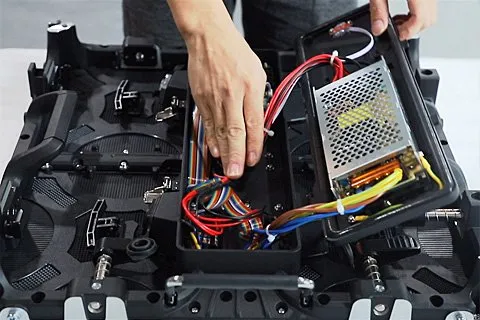
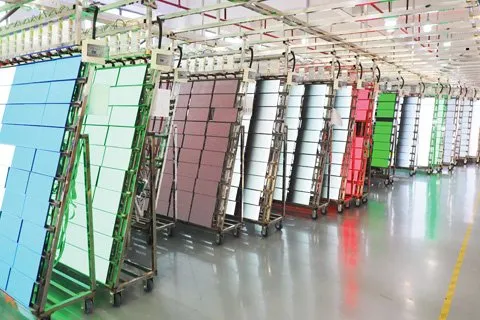
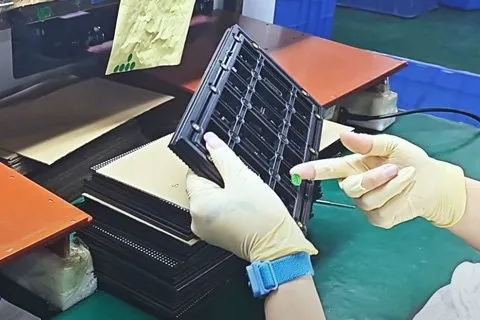
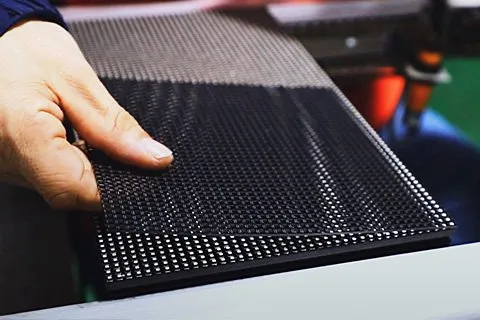
Module-level testing covers dead pixels, brightness and chroma uniformity, and solder quality. Cabinet ageing runs the assembled unit under load, typically for 48 to 72 hours, to force early failures before shipment rather than after installation. Waterproof testing to the relevant IP rating is essential outdoors and for rental stock, and vibration testing matters for anything that ships repeatedly. Each should produce a dated record with a serial number and a measured result.
02 Pre-shipment inspection checklist
Before goods leave, confirm the batch dead-pixel rate, cabinet flatness, edge colour and brightness uniformity, connector integrity, serial-number continuity, and that the spare parts you paid for are in the crate. If you cannot attend, a third-party inspection costs little against re-shipping a defective container.
| Test | Typical benchmark | What it proves |
|---|---|---|
| Dead-pixel inspection | Typically below 0.0001 of total pixels | Lamp and soldering quality |
| Brightness uniformity | Consistency across the panel, not a single peak figure | Bin sorting discipline |
| Colour uniformity | Consistent white balance across modules | Chroma calibration control |
| Cabinet ageing | 48–72 hours under load | Early-life failure removal |
| Flatness measurement | Sub-millimetre across the cabinet | Cabinet machining tolerance |
| Waterproof test | IP54 indoor, IP65/IP66 outdoor and rental | Sealing and gasket integrity |
| Refresh and greyscale test | Stated Hz at low greyscale | Driver IC quality |
| Load and thermal test | Stable temperature under sustained operation | Power-supply and thermal design |
7. Matching the LED Screen Factory to Your Application
The best LED screen factory for your project is the one with production experience in your application category, not the lowest price per square metre. Rental, outdoor and indoor retail screens are engineered against different constraints.
01 Indoor fixed installation and retail
Indoor screens reward fine pixel pitch, colour accuracy and quiet operation. Ask about front-service access, cabinet depth and heat management, because indoor screens often sit in occupied spaces where noise and servicing access become commercial issues.
02 Outdoor advertising
Outdoor screens live or die on brightness headroom, ingress protection and thermal design. Confirm the IP rating of module and cabinet, brightness in nits with its measurement condition, and expected peak power draw, which drives both electricity cost and electrical design.
03 Rental and live events
Rental fleets need speed of assembly, mechanical durability and consistent cabinet geometry across batches. Ask about quick-lock hardware, curvature options, spare-part availability and whether cabinets bought two years apart will still align.
04 Stadium, DOOH and immersive installations
Large-format and immersive projects add structural, viewing-angle and control-system requirements. Look for an LED screen factory with reference projects at comparable scale, and expect to discuss redundancy, signal routing and long-term service contracts.
| Application | Typical pixel pitch | Brightness | Ingress rating | Servicing | Key question for the factory |
|---|---|---|---|---|---|
| Indoor retail and corporate | P1.2 – P2.5 | 600 – 1,200 nits | IP40/IP54 | Front or rear | How is heat and noise managed in enclosed spaces? |
| Indoor advertising | P2.5 – P4 | 1,000 – 1,500 nits | IP40/IP54 | Front | What is the uniform brightness across the full panel? |
| Outdoor advertising | P4 – P10 | 5,000 – 8,000 nits | IP65/IP66 | Rear or front | What is the measured power draw at peak brightness? |
| Rental and events | P2.6 – P4.8 | 3,500 – 6,000 nits | IP65 | Front | Will cabinets from different batches still align? |
| Stadium and perimeter | P6 – P10 | 6,000 – 8,000 nits | IP65/IP66 | Rear | What are the wind-load and structural requirements? |
| DOOH and immersive | P1.5 – P4 | 1,500 – 6,000 nits | Depends on location | Project-specific | Can you supply redundancy and remote monitoring? |
8. Lead Times, MOQ and Customization
Scheduling and minimum order quantities are where an otherwise strong supplier becomes difficult. Agree both in writing before tooling starts.
01 Standard versus custom orders
Standard cabinet sizes in common pixel pitches ship fastest because they follow an existing production schedule. Custom cabinet dimensions, unusual pitches or bespoke finishes add tooling time, and minimum order quantities are set per production run — so ask what the minimum is, whether existing tooling can be reused, and who owns it.
9. Warranty, Spare Parts and After-Sales
A warranty is only as valuable as the supplier's ability to execute it. Two factories can offer the same five-year term and deliver completely different outcomes.
01 What a real warranty covers
A usable warranty names the covered components, the failure thresholds and the remedy. Ask whether it covers dead pixels and at what density, whether power supplies and receiving cards are included, whether replacement freight is shared, and how fast parts ship. Verbal assurances are not a warranty — get it into the purchase contract.
02 Spare parts and serviceability
Order a spare-parts kit with the screen: typically 2–5% of modules plus spare power supplies and receiving cards. Confirm the servicing direction, front or rear access, because it determines labour cost. Also confirm how long the exact module model stays in production — a screen you cannot re-module in five years becomes scrap long before its LED lifespan is spent.
10. Payment, Shipping and Risk When Ordering Overseas
Cross-border purchasing adds financial and logistical risk that has nothing to do with product quality. Structure both deliberately.
01 Payment terms that protect the buyer
The industry norm is a deposit with the balance before shipment, commonly 30/70. That structure is acceptable when the supplier has passed the vetting steps above and the contract fixes specification, delivery date and remedy. Be cautious with requests for 100% upfront or payments to an account in a different name. For larger orders, a letter of credit or a milestone structure tied to inspection protects both sides.
02 Incoterms, freight and customs
Agree the Incoterm explicitly. FOB leaves freight and insurance with you, CIF moves them to the supplier, and DDP places the whole chain on the supplier at a premium. LED cabinets are bulky but light, so you pay for volume rather than weight — packing efficiency directly affects landed cost. Confirm who clears duties and check destination certification before the goods ship.
11. Frequently Asked Questions About Choosing an LED Screen Factory
01 What is the difference between an LED screen factory and an LED display supplier?
An LED screen factory manufactures the product and owns the production line, the bill of materials and the quality-control process. An LED display supplier may be a factory, or it may be a trading company or agent reselling another manufacturer's product. The practical difference is accountability: a factory can change the specification, approve custom tooling and honour a warranty directly, while a reseller must relay all three through a third party.
02 How can I verify that a supplier is a real LED screen factory?
Check three things. Confirm the business licence scope includes manufacturing LED display products. Request an unannounced live video walkthrough of the SMT line, aging racks and warehouse. Ask for the bill of materials with part numbers for the LED lamps, driver ICs, power supply and receiving card. A genuine factory answers all three directly; a reseller usually deflects one of them to a showroom tour or a brand-name-only answer.
03 What certifications should an LED screen factory have?
It depends on the destination market. EU and UK buyers need CE or UKCA marking plus RoHS and REACH. US buyers need FCC emission compliance and often UL or ETL listing on power and control components. Australia and New Zealand require RCM. Beyond mandatory approvals, ISO 9001 signals process discipline. Verify certificate numbers with the issuing body rather than accepting a PDF.
04 How much does an LED screen factory charge per square metre?
There is no single market rate, because price follows pixel pitch, brightness, cabinet material and order volume rather than area alone. The only reliable comparison is a line-item quotation at an identical specification. Treat a quote that undercuts the market by about a third as a signal that the LED lamps, driver ICs or power supplies were downgraded.
05 What is the typical MOQ and lead time for an LED screen factory order?
Minimum order quantities are usually set per production run rather than by policy, so small custom orders often carry tooling charges or a unit premium. Standard cabinets in common pixel pitches ship fastest because they follow an existing schedule. Agree the quantity and the delivery date in the contract, not by chat message.
06 What warranty should I expect from an LED screen factory?
Warranty terms commonly run from two to five years, with longer terms offered on premium outdoor and rental products. What matters more than the number is the coverage: which components are included, what dead-pixel density triggers a claim, whether power supplies and receiving cards are covered, who pays replacement freight, and how quickly parts ship. A warranty that is not written into the purchase contract is difficult to enforce.
07 Is it cheaper to buy directly from an LED screen factory in China?
Usually yes, because a direct LED screen factory removes the trading margin a reseller adds, commonly in the 15–40% range. The saving is conditional: it assumes you specified the product precisely, arranged inspection and accepted responsibility for freight, duties and certification. Buyers who skip those steps often spend the difference on remedial work.
08 What payment terms are safe when ordering from an LED screen factory?
A deposit with the balance before shipment, typically 30/70, is standard practice and reasonable once the supplier has been vetted. Insist that the bank account name matches the company on the invoice and the business licence. For larger contracts, use a letter of credit or tie milestone payments to inspection results. Be cautious with any request for full payment upfront or payment to a personal or third-party account.
09 How should I handle shipping, duties and customs?
Fix the delivery term in writing. FOB makes you responsible for freight and insurance from the port, CIF adds them to the supplier's scope, and DDP places the whole chain on the supplier at a higher price. LED cabinets are bulky and comparatively light, so you pay for volume — packing efficiency has a direct effect on landed cost. Confirm who clears duties and verify the destination market's certification requirements before shipment, not after arrival.
10 Can an LED screen factory customize pixel pitch, cabinet size and shape?
Yes, within the limits of its tooling and production capability. Common customizations include non-standard cabinet dimensions, curved or right-angle cabinets, higher brightness for high-ambient-light locations, and integrated mounting or branding. Custom work adds engineering and tooling time and usually raises the minimum order quantity, so confirm who owns the tooling and whether replacement cabinets will still match the original batch in future.
12. Conclusion: Your LED Screen Factory Decision Checklist
Work through this list before you commit, and require written answers:
- Business licence, invoice and bank account name all match the same legal entity.
- An unannounced live video tour of the SMT line, aging racks and warehouse has been granted.
- The bill of materials names the LED lamp brand and bin, driver IC, power supply and receiving card.
- Certifications are valid for your destination market and verified with the issuing body.
- Aging, dead-pixel, brightness and flatness data have been supplied for a comparable order.
- The quotation is itemised, and a five-year total cost of ownership has been modelled.
- Warranty terms, spare parts and the RMA procedure are written into the contract.
- MOQ, lead time, Incoterm and payment milestones are agreed in writing.
- A pre-shipment inspection is booked and paid for.
EagerLED has manufactured LED display screens for indoor, outdoor and rental applications since 2012, and works directly with integrators and buyers on specification, customisation and after-sales support. If you would like a line-item quotation on a defined specification, send us your project requirements and we will come back with the bill of materials, not just a price.
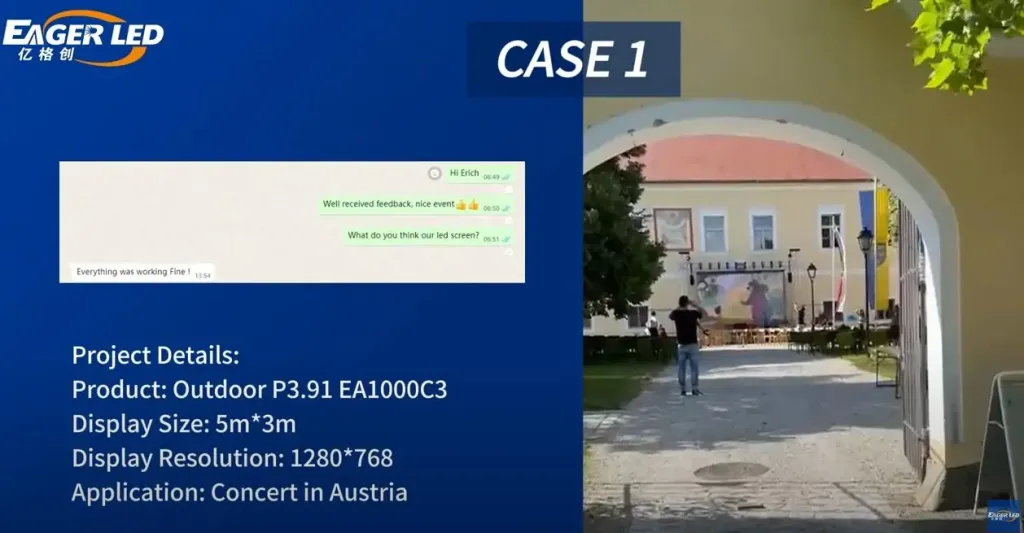 EagerLED European Customer Feedback Video Case Collection
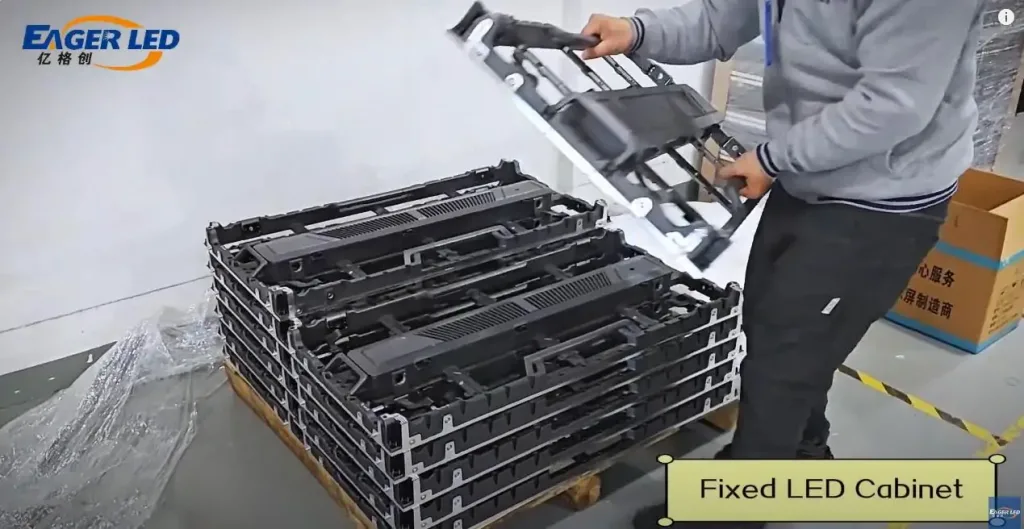 How to Assemble EA1000C6 Rental LED Screen?
Related Posts
Fill In Your Needs In Detail
Fill in the screen usage scene and size you need in “Content”.You will get a quote.