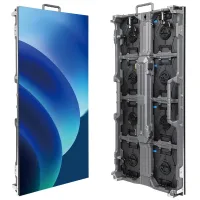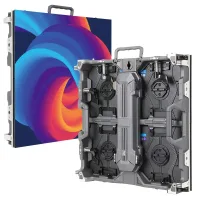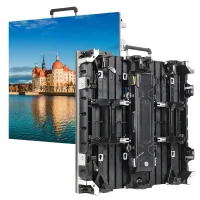
For most bright, camera-driven sanctuaries that want a permanent stage display, a church LED wall is the better long-term system. A projector is usually the better value when the room can be darkened, the initial budget is limited, or the display needs to disappear between services. The right choice is not determined by resolution alone. Ambient light, nearest viewing distance, screen size, camera use, structural support, maintenance access, and five-year operating cost matter more.
This church LED wall vs projector guide compares both systems using the conditions a worship team actually works with each week. It also provides a decision process that a church board, technical director, or AV integrator can use before requesting quotations.
1. How LED Walls and Projectors Create Images
An LED wall and a projector solve the same communication problem in different ways.
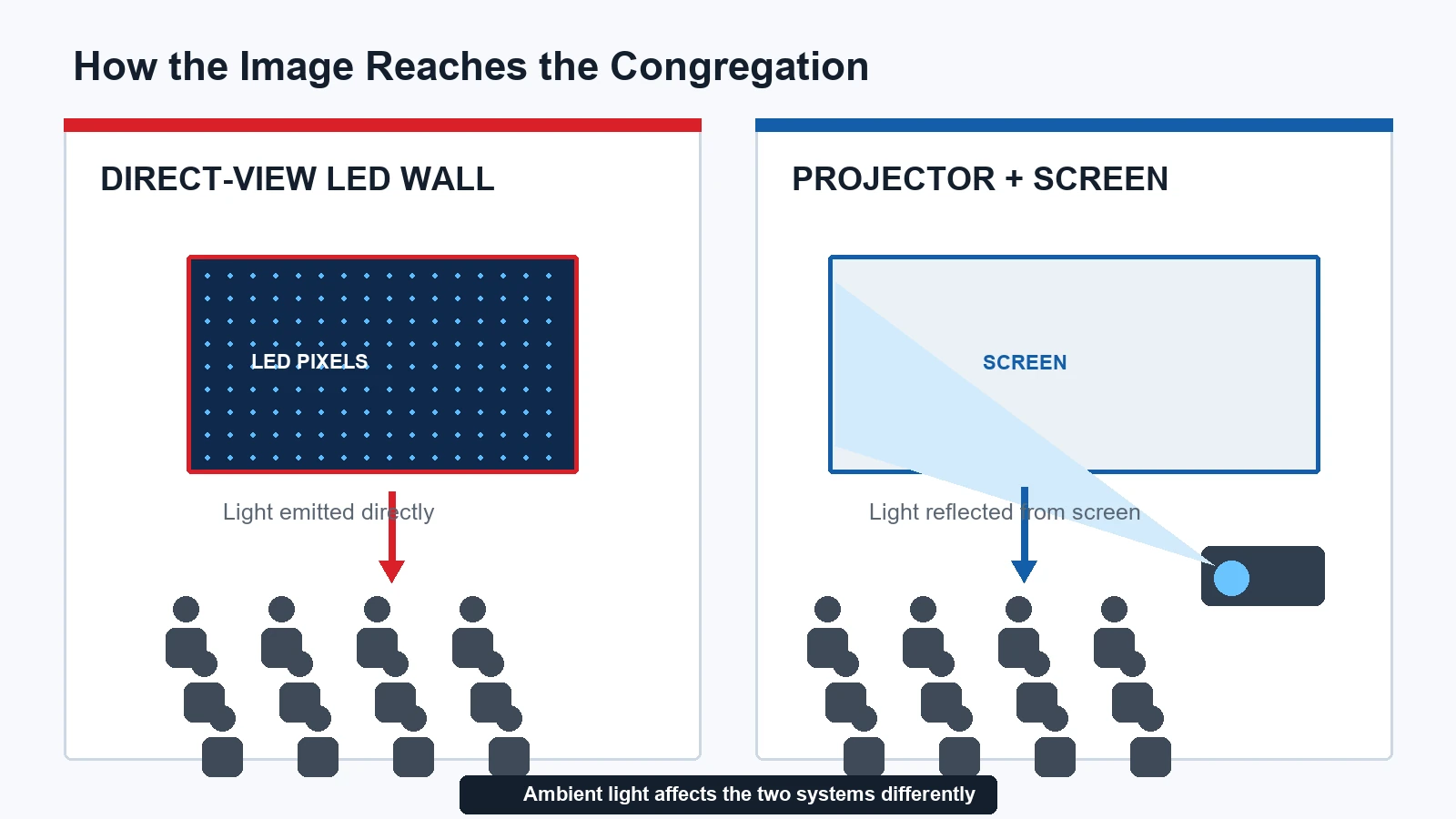
An LED wall is an emissive display. Each LED pixel produces light directly toward the congregation. The screen therefore does not need a projection surface, a throw path, or a dark room to form an image.
A projector is a reflective display system. It sends light across the room to a screen, and the congregation sees the light reflected from that surface. Image quality depends on the projector, lens, throw distance, screen material, room light, and viewing angle working together.
This difference explains most of the practical trade-offs. Direct-view LED usually retains stronger contrast under stage lighting and window light. Projection can create a large image with a lower initial equipment cost, but ambient light falling on the screen reduces apparent contrast.
Projector brightness and LED brightness also use different units. Projectors are normally specified in lumens, while direct-view LED displays are specified in nits, or candelas per square meter. BenQ’s explanation of ISO 21118 projector brightness measurement notes that projector output is measured from a nine-zone average. A lumen value and a nit value should not be converted directly without accounting for image area, screen gain, optics, and room conditions.
2. Church LED Wall vs Projector Comparison
The following table summarizes the decision. Treat it as a screening tool, then verify the final choice with an on-site demonstration.
| Factor | Church LED Wall | Church Projector | Better Choice When |
|---|---|---|---|
| Ambient light | Maintains stronger perceived contrast in bright rooms | Performs best when light on the screen is controlled | LED for windows and bright stage lighting |
| Initial equipment cost | Usually higher | Usually lower for a comparable large image | Projector for limited capital budgets |
| Screen size | Modular and customizable | Determined by lens, throw distance, brightness, and screen | Depends on architecture |
| Shadows and blocked light | No projection beam | People or scenery can interrupt the beam | LED for active stages |
| Viewing angle | Typically wide | Depends on screen material and gain | LED for wide seating layouts |
| Camera use | Strong option when refresh rate, scan mode, processor, and camera are matched | Can work well, but the projected image may appear less vivid on camera | LED for frequent IMAG and streaming |
| Service | Individual modules, power supplies, and receiving cards can be replaced | Projector, lens, filter, light source, and alignment require service | Depends on local technical support |
| Visual flexibility | Permanent rectangular canvas unless physically reconfigured | Can be retractable and supports projection mapping | Projector for changing scenic designs |
| Structural needs | Requires engineered support and safe service access | Requires secure rigging plus a screen | Projector where wall loading is restricted |
| Long-term planning | Higher capital cost with modular serviceability | Lower entry cost; maintenance depends on model and environment | Compare five-year total cost |
3. When Is an LED Wall Better for a Church?
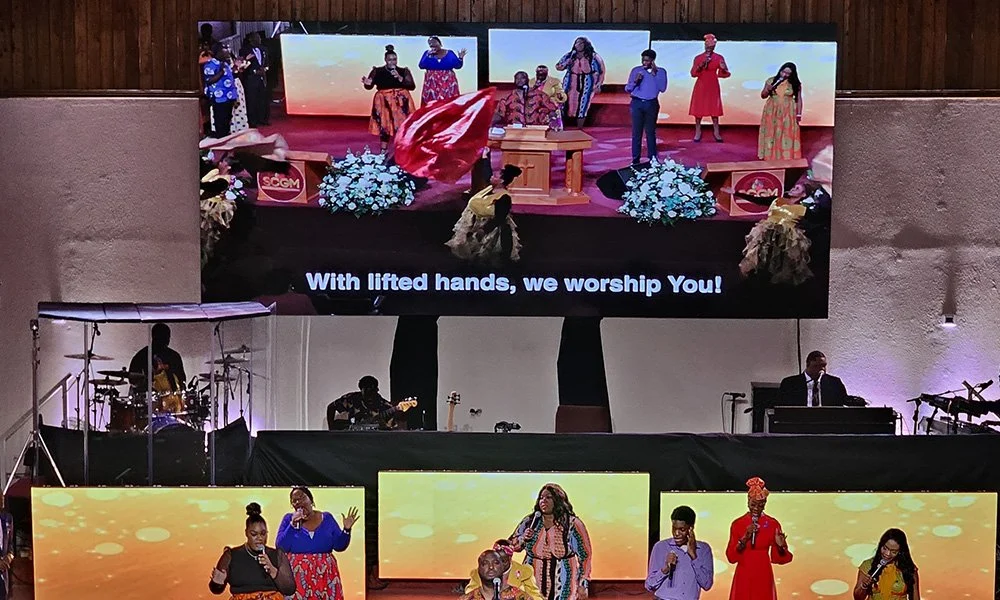
An LED wall is usually the stronger choice when the sanctuary has uncontrolled light, the display is part of the permanent stage design, or cameras regularly capture the screen.
3.1. The room cannot be darkened during worship
Sunlight from windows, house lighting, and stage fixtures all add light to a projection screen. A brighter projector can help, but it cannot stop ambient light from raising the black level on the screen. Because LED pixels emit their own light, an LED wall normally produces a more readable image in the same bright environment.
This advantage matters for lyrics, Bible verses, sermon points, and announcements. Text needs stable contrast across every seat, not only an impressive demo image viewed from the center aisle.
3.2. The church uses IMAG or livestreaming every week
For image magnification, the main display may appear in the background of camera shots for much of the service. A properly configured LED wall can create a vivid, consistent background, but the system must be selected for camera compatibility.
Ask suppliers to demonstrate the exact cabinet, receiving card, processor, and content workflow with the church’s cameras. Test common shutter speeds and frame rates. Many broadcast-oriented church projects request a refresh rate of 3,840 Hz or higher, but refresh rate alone does not prevent every artifact. Scan mode, PWM behavior, camera distance, pixel pitch, brightness setting, and shutter angle can still produce banding or moire.
3.3. The nearest viewer is far enough from the pixels
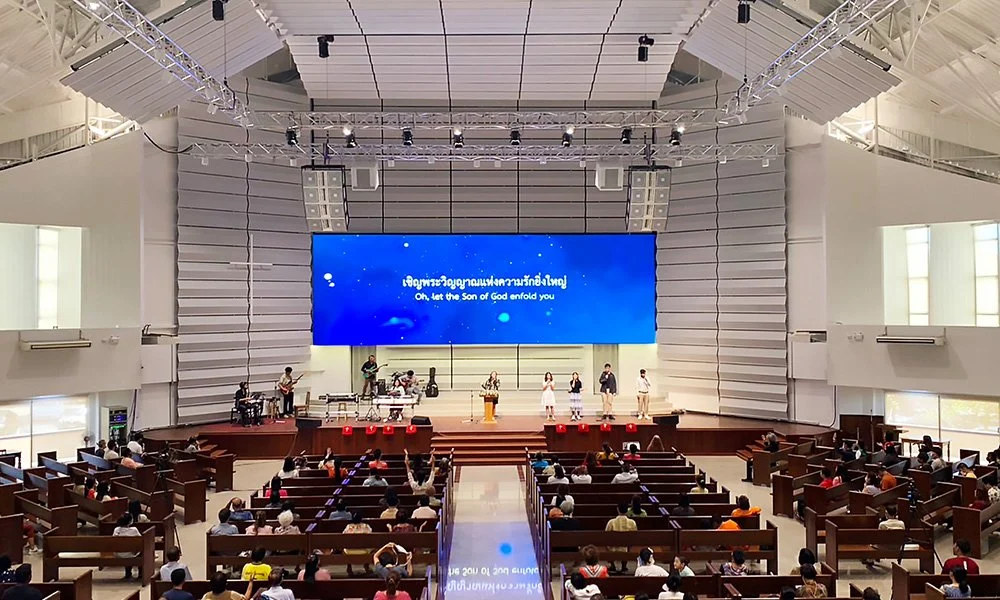
Pixel pitch is the center-to-center distance between adjacent LED pixels, measured in millimeters. A smaller pitch produces higher pixel density and usually costs more.
As an initial screening rule, a P2.5 display is often evaluated from about 2.5 meters or farther, while a P1.8 display can support a closer front row. This is not a universal guarantee. Text size, visual acuity, content resolution, camera distance, and product design change the result, so the final pixel pitch should be confirmed with real content at the actual viewing distance.
EagerLED’s indoor LED screen overview lists fine-pitch options including P1.25, P1.53, P1.86, P2, and P3. A church should not automatically buy the smallest pitch. It should buy the coarsest pitch that still looks clean from the nearest important viewing and camera positions.
3.4. The church wants modular repair
An LED wall is assembled from cabinets and modules. If a component fails, a trained technician can often replace the affected module, power supply, receiving card, or cable instead of replacing the complete display.
This benefit depends on the installation design. A front-service wall needs enough clearance and the correct magnetic or locking system. A rear-service wall needs a safe service corridor. Spare modules should come from the same production batch because later batches can differ slightly in color and brightness.
4. When Is a Projector Better for a Church?
A projector remains a sensible church display when the environment supports projection and the church values flexibility or lower initial cost more than high ambient-light performance.
4.1. The sanctuary can control light at the screen
Projection can look excellent when direct light is kept off the screen. A dark wall zone, carefully aimed stage lights, window shades, and a suitable screen surface can preserve contrast without requiring an LED wall.
Do not select projector brightness from the lumen label alone. Screen width, aspect ratio, throw distance, lens efficiency, screen gain, ambient light, and desired image brightness must be calculated as a system. Compare projectors using a recognized measurement such as ISO lumens rather than unstandardized marketing brightness.
4.2. The display should disappear
A motorized projection screen can retract when it is not needed. This may be important in historic sanctuaries, traditional worship spaces, multipurpose rooms, or buildings where a permanent black rectangle would conflict with the architecture.
Projection also supports scenery that extends beyond one rectangular canvas. In a 2026 Church Production Magazine article, Justin Firesheets wrote that “technology decisions should serve the mission, not just the aesthetic”. Projection mapping and multiple surfaces can be the right creative system when flexibility is part of the ministry plan.
4.3. The church needs a lower entry cost
A projector and screen generally require less initial capital than a comparable fine-pitch LED wall. That does not mean the cheapest projector is suitable. A large sanctuary may also need a high-brightness projector, a specialist lens, rigging, long-distance signal transport, a screen, and light-control improvements.
Modern laser projectors have also reduced routine light-source maintenance. Epson states that its laser projector range can provide up to 20,000 hours of virtually maintenance-free projection, with the exact rating and operating conditions varying by model. Churches should compare the manufacturer’s definition of service life, brightness decline, filter requirements, warranty, and replacement cost rather than assuming every projector uses a short-life lamp.
5. Eight Factors to Compare Before Buying
5.1. Ambient light at the screen
Measure light during a normal service, not in an empty sanctuary with all fixtures turned off. Check morning sunlight, house lights, stage wash, and seasonal changes. If the church cannot keep light off the display surface, LED gains a major advantage.
5.2. Nearest and farthest viewing distances
The nearest seat influences LED pixel pitch. The farthest seat influences screen height and text size. A technically sharp image can still fail if song lyrics are too small for the back row.
For planning, test actual slides with the longest expected lyric lines. Keep type large, use strong contrast, and avoid placing critical words at the outer edges of the display.
5.3. Camera positions and production workflow
Bring the church’s cameras to the product demonstration. Record wide shots, close shots, and moving shots. Test sermon slides, white text on black, saturated colors, gradients, and live video.
For LED, look for scan lines, flicker, moire, color shift, and clipped highlights. For projection, look for washed blacks, hot spots, brightness falloff, and color differences between the screen and the stage.
5.4. Content type
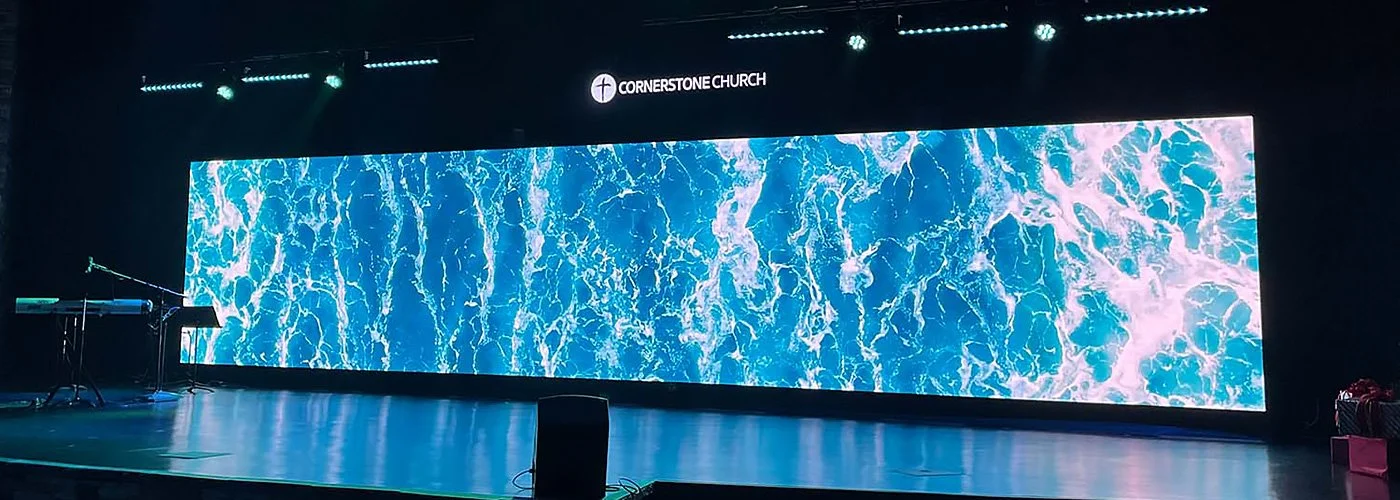
Lyrics and sermon notes reward contrast and text clarity. IMAG rewards camera-friendly processing and natural skin tones. Scenic motion graphics reward brightness, color, and smooth low-gray performance. A projector may be sufficient for occasional slides, while a weekly multi-camera production can justify a stronger direct-view system. Churches can also review how an LED screen on stage supports worship content and production workflows.
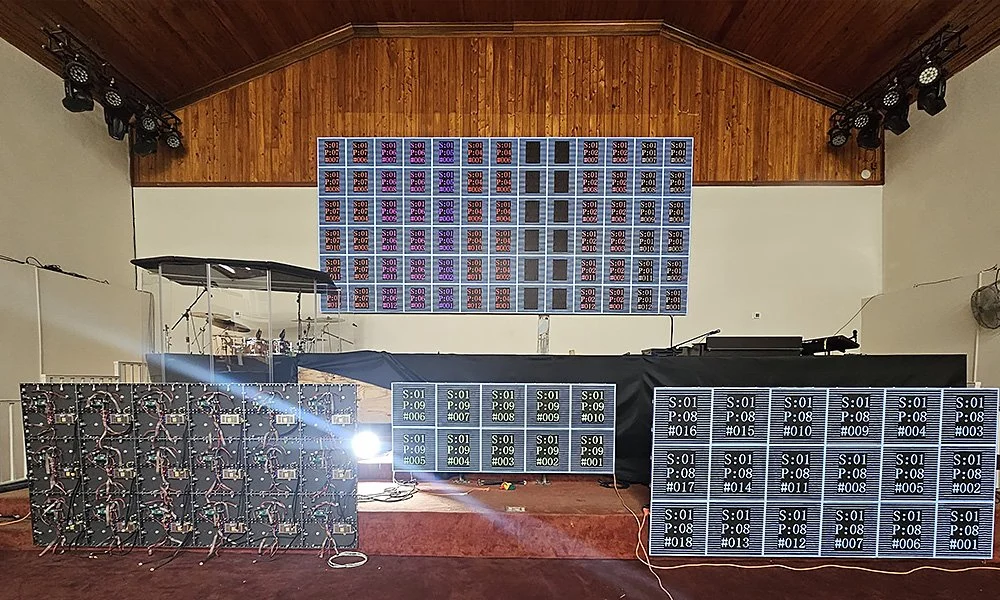
5.5. Structure, rigging, and service access
An LED wall places concentrated weight on a wall, frame, or ground-support system. A qualified structural professional should confirm the support design, anchors, access, and safety factors. Electrical circuits, heat management, data paths, fire-code requirements, and emergency egress must also be addressed.
A projector needs safe rigging, the correct lens position, a clear beam path, and access for cleaning or service. A projection screen must be flat, correctly tensioned where required, and protected from direct stage light. See EagerLED’s indoor LED display installation tutorial for an example of installation planning.
5.6. Redundancy and failure behavior
Ask what the congregation will see when one component fails. An LED wall can be designed with backup power or signal paths, but not every quotation includes them. A projector system can use a backup projector or an alternate confidence display, but the switching workflow must be rehearsed.
Specify critical spares, signal backup, processor configuration files, and a recovery procedure before installation. A system is not resilient merely because replacement parts exist somewhere in the supply chain.
5.7. Maintenance capability
Identify who will clean, inspect, update, and troubleshoot the display. Volunteers need a documented startup and shutdown procedure. Technical leaders need training, spare-part records, cable maps, processor backups, and supplier contact details.
For LED walls, budget for spare modules, power supplies, receiving cards, and calibration support. For projectors, check filters, lenses, alignment, cooling paths, and the stated light-source maintenance schedule.
5.8. A five-year ministry plan
Consider how the system will be used beyond Sunday morning. Funerals, conferences, youth events, concerts, community meetings, overflow rooms, and livestream production can change the value calculation.
If the display will operate frequently and remain central to the room, a higher initial investment may be justified. If it will be used occasionally or the sanctuary may be renovated soon, a flexible projection system may preserve capital.
6. Upfront Cost vs Five-Year Total Cost
Do not compare only the LED cabinet price with the projector chassis price. Request complete, installed quotations with the same scope.
6.1. Church LED wall cost should include
- LED cabinets or panels
- Mounting frame or ground support
- Structural engineering where required
- Video processor and receiving system
- Power distribution and data cabling
- Installation, calibration, and commissioning
- Front or rear service access
- Spare modules, power supplies, receiving cards, and cables
- Training, warranty, and planned technical support
- Content computer, switcher, scaler, or format conversion if required
6.2. Church projector cost should include
- Projector chassis
- Correct lens for the throw distance and image size
- Projection screen and mounting
- Rigging and service access
- Signal transport and switching
- Window treatment or lighting changes where required
- Alignment, calibration, filters, and cleaning
- Light-source or lamp provisions based on the selected model
- Backup plan for a projector or signal failure
Use this formula for each option:
Five-year total cost = purchase + engineering + installation + supporting equipment + energy + planned maintenance + expected replacement parts + service support.
Obtain measured or manufacturer-rated power data for the proposed operating brightness and expected weekly hours. Do not assume that either technology always uses less electricity; screen size, brightness setting, content, projector class, and operating schedule can reverse the comparison.
7. Three Church Scenarios
7.1. Bright 600-seat sanctuary with weekly livestreaming
The room has windows, strong stage lighting, a wide seating plan, and three broadcast cameras. Lyrics, sermon content, and IMAG appear on the main display throughout every service.
Recommended direction: LED wall. Prioritize a camera test, suitable pixel pitch for the front row, redundant signal design, front-service access, and an engineered support structure. The ambient-light and production benefits are likely to justify the higher initial investment.
7.2. Dark 180-seat sanctuary with simple presentation needs
The church uses lyrics, scripture, and occasional video. It can keep direct light off the screen, does not use IMAG, and has a limited capital budget.
Recommended direction: laser projector. Specify the screen size, lens, ISO-lumen output, and lighting conditions together. Spend part of the saved capital on a proper screen, reliable signal transport, and operator training.
7.3. Historic or multipurpose worship space
The room must preserve architectural character and regularly changes between worship, concerts, classes, and community events. Permanent wall loading or a fixed black screen is undesirable.
Recommended direction: retractable projection or a carefully designed hybrid system. Flexibility may create more ministry value than maximum brightness. If some events require high-impact visuals, consider a movable LED system only after reviewing storage, transport, setup time, and safety.
8. How to Make the Final Decision
Use the following six-step process before approving a purchase.
- Document the room. Record dimensions, seating layout, screen location, window orientation, stage lighting, rigging points, power, and cable paths.
- Define the content. List the percentage of time used for lyrics, sermon slides, IMAG, video, scenic graphics, and special events.
- Set performance tests. Include front-row pixel visibility, back-row text readability, ambient-light contrast, camera artifacts, color, latency, and failure recovery.
- Request equal-scope quotations. Give LED and projection suppliers the same screen size, operating schedule, installation scope, training requirement, warranty expectation, and five-year period.
- Run an on-site demonstration. Use the church’s content, cameras, lighting, and operators whenever possible. A showroom demo cannot reproduce the sanctuary by itself.
- Score the decision. Weight image performance, capital cost, five-year cost, aesthetics, serviceability, flexibility, and risk according to the church’s ministry priorities.
EagerLED’s church LED screen buying guide provides additional selection criteria for pixel pitch, size, installation access, control systems, and project cost. Churches considering a permanent direct-view system can use it to prepare a more complete request for quotation.
9. Common Mistakes to Avoid
9.1. Choosing from a specification sheet alone
Brightness, contrast, refresh rate, and resolution do not describe the complete room. Insist on a demonstration or mock-up with real content and cameras.
9.2. Buying the smallest LED pixel pitch available
A finer pitch raises pixel density and cost, but it may create little visible improvement beyond the nearest viewing distance. Allocate budget to processing, structure, spares, and support instead of overspecifying pitch.
9.3. Comparing incomplete prices
A projector quote without its lens and screen is not comparable to an installed LED quotation. An LED panel price without structure, processor, power distribution, installation, and spares is also incomplete.
9.4. Ignoring service access
A beautiful wall that cannot be safely serviced will create expensive downtime. Confirm how every module, cable, filter, lens, power supply, and controller can be reached after installation.
9.5. Treating the display as an isolated purchase
The display must work with cameras, presentation software, switchers, cabling, audio-video sync, stage lighting, and volunteer workflows. Plan and test the complete signal chain.
10. FAQs
11. Conclusion
In a church LED wall vs projector decision, LED is usually better for bright rooms, permanent installations, wide seating layouts, and camera-heavy worship production. Projection is usually better for controlled-light rooms, lower initial budgets, retractable displays, and flexible scenic applications. Neither technology wins every sanctuary.
The safest decision is based on the room, content, cameras, service plan, and five-year cost. Document those requirements, compare equal-scope quotations, and test the proposed system in conditions that match a normal service. That process protects the budget and gives the congregation a display that remains readable and reliable after the installation-day excitement is over.
 How to Choose a Church LED Screen: Complete Guide
 How to Choose an LED Screen for a Small Church?
Related Posts
Fill In Your Needs In Detail
Fill in the screen usage scene and size you need in “Content”.You will get a quote.