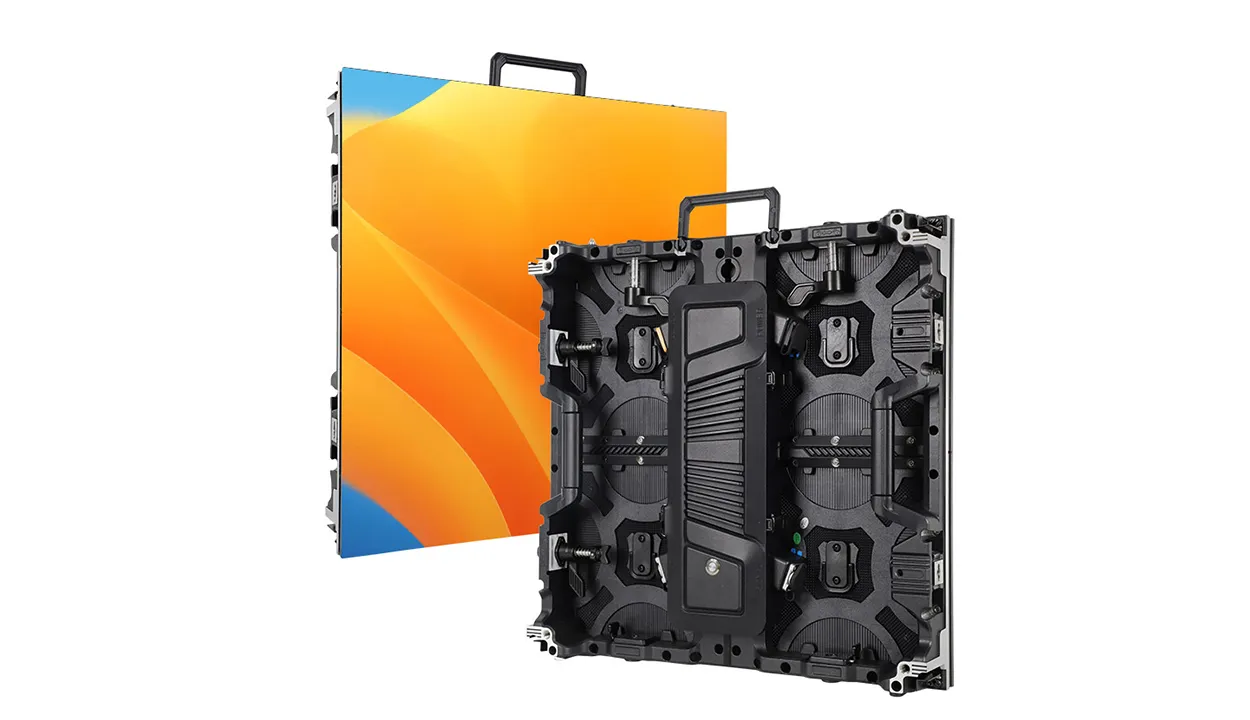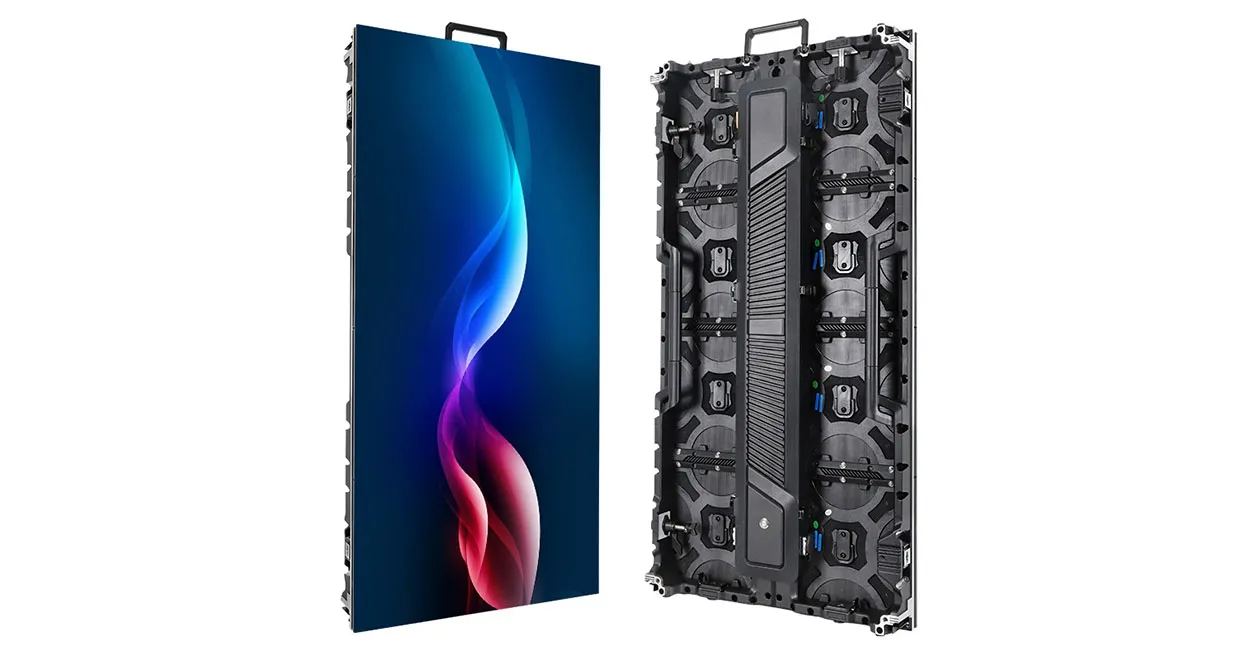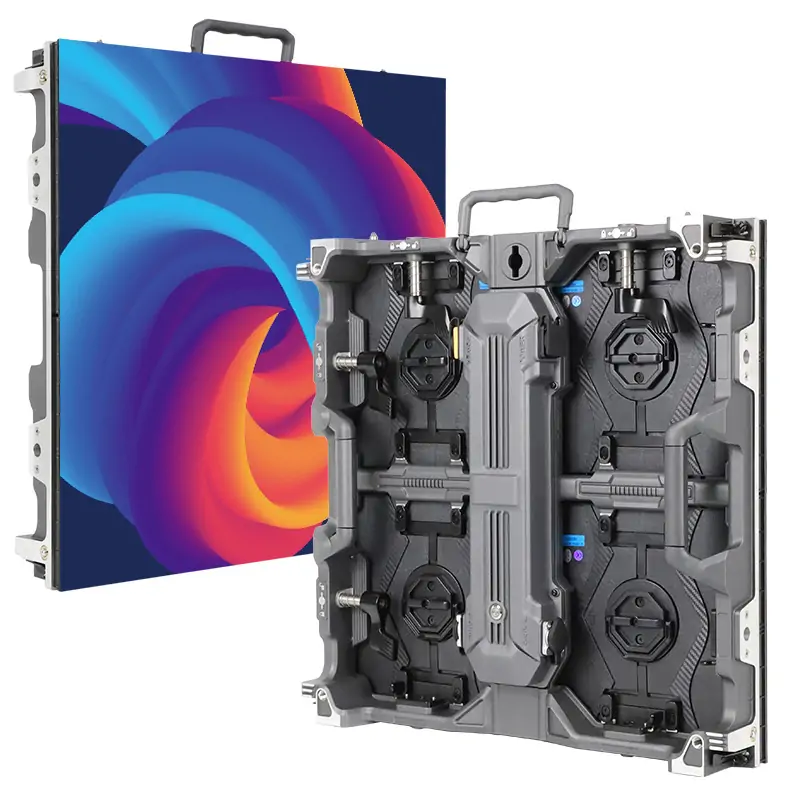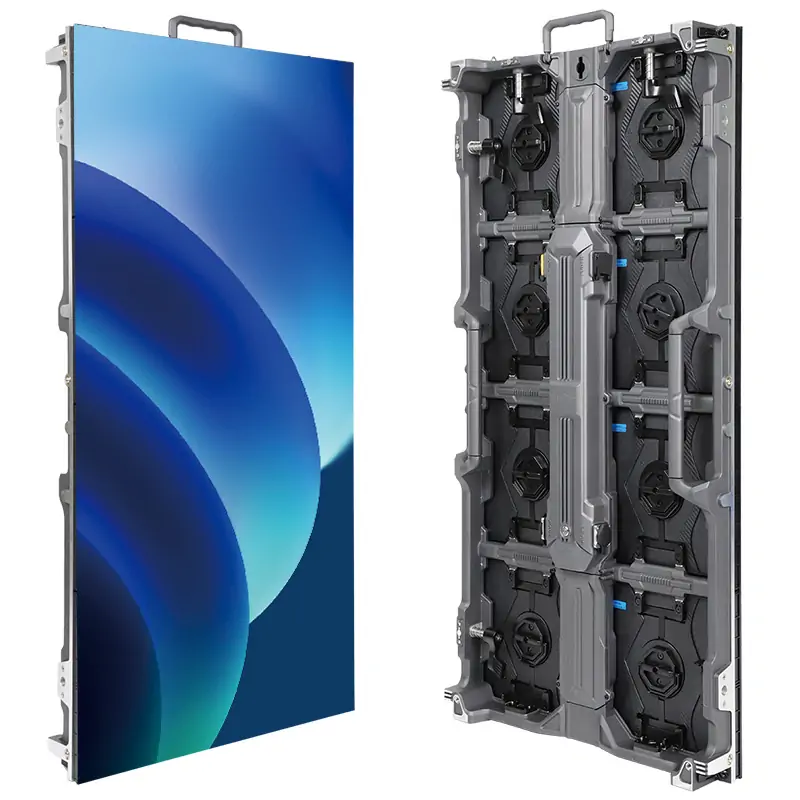
Football perimeter LED screens are modular digital advertising displays installed around a football pitch. They let venues rotate sponsor messages, schedule campaigns, and present coordinated content along the touchlines and behind the goals. For professional buyers, their value depends on how reliably they perform for spectators, broadcast cameras, and matchday operators.
Choosing a system involves more than comparing pixel pitch and price per square metre. A display can look bright during a factory demonstration yet produce distracting patterns on camera. A cabinet can suit outdoor installation but leave insufficient space for maintenance. These differences matter to distributors, AV integrators, and contractors responsible for delivering an operational venue system.
A useful specification connects each requirement to a practical outcome: readable advertising, predictable camera performance, suitable player protection, manageable electrical demand, and efficient servicing. It also defines how the buyer will verify those outcomes before shipment and after installation.
This guide explains how to specify football perimeter LED screens, compare installation options, evaluate costs, and prepare a clear purchasing brief for EagerLED or another shortlisted manufacturer.
1. What Are Football Perimeter LED Screens?
Football perimeter LED screens combine multiple LED cabinets into long advertising surfaces around the playing area. A complete installation includes display modules, cabinet supports, power distribution, signal connections, processing equipment, and content playback controls.
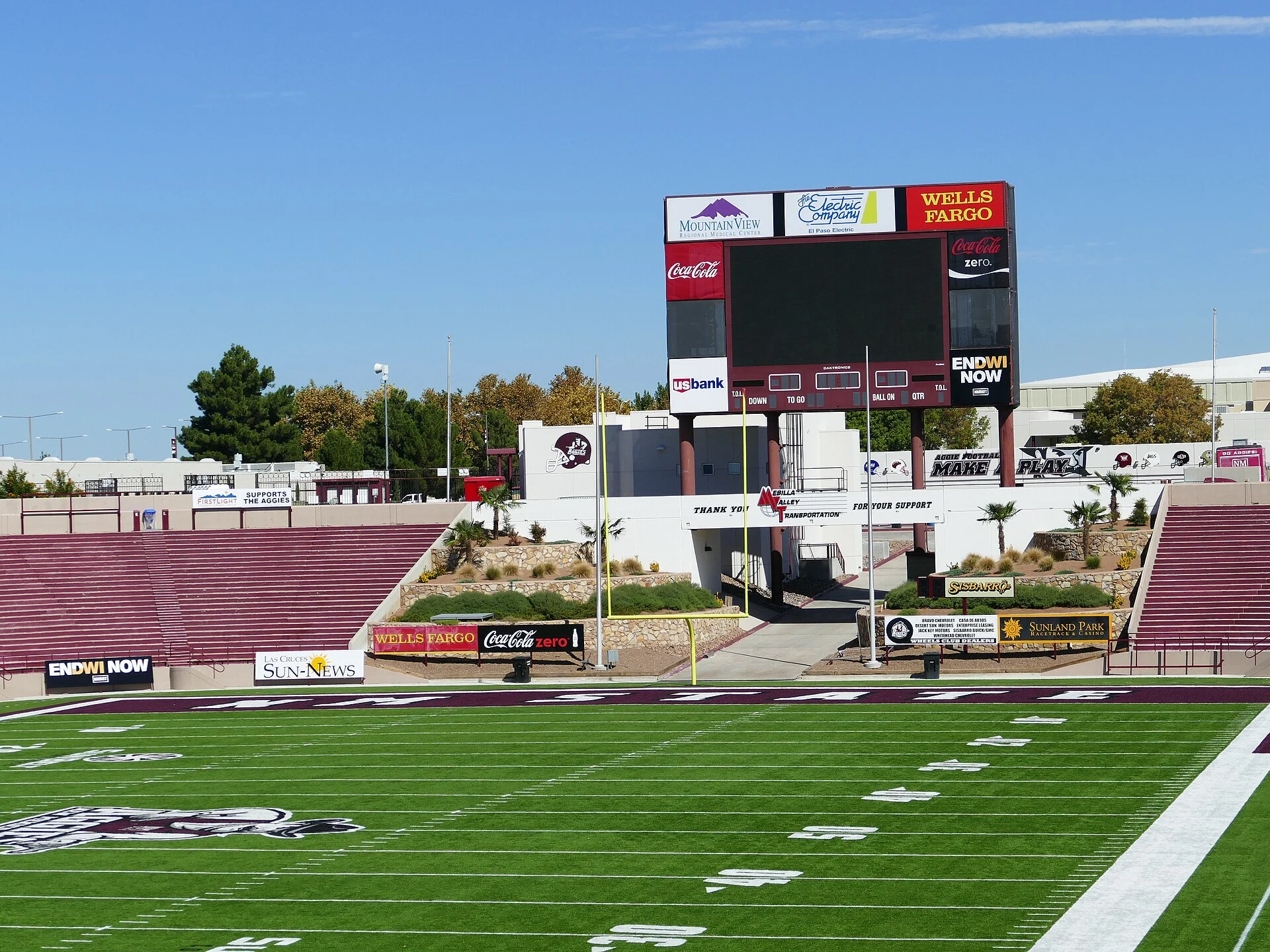
Unlike a stadium scoreboard, a perimeter LED display normally uses a wide, shallow canvas. Artwork must remain understandable within that limited height and from oblique viewing angles. A sponsor logo that works on a large video wall may need a different layout for pitchside advertising.
01. Define the venue’s actual operating requirements
Begin with a site plan showing the proposed display route, camera positions, access openings, drainage, and available electrical supplies. Confirm whether the installation must remain in place throughout the season or move between events.
The project brief should identify who operates the football perimeter LED screens and who approves their output. Those parties may include the venue, advertising rights holder, broadcaster, event organiser, and installation contractor.
Competition requirements also need separate verification. For example, UEFA’s 2026/27 Champions League regulations require relevant LED advertising systems and controllers to meet technical specifications communicated by UEFA. A general claim of “stadium suitability” therefore does not establish acceptance for a particular competition. Source: UEFA Champions League regulations, Article 74.
Treat the screen, supporting infrastructure, and operating workflow as one procurement package. Otherwise, gaps between suppliers can become the integrator’s responsibility during commissioning.
For a broader comparison of venue display types, see our guide to stadium screens.
2. Pixel Pitch, Resolution, and Viewing Distance Explained
Pixel pitch is the distance between adjacent pixel centres, expressed in millimetres. A smaller pitch places more pixels within the same display area, allowing finer detail when the content and viewing conditions justify it.
For football perimeter LED screens, the selection should account for nearby spectators, distant seating, and camera framing. There is no universally correct pitch for every stadium.
01. Calculate the usable advertising canvas
The basic relationship is:
Pixels across a dimension = dimension in millimetres ÷ pixel pitch
As a hypothetical example, a 960 mm-wide active display area using an exact 10 mm pitch contains 96 pixels across. Actual cabinet resolution must come from the manufacturer’s module arrangement; rounded product labels should not replace confirmed pixel counts.
Screen height deserves particular attention. A long advertising strip can contain many horizontal pixels while offering limited vertical detail. Thin lettering, small legal text, and complicated sponsor artwork may remain difficult to read.
| Specification item | What to request | Why it matters |
|---|---|---|
| Exact pixel pitch | Confirmed pitch for the quoted configuration | Establishes physical pixel spacing |
| Cabinet resolution | Horizontal and vertical pixel counts | Enables accurate content mapping |
| Active display dimensions | Illuminated width and height | Separates image area from cabinet size |
| Complete canvas | Pixel dimensions for each screen section | Guides playback and artwork preparation |
| Viewing geometry | Seating distances and camera sightlines | Tests whether detail is useful |
| Representative artwork | Sponsor logos at intended output size | Reveals practical readability limits |
02. Balance detail against project complexity
A finer-pitch perimeter LED display increases pixel count for a given area. It can therefore increase processing requirements and may increase purchase cost, depending on the product architecture.
However, finer pitch alone does not guarantee better broadcast images. Lens choice, camera distance, focus, LED structure, and image processing also influence the result.
Ask suppliers to demonstrate representative artwork at the intended display height. Evaluate it from relevant spectator positions and through the proposed camera setup. This provides a stronger basis for selection than a simple “viewing distance equals pitch” rule.
3. Brightness, Refresh Rate, and Broadcast Performance
Football perimeter LED screens must remain legible in daylight and behave appropriately under floodlights. These are different operating conditions, so both maximum output and controlled dimming belong in the specification.
01. Specify usable brightness
LED display luminance is commonly stated in cd/m², also called nits. A maximum brightness value indicates available output, but buyers should also ask about uniformity, calibration, and image quality at reduced brightness.
An excessively bright pitchside screen can dominate the camera image. At lower settings, weak grayscale performance may cause dark gradients to lose detail or colours to shift.
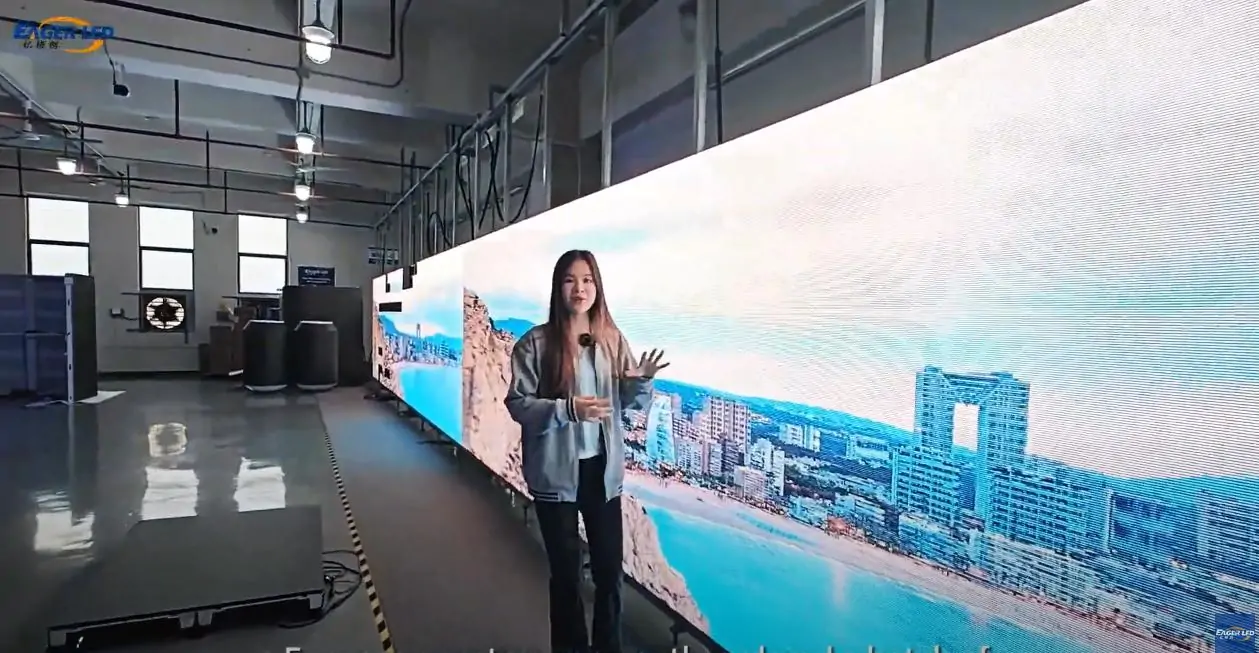
For a model-specific example, EagerLED lists 6,000 cd/m² brightness and a 3,840 Hz refresh rate for its EA960SP4 stadium display, alongside adjustable supports and protective features. These are published product parameters, not universal requirements for every venue or configuration. Confirm the current quotation and technical documentation. Source: EagerLED EA960SP4 product page.
02. Separate refresh rate from video frame rate
Video frame rate describes how frequently new image frames arrive. LED refresh rate describes aspects of how the display’s driving system repeats its light output. The two figures are not interchangeable.
Camera performance also depends on shutter timing, scan behaviour, driver settings, and synchronisation. Brompton’s technical documentation explains how matching LED timing to camera exposure can reduce scan-related artefacts, illustrating why a headline refresh rate cannot establish compatibility by itself. Such functions depend on the selected processing ecosystem. Source: Brompton ShutterSync documentation.
| Performance check | Suggested demonstration | Buyer’s acceptance focus |
|---|---|---|
| Daylight readability | Sponsor artwork in representative ambient light | Clear recognition at intended distances |
| Reduced-brightness output | Gradients and dark colours at match settings | Stable detail and colour |
| Camera compatibility | Intended frame rates and shutter settings | Acceptable banding and flicker performance |
| Cabinet consistency | Solid colours across adjacent cabinets | No distracting visible differences |
| Motion handling | Actual campaign animations and transitions | Clean, consistent playback |
| Angled visibility | View from relevant camera and seating positions | Acceptable brightness and colour changes |
03. Include moiré in the camera assessment
Moiré is a spatial interference pattern involving the LED pixel structure and camera imaging system. It differs from timing-related banding. Increasing refresh rate will not necessarily remove it.
Evaluate football perimeter LED screens using realistic lenses, framing, camera positions, and operating brightness. UEFA’s stadium lighting guidance likewise calls for assessment on installation and testing before broadcast events, with attention to camera balance and exposure. Source: UEFA Stadium Lighting Guide.
4. Player Safety, Weather Resistance, and Cabinet Design
Pitchside equipment operates near players, officials, photographers, and maintenance teams. Football perimeter LED screens need mechanical design appropriate to that environment.
01. Assess the complete installed assembly
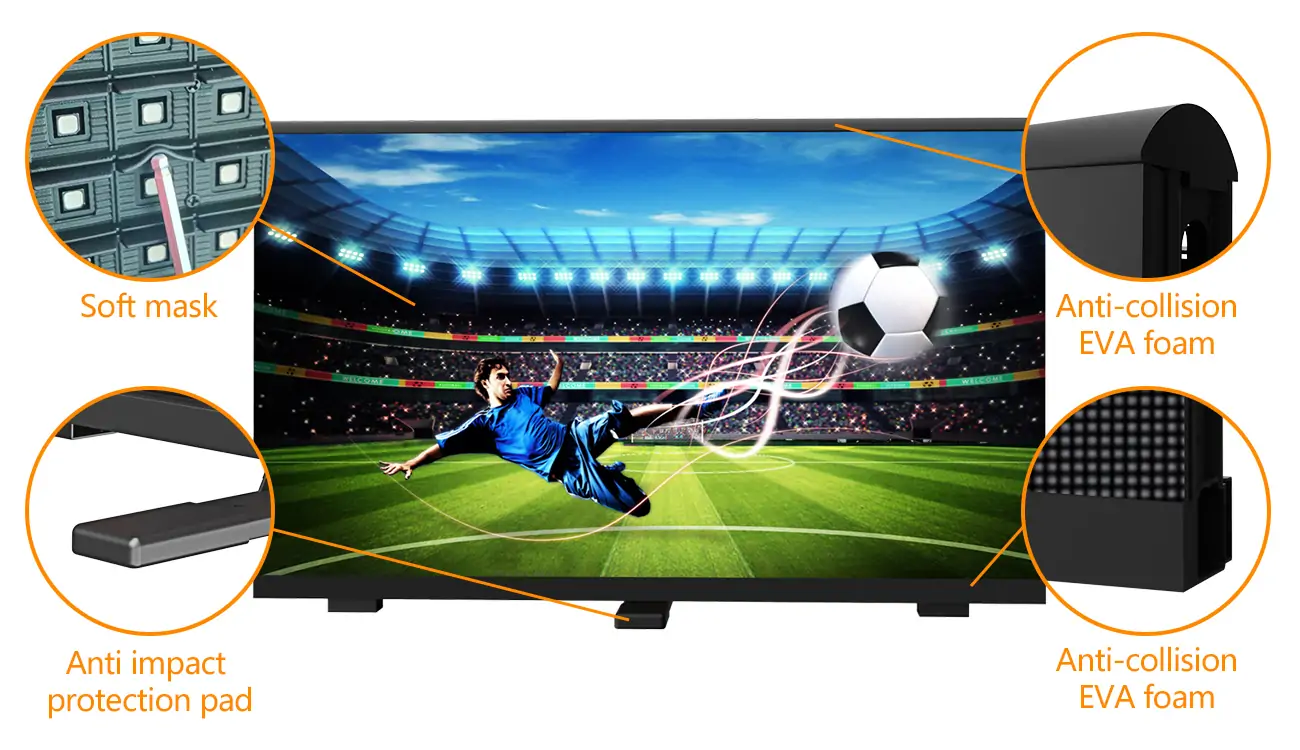
Soft masks and padded upper edges can reduce exposure to hard surfaces, but they do not establish the safety of the entire installation. Inspect supports, rear projections, corner transitions, cable routes, and cabinet connections.
Ask how the system resists movement and how support angles are locked. The installation design should address local wind conditions, ground characteristics, and venue-approved anchoring or ballast arrangements.
A cabinet’s adjustable bracket is not a substitute for an assessment of the assembled structure.
02. Understand what an IP rating covers
Ingress protection ratings classify enclosure protection under defined conditions. They do not, by themselves, establish corrosion resistance, UV durability, or suitability for standing water. The relevant enclosure classification framework is IEC 60529. Source: IEC 60529.
For outdoor perimeter LED displays, confirm whether the stated protection applies to the front, rear, connectors, and complete cabinet assembly. The rating may depend on correctly closed doors, installed seals, and fully mated connectors.
| Design area | Evidence to request | Site issue to resolve |
|---|---|---|
| Protective surfaces | Mask and padding details | Exposed hard edges and damaged covers |
| Support system | Drawings and installation instructions | Stability, projections, and footprint |
| Weather protection | Applicable rating and supporting documentation | Rain, irrigation, and exposed connections |
| Corrosion resistance | Material and coating information | Coastal or otherwise corrosive conditions |
| Thermal management | Operating limits and ventilation requirements | Solar heating and blocked airflow |
| Service access | Demonstrated component replacement method | Clearance behind or in front of cabinets |
03. Match materials to the duty cycle
Compare cabinet materials through weight, stiffness, corrosion protection, manufacturing quality, and repairability. Material names alone do not predict field performance.
For portable football perimeter LED screens, also examine handles, transport protection, fasteners, and connector durability. For permanent installations, drainage, cable protection, and long-term access may carry more weight in the decision.
5. Power, Control Systems, and Maintenance Requirements
A reliable perimeter LED display requires a documented electrical and signal design. These systems should be reviewed before cabinet production, while layout changes are still manageable.
01. Distinguish maximum demand from operating consumption
Maximum power demand helps determine the required electrical infrastructure. Operating consumption depends on brightness settings, image content, and equipment efficiency.
For preliminary estimation:
Display load in kW = active area in m² × specified W/m² ÷ 1,000
The calculation must use clearly defined manufacturer data. Add processing equipment and other associated loads separately, and have the electrical designer account for supply characteristics, protective devices, cable lengths, and applicable requirements.
Startup behaviour also matters. MEAN WELL notes that several switching power supplies energising together can create sufficient inrush current to trip upstream protection. A large installation therefore needs an appropriate startup and distribution design. Source: MEAN WELL display power supply FAQ.
For the relationship between load, operating hours, and electricity cost, read our LED screen power consumption guide.
02. Define the signal architecture
Football perimeter LED screens can form an unusually wide pixel canvas. Confirm the processor’s supported dimensions and output allocation, not just its total advertised pixel capacity.
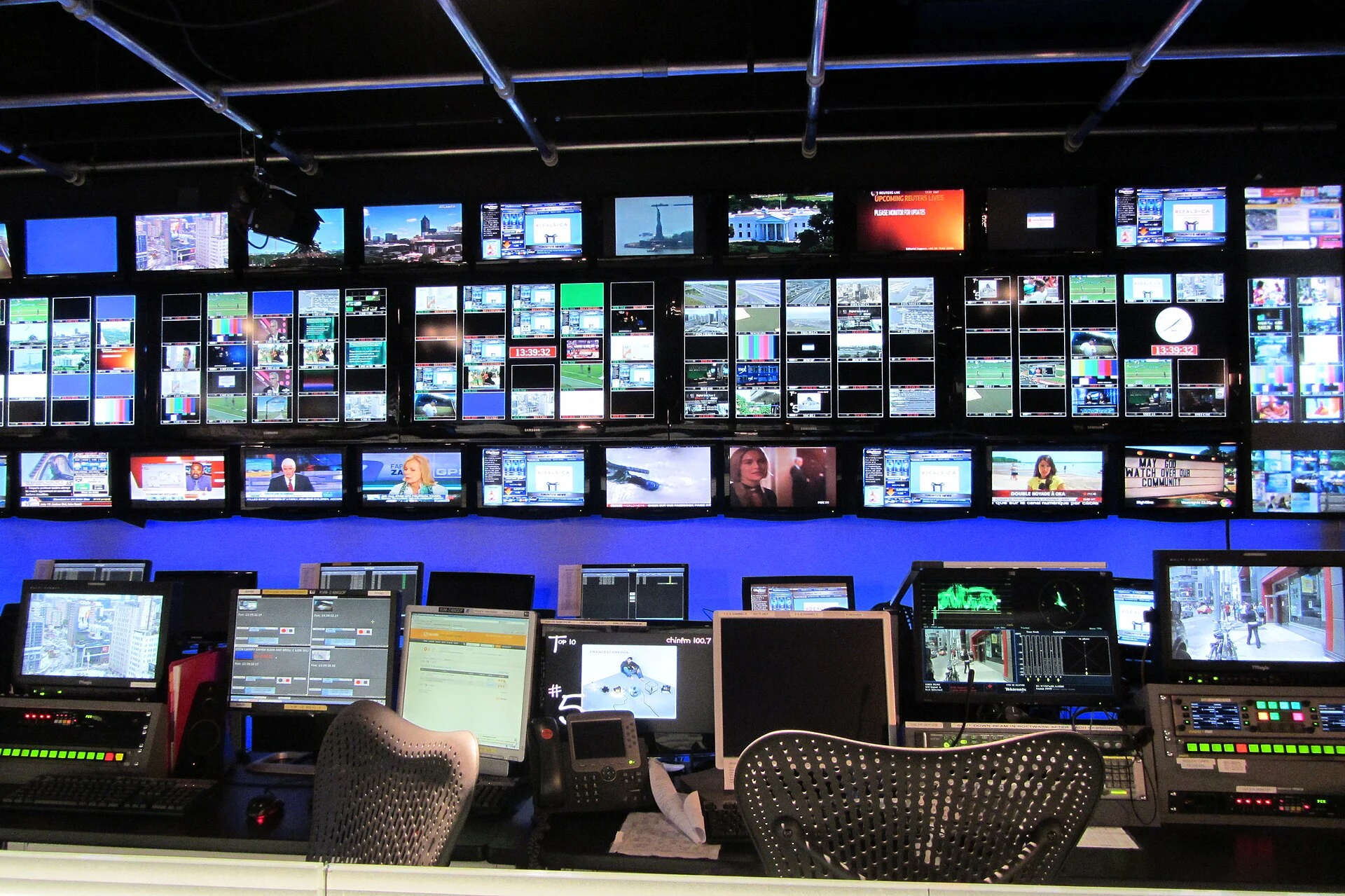
A typical signal chain includes a playback source, processing or sending equipment, transmission links, and receiving cards within the cabinets. Long distances may require fibre equipment, depending on the selected system.
If redundancy is required, identify the failures it must cover. Backup signal routing does not automatically protect against loss of a cabinet power supply, playback computer, or shared upstream electrical source.
03. Make maintenance practical
Specify access for modules, power supplies, receiving cards, and connectors. “Front service” may describe only some components.
EagerLED’s stadium solution page lists rear-service and dual-access product options across its range. Buyers should select the access arrangement for their actual installation clearance and confirm it for the quoted model. Source: EagerLED stadium LED screen solutions.
For football perimeter LED screens, the maintenance package should include wiring diagrams, configuration backups, labelled spare parts, troubleshooting instructions, and operator training. Demonstrate representative repairs before acceptance.
Our front-service vs. rear-service LED display guide explains the access decisions in more detail.
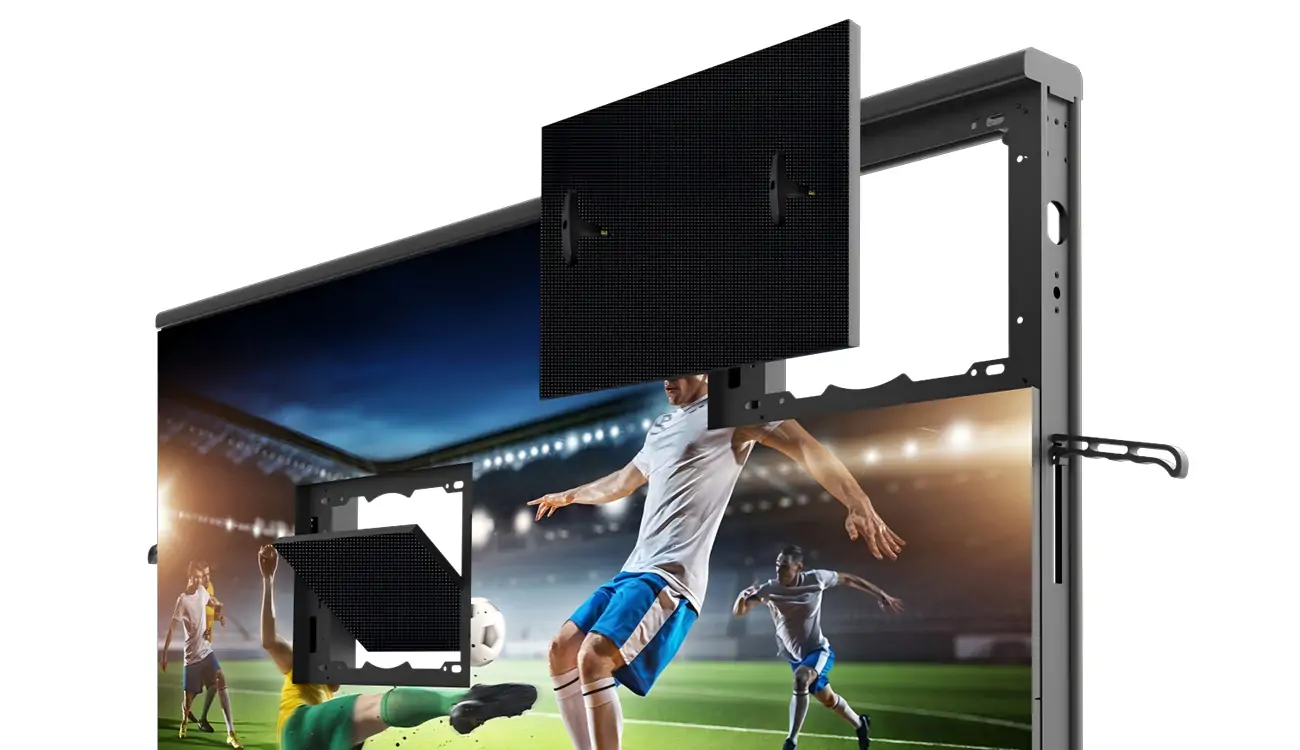
6. LED Perimeter Boards vs. Static Advertising: Pros and Cons
LED perimeter boards let venues change messages electronically and schedule multiple advertisers within the same physical space. Static boards offer a simpler arrangement with fewer technical dependencies.
The commercial choice depends on advertising demand, event frequency, operating resources, and contractual commitments.
| Consideration | LED perimeter boards | Static advertising boards |
|---|---|---|
| Campaign changes | Updated through a playback workflow | Require physical artwork replacement |
| Advertising rotation | Multiple scheduled messages | Usually one visible message per surface |
| Creative format | Supports motion and timed sequences | Fixed printed graphics |
| Technical operation | Requires power, controls, and trained support | Lower technical complexity |
| Maintenance | Electronic and mechanical servicing | Printing, surface, and structural upkeep |
| Failure exposure | Power, signal, or component faults | Physical damage and visual deterioration |
| Commercial evaluation | Depends on inventory sold and delivery costs | Depends on fixed placements sold |
01. Evaluate revenue assumptions separately
Football perimeter LED screens create additional scheduling possibilities, but they do not guarantee additional revenue. Sponsor demand, broadcast exposure, sales capacity, and rights agreements determine the commercial result.
Build a business case from realistic occupancy of advertising slots and the cost of delivering them. Include content preparation, staffing, maintenance, and downtime exposure.
Static boards may remain appropriate where campaigns change rarely or operating resources are limited. A venue may also combine formats, provided competition rules and commercial agreements permit the arrangement.
7. Fixed vs. Rental LED Screens for Football Venues
Fixed and rental football perimeter LED screens serve different operational needs. The decision should follow the venue calendar and installation workflow.
01. Fixed installations
A permanent system can simplify recurring setup and allow protected cable routes and dedicated electrical distribution. It suits venues with frequent use and a stable pitchside arrangement.
The main constraints are continuing outdoor exposure, access for grounds maintenance, and potential conflicts with other events. Confirm how the installation interacts with irrigation, cleaning equipment, and pitch renovation.
Permanent perimeter LED displays still need inspection and maintenance access. A compact installation that makes routine servicing difficult can increase long-term operating costs.
02. Rental and portable installations
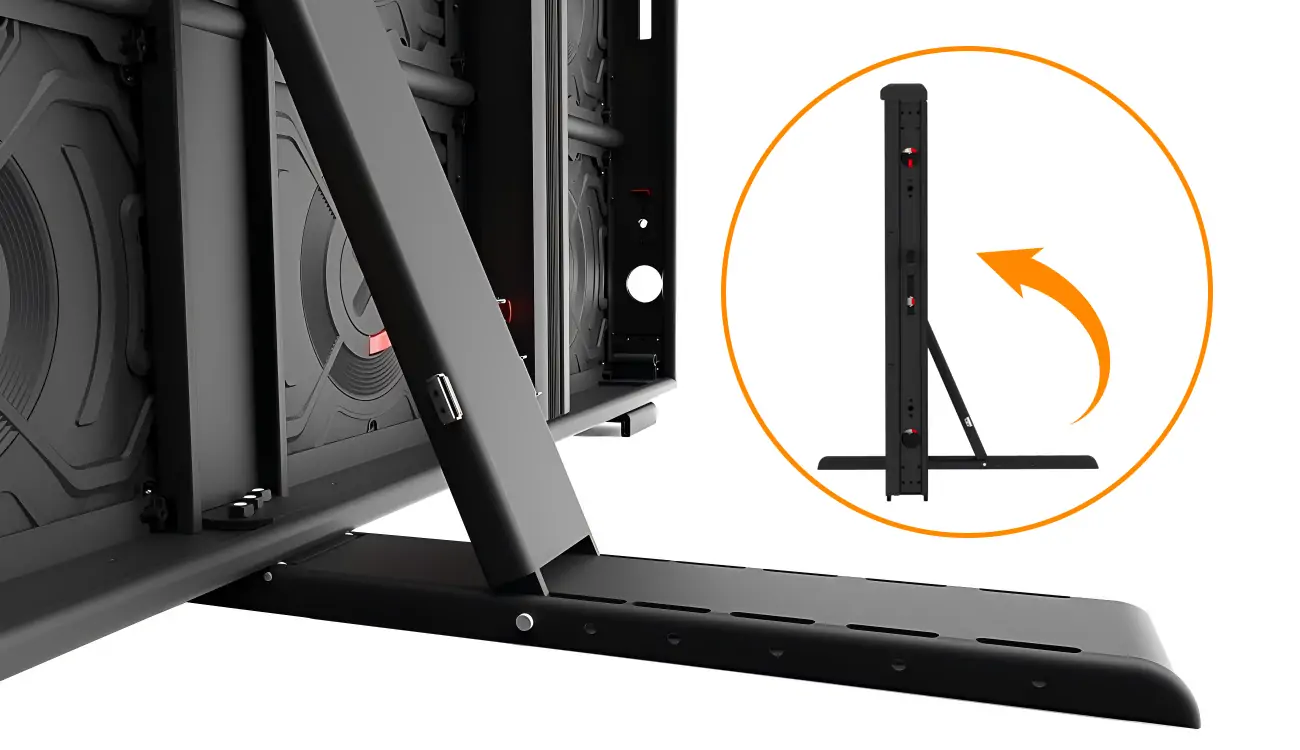
Portable systems suit temporary events, touring inventory, and venues that regularly change configuration. Buyers should assess handling weight, packing volume, connection speed, support adjustment, and replaceable wear components.
Cabinets designed for quick assembly still require careful alignment and secure installation. Rental operators should time a representative setup rather than relying on a claim that installation is “fast.”
03. Plan mixed-use inventory carefully
Some buyers want football perimeter LED screens that can also serve other display applications. Confirm each permitted configuration, required accessories, and supporting documentation.
Do not assume a ground-supported perimeter cabinet is suitable for suspension or tall stacking. Alternative uses can introduce different load paths and structural requirements.
For distributors, a well-defined permitted-use matrix helps sales teams quote the system accurately and prevents unsupported promises to downstream customers.
8. How Much Do Football Perimeter LED Screens Cost?
There is no dependable universal price for football perimeter LED screens. Cost changes with pixel pitch, display area, cabinet construction, electronics, accessories, service requirements, and delivery scope.
A useful quotation separates equipment cost from the cost of delivering an operational system.
01. Compare equivalent scopes
Two offers with the same price per square metre may include different controllers, support structures, spare parts, and packaging. One may cover a complete system while the other covers cabinets only.
| Cost category | Items to include | Common comparison gap |
|---|---|---|
| Display equipment | Cabinets, modules, drivers, and power supplies | Different component configurations |
| Processing | Controllers, receiving cards, and required licences | Missing capacity or functions |
| Installation hardware | Supports, corners, and specified mounting items | Site hardware excluded |
| Electrical and data systems | Distribution, cables, fibre equipment, and protection | Infrastructure priced separately |
| Logistics | Packaging, transport, insurance, and handling | Different delivery terms |
| Commissioning | Configuration, testing, and training | Factory testing confused with site acceptance |
| After-sales support | Spares, warranty terms, and service arrangements | Return freight or labour excluded |
02. Estimate ownership cost
A practical budget includes purchase, installation, energy, servicing, and eventual component replacement. Portable systems also incur repeated handling, storage, and transport costs.
Energy estimates should use a stated operating scenario: expected brightness, representative content, and scheduled hours. An unexplained “average power” figure offers little basis for comparison.
Ask suppliers to identify exclusions explicitly. Civil work, local approvals, electrical upgrades, import costs, and specialist labour can materially change the final budget.
When comparing football perimeter LED screens, evaluate the cost of restoring operation after a fault as well as the initial purchase price. Accessible components and available spares can be more valuable than a small reduction in cabinet cost.
See our stadium screen cost guide for a wider discussion of venue display budgeting.
9. How to Specify Your Screen and Evaluate Suppliers
An effective request for quotation gives every supplier the same project information and requests evidence against the same acceptance criteria.
01. Prepare a clear purchasing brief
Provide a dimensioned layout, display height, intended viewing positions, environmental conditions, competition requirements, and expected operating schedule.
Then request the following:
- Confirmed model, pixel pitch, cabinet resolution, and active dimensions.
- Brightness and camera-performance requirements under stated conditions.
- Component list covering drivers, receiving cards, power supplies, and processing.
- Support drawings, service clearances, and connection details.
- Maximum electrical demand and defined consumption estimates.
- Applicable compliance documents for the product and destination.
- Spare-parts schedule, warranty terms, and delivery scope.
Avoid accepting unrestricted component substitutions. Any proposed change should be assessed for its effect on performance, compatibility, and maintenance.
For an EagerLED enquiry, submit these details with the venue drawings so the proposed football perimeter LED screens can be evaluated against the project requirements. A named configuration is easier to compare and approve than a general product-family description.
The EA1600SP stadium LED display introduction provides a starting point for discussing cabinet configuration; confirm all project requirements in the quotation.
02. Separate factory and site acceptance
Factory acceptance should verify the supplied configuration, assembly quality, image consistency, cabinet mapping, accessories, and agreed functions. Record serial numbers and configuration versions.
Site acceptance should address the installed perimeter LED display, including physical alignment, operating brightness, camera output, electrical distribution, access, and playback workflow.
Agree on test methods and pass criteria before ordering. If the contract requires signal failover, demonstrate it by introducing the relevant fault. If maintenance speed matters, observe a representative component replacement.
The handover package should leave the venue able to operate and support the system: as-built drawings, configuration files, spare-parts identification, training records, and clear escalation contacts.
10. FAQ
11. Conclusion
Football perimeter LED screens should be specified around the conditions in which they will operate: viewing geometry, broadcast production, pitchside installation, weather exposure, maintenance access, and matchday staffing.
Pixel pitch, brightness, and refresh rate help describe the equipment, but procurement decisions also need verified configurations, complete installation costs, and measurable acceptance criteria. A carefully documented system is easier to compare, commission, and support.
For buyers, distributors, and integrators considering EagerLED, the next step is to prepare a venue layout and operating brief, request a model-specific proposal, and agree on the evidence required for approval. That process turns a product quotation into a practical specification for football perimeter LED screens.
 EagerLED Mid-Autumn Festival 2026 & Holiday Notice
Related Posts


Fill In Your Needs In Detail
Fill in the screen usage scene and size you need in “Content”.You will get a quote.