A useful 3D billboard cost estimate includes the LED display, control system, site engineering, installation, custom animation and ongoing operation. A price per square meter covers only the items listed in that supplier’s scope. It cannot tell you the installed cost of a building-corner display without dimensions, access conditions and a content brief.
For one public reference, creative studio Coper lists simple anamorphic scenes at US$2,000-US$4,000, medium-complexity work at US$4,000-US$5,000 and complex projects from US$5,000. These are that studio’s production prices, not screen prices or EagerLED quotations. Below, a clearly labeled 100 m2 example shows how to build an ownership budget and compare bids without mixing equipment costs with advertising airtime.
Budget essentials
- Separate equipment ownership, animation production and advertising airtime.
- Compare complete installed scopes, not panel prices alone.
- Use maximum power for electrical design and average operating power for energy budgets.
- Replace every illustrative allowance with a project-specific quotation.
1. What Does a 3D Billboard Cost Include?
For an owner, total project cost = display hardware + control and playback + structure and electrical work + freight and installation + initial content + spares + contingency. Add energy, maintenance, software, site fees and future creative to compare the cost over several years.
A naked-eye 3D billboard normally uses anamorphic animation: a distorted image looks dimensional from a planned viewing zone. The LEDs still display a two-dimensional pixel canvas. A corner or curved screen helps establish the apparent depth, but the animation must match its geometry. Read the EagerLED 3D billboard technology guide for the visual principles.
Buying a permanent display is a construction and equipment project. Booking an existing screen is a media purchase, typically priced around location, dates, spot duration and share of the loop. Commissioning animation is a third purchase. A monthly advertising rate is therefore not evidence of what it costs to build that screen.
For a media-only campaign, request the exact screen, pixel map, permitted format, plays per hour, operating hours, approval process and proof of play. For ownership, start with a measured site survey and a complete bill of quantities.
This guide covers perspective-based LED billboards. Mechanical moving displays, stereoscopic multi-view systems and holographic products have different hardware and engineering requirements. Put the intended effect, priority viewing point and physical screen shape into the brief so suppliers quote the same technology.
2. 3D Billboard Cost Drivers at a Glance
Use the following table as a scope comparison. The lowest equipment figure is useful only when the competing proposals include the same components and performance requirements.
| Cost item | What changes the cost | What to request |
|---|---|---|
| Display area and cabinets | Total active area, pixel pitch, corner radius, module format and spare quantities | Dimensions for each face; cabinet drawing; exact native resolution |
| Display performance | Calibrated brightness, LED package, refresh behavior and environmental protection | Configuration-specific data sheet and an actual-content demonstration |
| Control and playback | Total pixels, output topology, synchronization, redundancy and monitoring | Processor models, port loading, playback licenses and backup scope |
| Structure and site work | Wind exposure, mounting height, foundations, facade condition and service access | Local engineering scope, structural drawings and installation responsibilities |
| Electrical and thermal work | Maximum load, utility connection, cable length, distribution and ventilation | Electrical load schedule and equipment inclusions |
| Content production | Modeling, animation, simulation, duration, versions, rights and revisions | Storyboard, deliverables, revision allowance and usage license |
| Delivery and installation | Destination, Incoterm, packing, lifting, labor, traffic controls and commissioning | Freight, import, crane and site acceptance line items |
| Operation | Hours, brightness, electricity tariff, cleaning, repair access and creative refreshes | Annual operating assumptions and service contract terms |
3. Hardware: Area, Pixel Pitch and Cabinet Design
Display area is the first quantity to establish. For two rectangular faces meeting at a corner, add the actual illuminated area of both faces. Do not price the screen using only its apparent width in a photograph. Curved transition sections need their own measured area and cabinet layout.
Consider two hypothetical faces, each 10 m wide and 5 m high. Their combined area is 100 m2. At a nominal 5 mm pitch, each face is approximately 2,000 x 1,000 pixels, or 4 million pixels across the two faces. At 4 mm pitch, the same area becomes approximately 6.25 million pixels.
That change adds 56.25% more pixels; it does not prove that the total project price rises by the same percentage. Module design, receiving cards, processing and commercial terms still matter. These calculations assume exact dimensional compatibility; the supplier must confirm the real cabinet increments and corner pixel map.
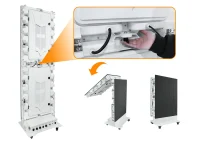
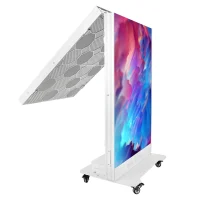
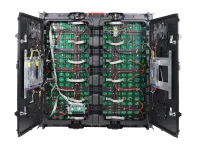
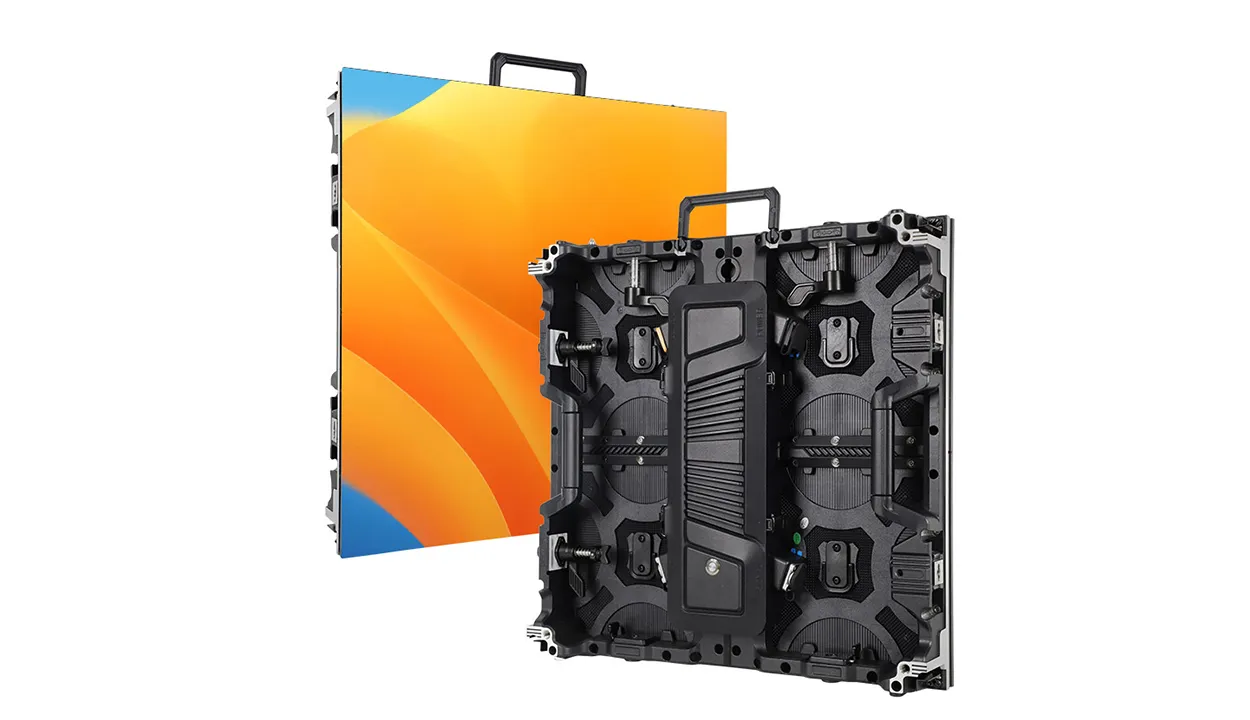
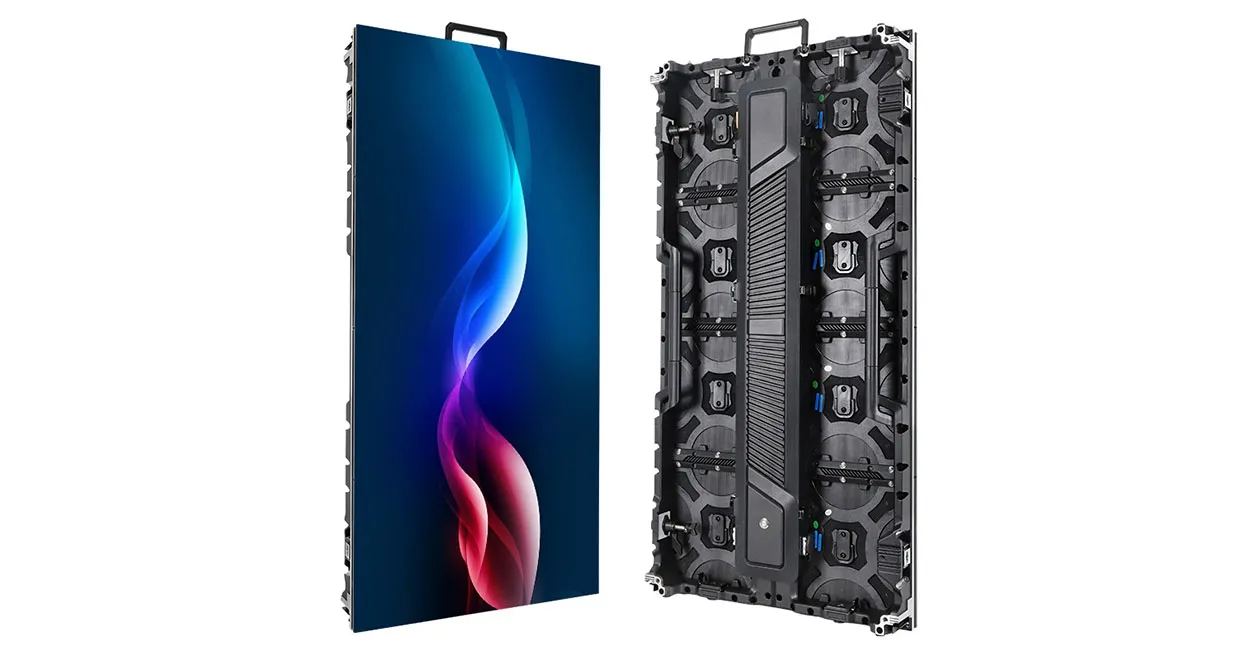
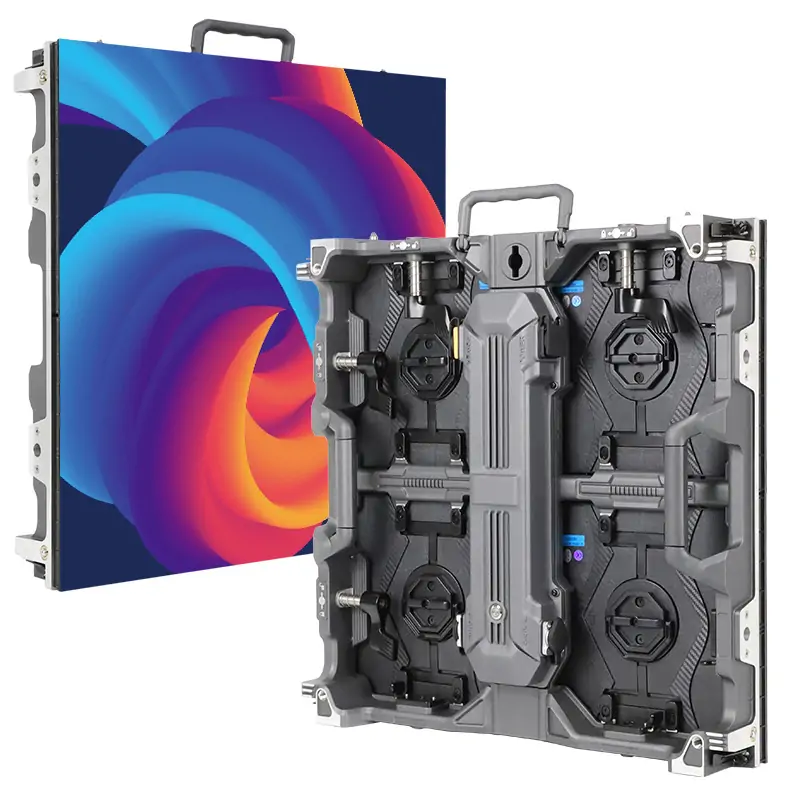
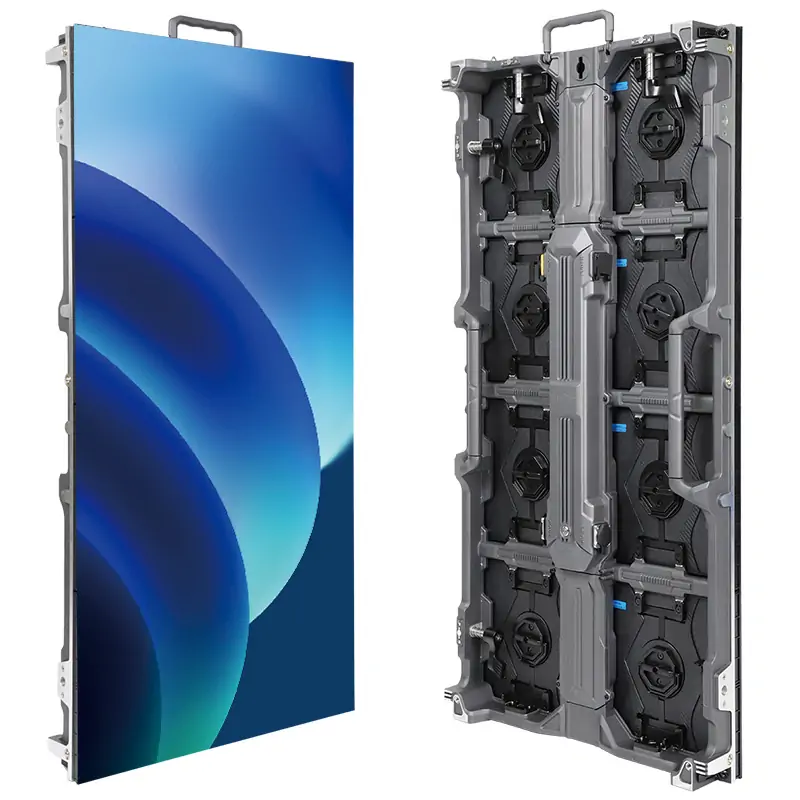
A corner-capable cabinet, a curved transition and a standard flat cabinet are not interchangeable items. Ask how the junction is formed, how the image stays aligned across it and how a failed module can be replaced at that location. Front access may reduce the need for a rear corridor, but maintenance at height still needs safe access equipment.
For example, EagerLED’s EA3D-VR outdoor 3D LED billboard page specifies front and rear service, 90-degree corner assembly, IP66 protection, 6,000 cd/m2 brightness and 3,840 Hz refresh rate. These describe a product family. Confirm the selected pitch and configuration in the quotation; an IP rating does not replace structural, electrical or site-specific approval.
List the media player, video processor, sending and receiving equipment, fiber links where needed, distribution hardware, sensors and monitoring software. Ask the integrator to confirm the required resolution and frame rate across every output, not just the processor’s headline pixel capacity.
Specify whether redundancy covers the input, player, signal path or power supply. Test the proposed configuration with a mapped 3D clip and ordinary advertising content. Frame continuity at the corner, low-gray detail, calibration and phone-camera behavior are more useful acceptance criteria than isolated specification numbers.
4. Content: What Changes the Animation Budget?
3D billboard content cost follows the production brief. A short product reveal built from an approved model requires a different scope from a photorealistic character, fluid simulation or several site-specific versions. Ask for a line-item creative proposal before approving the screen budget.
Coper’s production guide, published July 31, 2025, lists these public benchmarks. They are one provider’s published menu, checked September 10, 2026, and should not be treated as market averages or a guaranteed current offer.
| Published production tier | Listed price (USD) | Described scope |
|---|---|---|
| Simple scene | $2,000-$4,000 | 1-2 objects and basic animation |
| Medium complexity | $4,000-$5,000 | Custom 3D model, visual effects and compositing |
| Complex project | From $5,000 | Simulations, characters and advanced camera work |
Coper describes measuring the screen and location, modeling the screen, positioning the virtual camera at the viewer’s location and applying forced perspective. This explains why the final pixel map and viewing coordinates are production inputs, not details to resolve after animation.
Require approval of a low-resolution animatic before final rendering. Confirm the screen elevation, angle, curved transition, safe areas, brand placement and how the scene looks from secondary approaches. A late geometry change can trigger modeling, animation and render work again.
Define clip length, frame rate, codec, resolution, looping behavior, languages, number of screen adaptations and correction rounds. State who provides product models and who owns the source files. Music, stock assets and character licenses must cover the intended territory and media use.
Keep on-screen testing in the production scope. A file that plays successfully on a laptop has not passed a site perspective test. Reserve access to the installed screen and agree who pays for revisions after technical acceptance or a changed creative brief.
5. Installation: Structure, Power and Site Access
The same cabinets can produce different installed totals on a low facade and a high, exposed building corner. Construction cost comes from the building and work method as well as the screen weight. Obtain a local survey before treating an installation allowance as a firm price.
Ask a qualified local engineer to assess the supporting building or foundation, wind actions, attachment points, corrosion exposure and service loads under the applicable local rules. Include steel fabrication, coatings, waterproof interfaces and any facade repairs. Identify the party responsible for sign consent, building approval and inspection in the project location.
Separate display supply from engineering responsibility. A cabinet drawing is not a site structural design, and an overseas equipment quote does not establish what a local authority will approve.
Budget for the utility connection, distribution boards, protective devices, isolators, grounding, surge protection, cable routes and installation labor as specified by the local electrical designer. Size the electrical installation using the actual maximum load and applicable design rules. Estimate energy bills using expected operating consumption; the two figures serve different purposes.
Check ventilation around the complete mounted system, especially where a rear enclosure traps heat. Include cooling equipment only where the product design and site thermal assessment require it. Do not assume that an outdoor rating guarantees acceptable temperature inside a poorly ventilated enclosure.
Crane reach, lift duration, traffic management, work windows, storage and weather delays can alter the installation budget. For U.S. work, OSHA’s crane, derrick and hoist safety resources identify the relevant safety framework; the installer must determine the standards and qualifications that apply. Other locations require their own local rules.
Price commissioning and operator training. Acceptance should cover cabinet alignment, color uniformity, the corner seam, content mapping, brightness schedules, playback recovery, fault alerts and a supervised service demonstration. Obtain drawings, calibration files, configuration backups, spare-part records and warranty contacts at handover.
6. Worked 3D Billboard Cost Example
Illustrative calculation only: the figures below are deliberately selected planning inputs, not a market survey, customer project or EagerLED quotation. They show how to assemble a budget. Replace every allowance with a written supplier or local contractor quote.
Assumptions: a permanent 100 m2 outdoor corner display; two 10 x 5 m faces; nominal P5; a new support structure; one initial custom clip; normal project access; and USD as the budget currency. Cabinet feasibility, structure and final electrical demand remain subject to design. The example does not include land or facade lease, advertising rights, taxes, import duties, utility upgrades beyond the allowance, financing or future content.
| Example budget line | Illustrative input | Calculated amount |
|---|---|---|
| LED cabinets and modules | 100 m2 x $1,200/m2 | $120,000 |
| Control and playback | Separate allowance | $8,000 |
| Engineered structure | Separate allowance | $25,000 |
| Electrical and thermal provisions | Separate allowance | $12,000 |
| Freight and local handling | Separate allowance | $6,000 |
| Installation and commissioning | Separate allowance | $15,000 |
| Initial custom animation | Separate allowance | $6,000 |
| Spares and training | Separate allowance | $4,000 |
| Subtotal | Sum of the eight lines | $196,000 |
| Contingency | 10% of subtotal for this example | $19,600 |
| Illustrative initial budget | Subtotal plus contingency | $215,600 |
At 100 m2, a $200/m2 change in the cabinet input changes the equipment subtotal by $20,000. With the same 10% contingency convention, the example total changes by $22,000. This sensitivity is arithmetic, not a prediction of supplier pricing.
Changing area is more complicated: it changes cabinet quantity and may also require another processor, a different structure or additional circuits. Ask for separately engineered options instead of scaling every line in proportion to area. A smaller screen with safe maintenance access can have a more predictable lifetime budget than a larger screen squeezed onto an unsuitable facade.
If the cabinet quote already includes power supplies, receiving cards or spares, mark those items as included rather than adding another allowance. Conversely, identify every item described as supplied by others. Assign an owner and a price to it before approval.
Record the delivery Incoterm, named place, currency, quote validity, payment milestones and warranty scope. Freight, tax and import treatment can make two equal factory prices produce different delivered totals. A contingency reserve does not substitute for an unpriced major scope item.
7. Operating Costs and Five-Year Ownership
Annual operating cost includes electricity, monitoring or software, service visits, cleaning, calibration, repair access, insurance, site fees and replacement creative. Keep scheduled maintenance separate from the warranty: a warranty may cover parts while leaving access equipment, labor or shipping to the owner.
Annual display energy (kWh) = area (m2) x average operating load (W/m2) / 1,000 x hours/day x days/year. Multiply the result by the applicable energy tariff. Add the player, network and cooling loads separately, and include demand charges or time-of-use pricing where your electricity contract applies them.
For an illustrative 100 m2 display averaging 250 W/m2 for 12 hours per day, 365 days per year, consumption is 109,500 kWh/year. At an assumed $0.12/kWh, the display-only energy charge is $13,140/year. Neither the load nor the tariff is a measured EagerLED specification. Request a representative power test at the intended brightness and content mix.
If the average load were 350 W/m2 instead, the same calculation gives 153,300 kWh and $18,396 per year. The $5,256 annual difference explains why the operating-power assumption deserves as much attention as the headline hardware price.
Five-year ownership cost = initial installed budget + five years of operating expenses + planned replacements and creative refreshes. For a simple undiscounted comparison, the example’s $215,600 initial budget plus five years of its $13,140 display energy charge equals $281,300. This is a partial subtotal, not a full ownership forecast, because the other operating lines remain unpriced.
Use the same operating hours, tariff assumptions, service response and content refresh frequency for every bidder. Ask how long matching modules will be available and what happens to calibration when a module is replaced. Store configuration backups and agree who responds when the screen stops during an advertised campaign.
The U.S. Energy Information Administration explains the distinction between kilowatts and kilowatthours: energy is power used over time. Use your local utility tariff rather than a national average when estimating project costs.
8. Quote Checklist and Ways to Control the Budget
Send the same brief to every supplier. A comparable proposal should answer the following questions without requiring the buyer to infer the scope.
- Site: What are the address, mounting elevation, facade or foundation details, climate exposure and installation restrictions?
- Geometry: What are the dimensions of each face, corner angle or radius, total active area and priority viewing positions?
- Display: What are the exact model, pitch, cabinet count, native pixels, calibrated brightness and protection rating?
- Control: Which player, processor, receiving system, connectivity, synchronization and backup features are included?
- Construction: Who designs and pays for structure, electrical work, permits, lifts and site reinstatement?
- Creative: What are the duration, animation complexity, deliverables, rights, adaptations and revision limits?
- Service: What spares, training, remote support, response times and warranty exclusions apply?
- Commercial terms: What are the currency, Incoterm, named delivery place, taxes, payment milestones and quote expiry?
- Acceptance: Which factory and site tests must pass, and who signs off the mapped content?
Freeze the screen geometry before final animation. Compare appropriate pitches from the closest priority viewing position. Use standard cabinet increments where they suit the building. Design service access early and approve an animatic before expensive render work.
Avoid unsupported savings percentages. Ask suppliers to price each alternative and show what changes in the scope. Removing backup playback, lowering the spare quantity or shortening support can lower the purchase price while increasing downtime exposure.
Review EagerLED advertising LED screen options, then send drawings, photos, face dimensions, viewing distances, local conditions and the content brief through the EagerLED project contact page. Request hardware, control, freight, installation assistance and spares as separate lines, with local construction responsibilities clearly assigned.
Do not choose a supplier by a per-square-meter figure alone. The useful comparison is the documented installed scope, the ability to maintain it and the operating assumptions over the period you intend to own it.
9. FAQs
10. Conclusion
A defensible 3D billboard cost starts with a measured screen and a defined project scope. Price cabinets and processing, local structure and power, installation, content and operation separately. Use public production prices only as scoped references, and label any budget assumptions before sharing the estimate.
Before placing an order, replace allowances with written quotes, confirm the actual pixel map and service access, and agree on technical acceptance. This gives the owner a cost model that can support a decision and gives the supplier the information needed to price the real project.
 How to Create Content for an LED Poster Display
 Event LED Screen Guide: Size, Rigging and Power Planning
Fill In Your Needs In Detail
Fill in the screen usage scene and size you need in “Content”.You will get a quote.