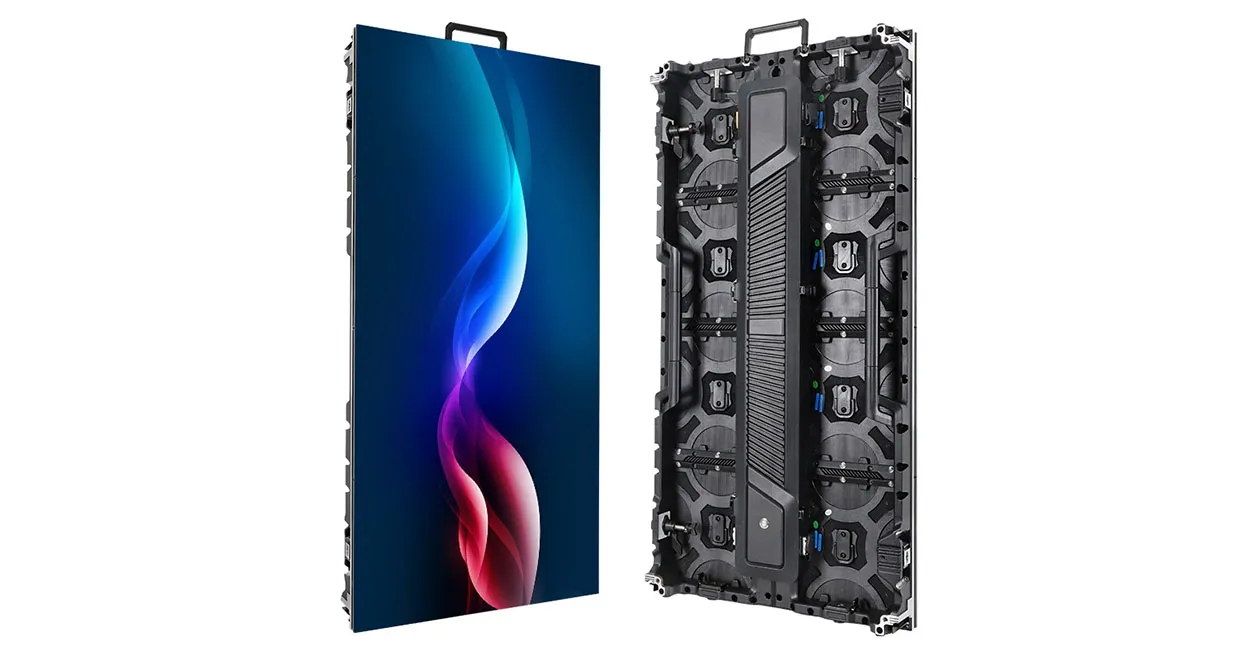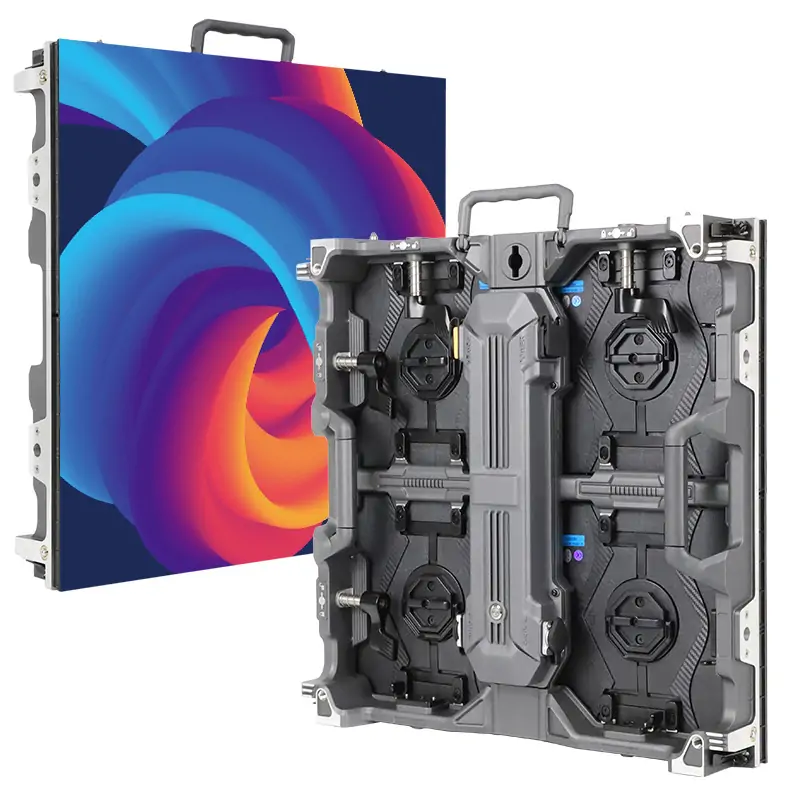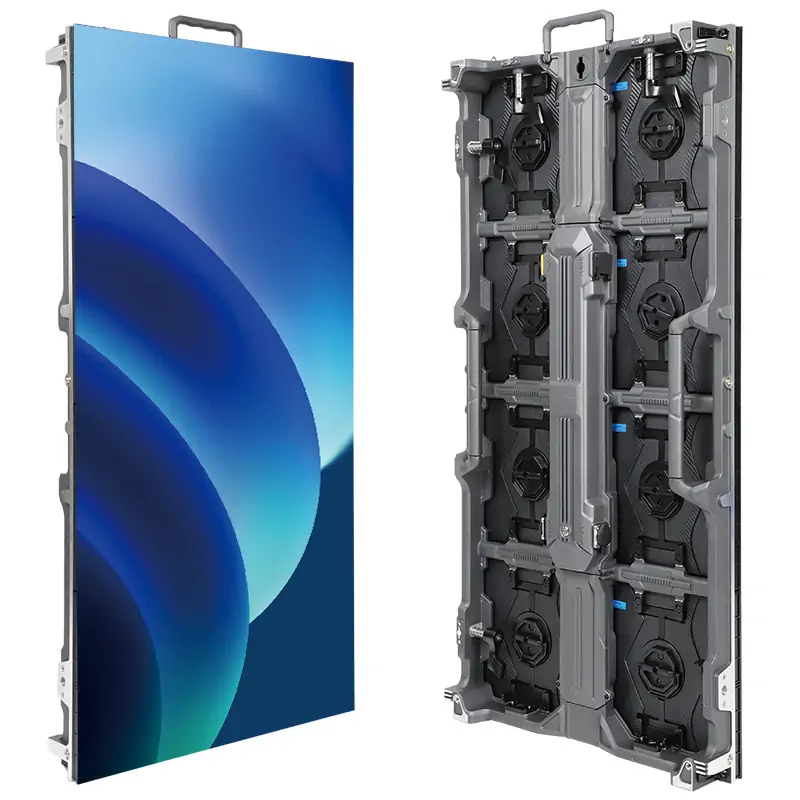
Choosing LED screen suppliers in the Netherlands means comparing more than display specifications. Some companies supply permanent installations with local maintenance; others specialize in event equipment, mobile screens, or dealer distribution. The right shortlist depends on whether your business needs a finished installation, rental inventory, or hardware for integration into a larger project.
For AV integrators and project contractors, the most useful comparison starts with responsibility: who designs the system, supplies the structure, configures the controls, and restores operation when something fails? Two quotations for the same screen area can cover substantially different work.
This guide examines ten LED screen suppliers relevant to Dutch projects, with EagerLED in eighth position as a China-based manufacturer for buyers considering direct procurement. The order is an editorial shortlist, not an independently tested performance ranking. This is an EagerLED commercial guide, and EagerLED’s inclusion should be understood in that context.
Company profiles reflect official product and service pages checked on October 23, 2026. Published offerings establish relevance; current availability, project coverage, warranties, and contractual commitments still require written confirmation.
1. Understanding Indoor, Outdoor, and Rental LED Screens
Professional direct-view LED screens create images using light-emitting pixels arranged across modules and cabinets. They differ from LCD displays with LED backlights. When requesting a “video wall,” specify the technology because the term can describe either system.
LED screen suppliers generally organize their ranges around installation environment and handling requirements. Indoor displays prioritize viewing comfort, image detail, and integration into occupied spaces. Outdoor systems must address daylight visibility, environmental exposure, and the complete mounting arrangement.
Rental-grade cabinets are designed for repeated assembly and transport. However, purchasing rental cabinets for an equipment fleet is different from hiring a screen for an event. Make that distinction clear when contacting LED screen suppliers.
| Screen category | Typical purchasing need | Main selection consideration |
|---|---|---|
| Indoor fixed LED | Permanent retail or corporate installation | Viewing distance, image quality, service access |
| Outdoor fixed LED | Advertising or public information | Visibility, environmental protection, structural design |
| Rental-grade LED cabinets | Equipment owned by a production company | Handling, rigging compatibility, repair workflow |
| Complete event rental | Temporary screen with agreed services | Equipment, crew, transport, setup, and operating period |
An indoor screen behind glass also needs careful assessment. Sunlight, reflections, heat accumulation, and viewing angles can make a shop window more demanding than a conventional interior wall.
2. How We Selected the LED Screen Suppliers
The shortlist includes businesses whose official websites describe direct-view LED products, installation services, distribution, or professional rental equipment. General electronics retailers and businesses supported only by directory listings were excluded.
These LED screen suppliers represent different procurement routes. A rental provider can be relevant to a production contractor without being the right choice for a permanent reception display. Likewise, a manufacturer can suit an experienced distributor while requiring more project coordination from an end customer.
The selection focuses on identifiable offerings rather than unsupported claims about market share, reliability, or customer satisfaction. It does not establish that every company can deliver every project type.
Before appointing LED screen suppliers, request a model-specific proposal, comparable project evidence, and a named technical contact. A useful submission should identify the equipment, installation boundaries, acceptance procedure, and ongoing support arrangements. Marketing descriptions alone cannot establish whether a particular cabinet, controller, and mounting system will work together at your site.
3. Top 10 LED Screen Suppliers in the Netherlands
01. Ace Vision B.V.
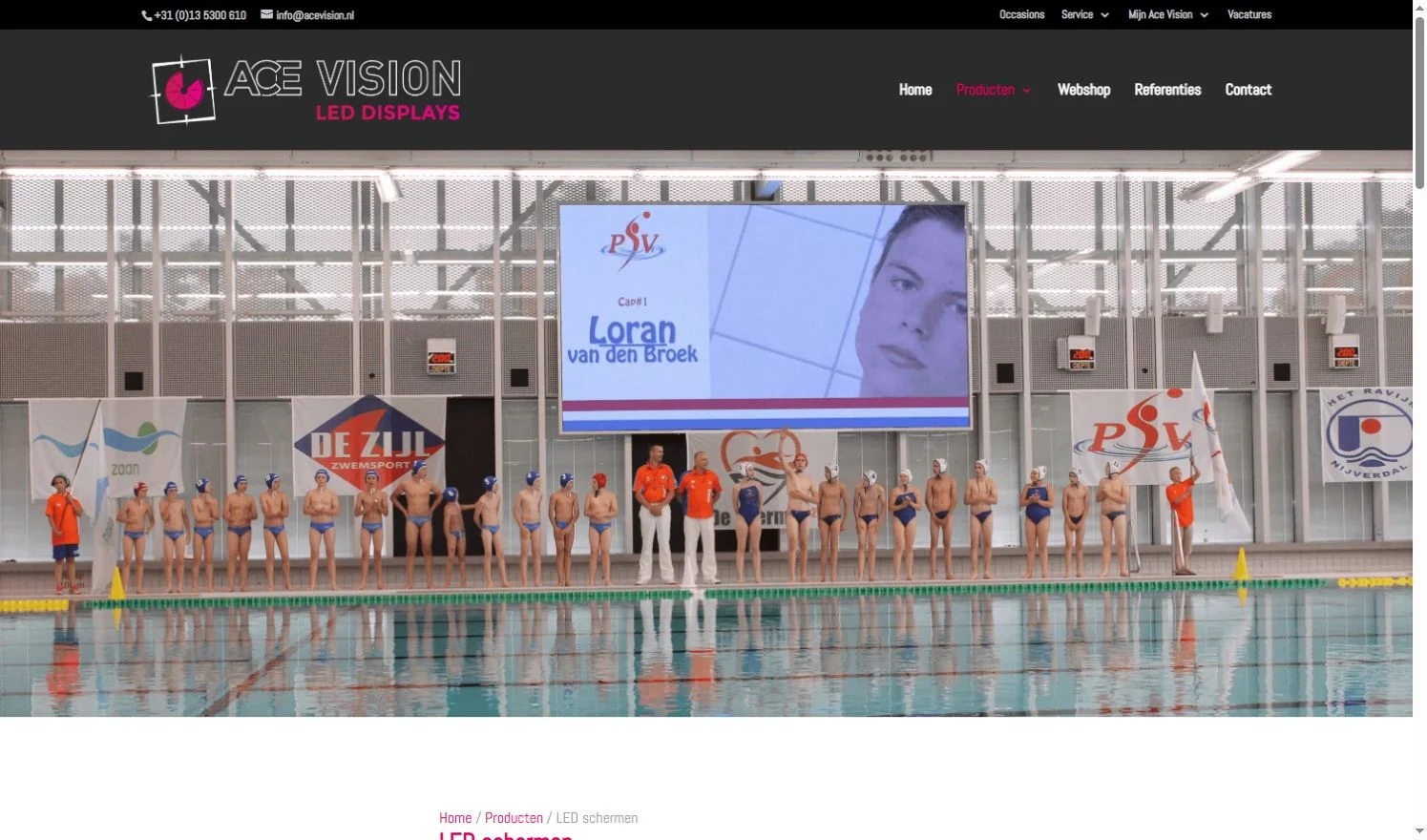
Ace Vision’s official website lists LED screens alongside information displays, glass LED products, display columns, and scoreboards. It also identifies sales, installation, and maintenance as service areas.
Among LED screen suppliers, Ace Vision is worth evaluating when a project combines video advertising with practical information display requirements. A sports facility, for example, may need both sponsor content and a scoreboard workflow.
Ask how the proposed display will receive its content and how maintenance is organized. For installations connected to an operational system, define which party maintains the interface between the display and the source of information. That connection deserves the same attention as the screen itself.
02. Vidiled
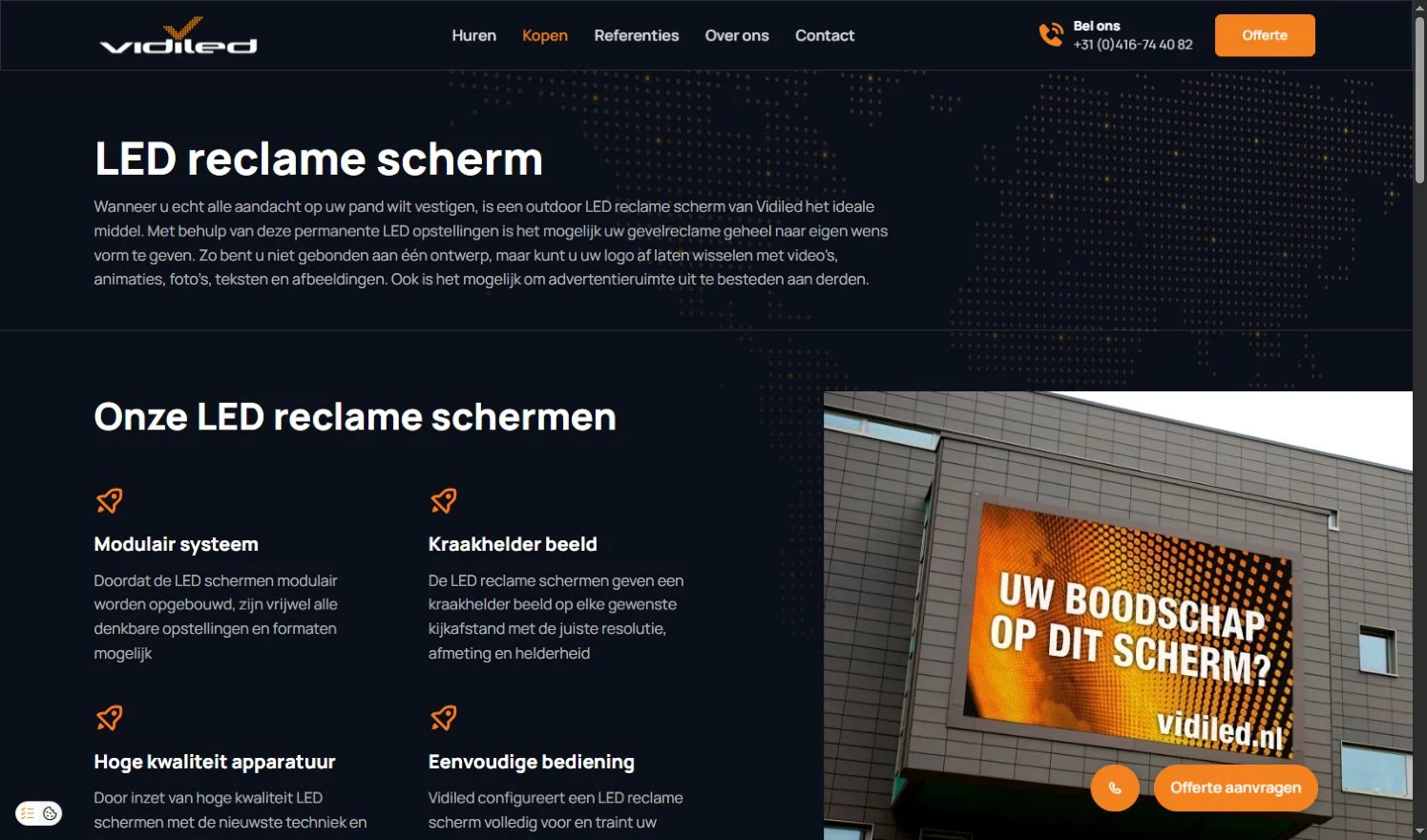
Vidiled describes both LED display sales and rental, including fixed, mobile, and modular applications. Its published offering covers business premises, retail, outdoor advertising, sports locations, and events.
Buyers comparing LED screen suppliers can consider Vidiled when deciding between a permanent asset and a temporary deployment. Its rental description includes transport, installation, content preparation, and dismantling; the exact package should be confirmed for each booking.
For a permanent installation, separate the initial installation scope from recurring services. Identify who controls scheduling, monitors faults, and authorizes maintenance visits. For an event, confirm when the screen must be operational and whether a technician remains on site during the program.
03. Leddisplay Expert
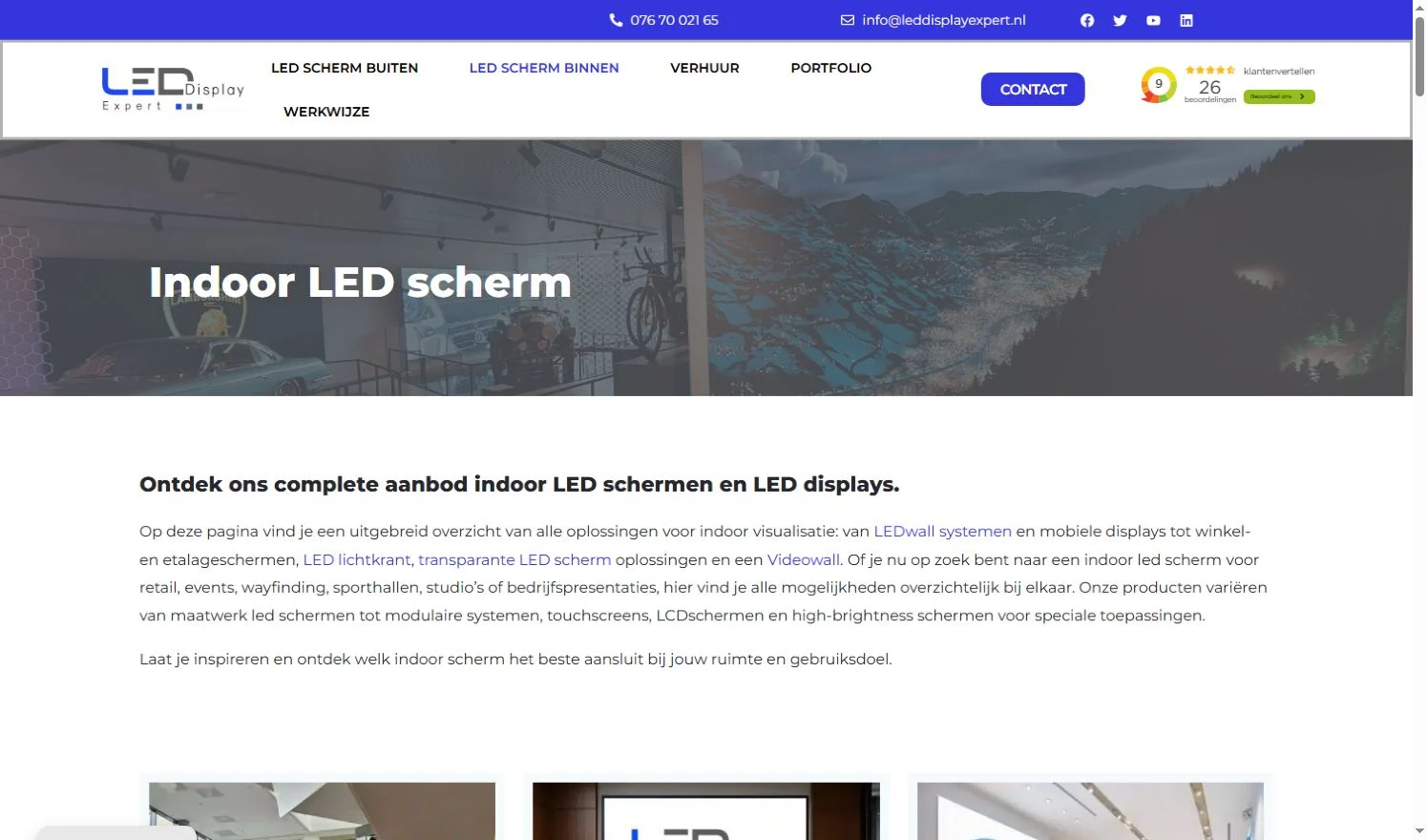
Leddisplay Expert advertises indoor and outdoor LED displays, rental options, and a process extending from advice and design through installation, control, and service.
Its published application range makes it relevant to buyers evaluating LED screen suppliers for retail, offices, exhibitions, and exterior advertising. The proposed configuration should still be judged against the actual content and viewing conditions.
For close-viewing installations, request a demonstration using your own material. Detailed presentation slides can expose limitations that promotional video conceals. Also confirm the usable display dimensions, native pixel resolution, and access method for replacing modules, power supplies, and receiving cards after installation.
04. Display4All
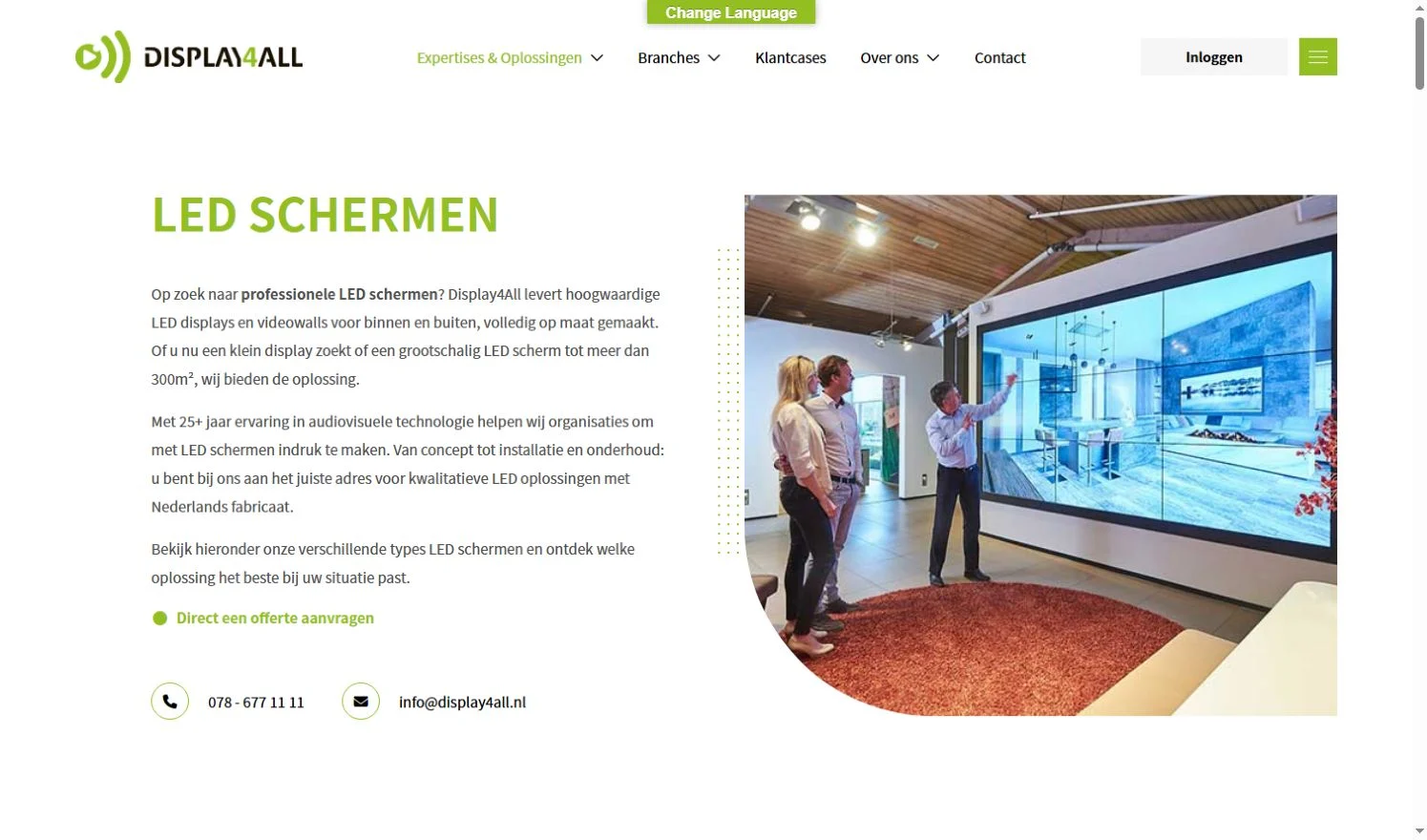
Display4All presents professional indoor, outdoor, and transparent LED screens within a wider audiovisual and digital signage offering. Its website also describes installation, maintenance, and financing-related services.
For organizations comparing LED screen suppliers as part of a broader workplace or retail project, this wider integration scope can be relevant. The display may need to share content, controls, or support arrangements with other systems.
Check which functions are included in the proposed content platform and which require additional subscriptions. If several locations will use the same system, establish account ownership, publishing permissions, and the process for transferring administration when personnel or service providers change.
05. QledX Europe
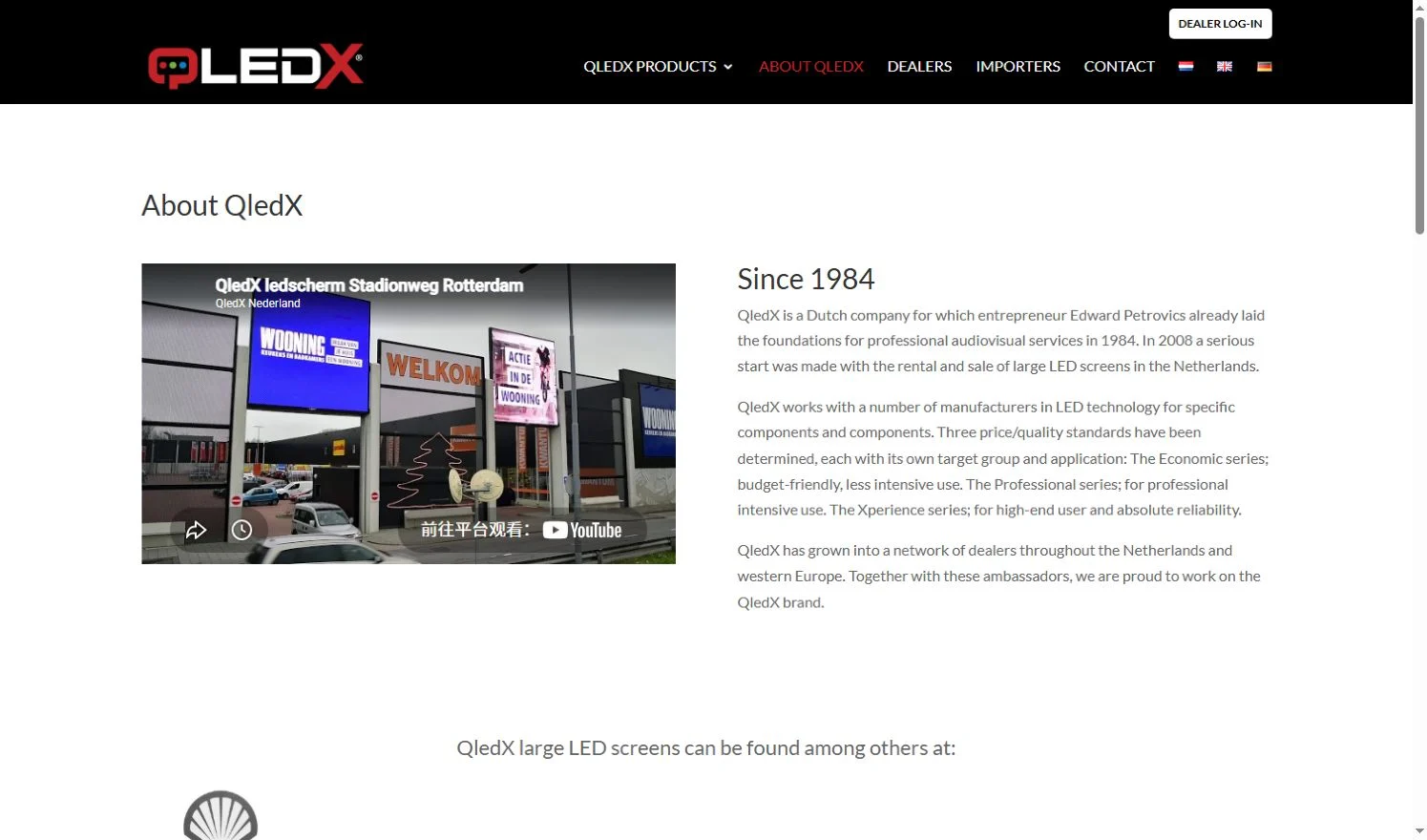
QledX Europe identifies indoor, outdoor, and rental product groups and provides dealer and importer channels. Its official website directs prospective customers to dealers for information and demonstrations.
This makes QledX relevant to distributors and integrators comparing LED screen suppliers through an established product channel. A defined product family can help when building repeatable solutions across several projects.
Qualification should cover both the product and the company delivering it. Ask which dealer handles installation, who approves warranty claims, and where replacement components are held. Do not assume that every dealer offers the same engineering resources or on-site support package simply because the display carries the same brand.
06. Megalux
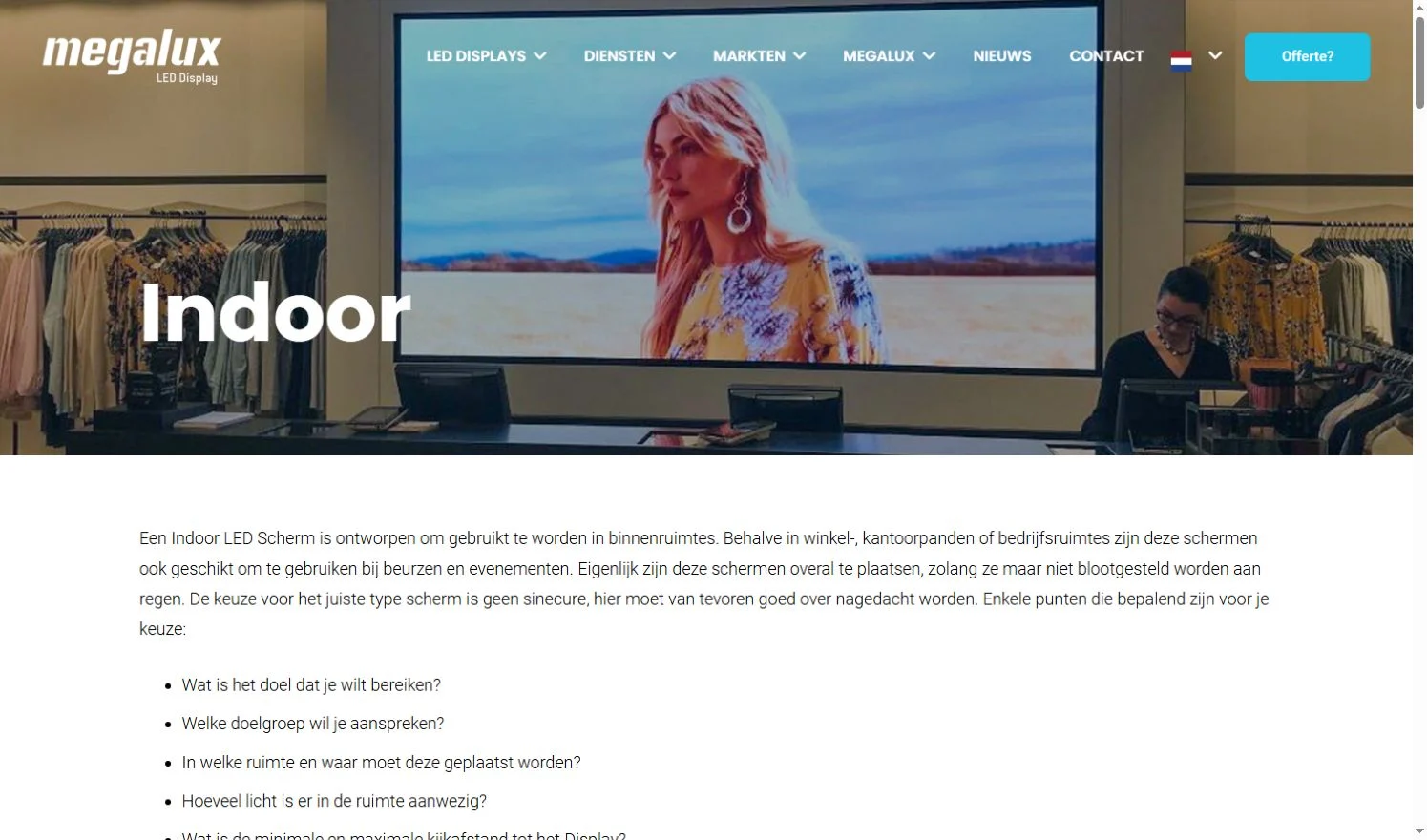
Megalux presents LED display solutions for indoor spaces, outdoor applications, and shop windows. Its published services include installation, software, financing, and LED-as-a-service arrangements involving Megalux and its partners.
Megalux is therefore relevant when comparing LED screen suppliers for commercial installations where equipment, software, and ongoing services may be packaged together.
Request a clear division between hardware ownership and service obligations. Establish what happens to the screen, content accounts, and stored material when the agreement ends. For window installations, discuss the actual orientation of the glass and surrounding lighting rather than treating every storefront as an equivalent display environment.
07. Event Displays
Event Displays describes mobile LED trailers, rental solutions, and permanent installations. Its website also lists event-related services such as setup, operating support, content assistance, and dismantling.
Production teams comparing LED screen suppliers can assess Event Displays for temporary deployments, while commercial buyers can investigate its fixed installation offering.
For mobile screens, confirm the complete site footprint, vehicle access, power arrangements, and positioning restrictions. For modular rental walls, clarify whether the quotation includes the supporting structure and the people responsible for its installation. The screen dimensions alone do not describe the space or resources required to operate the system.
08. EagerLED
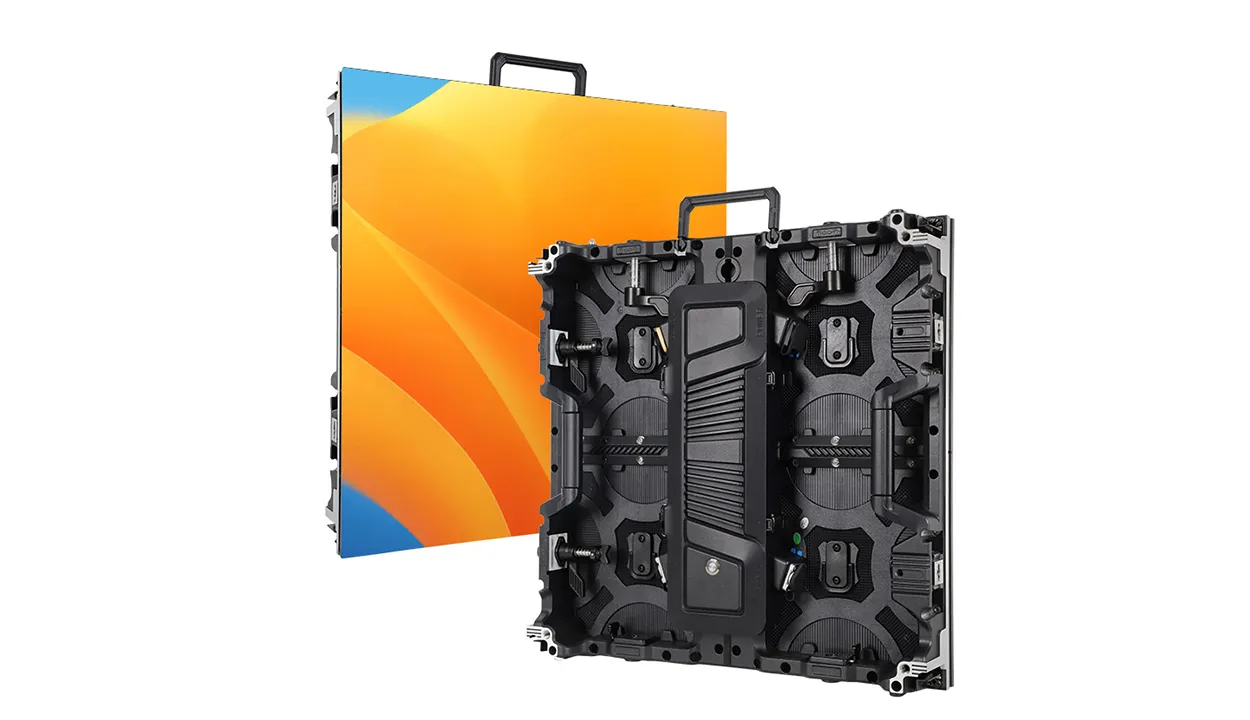
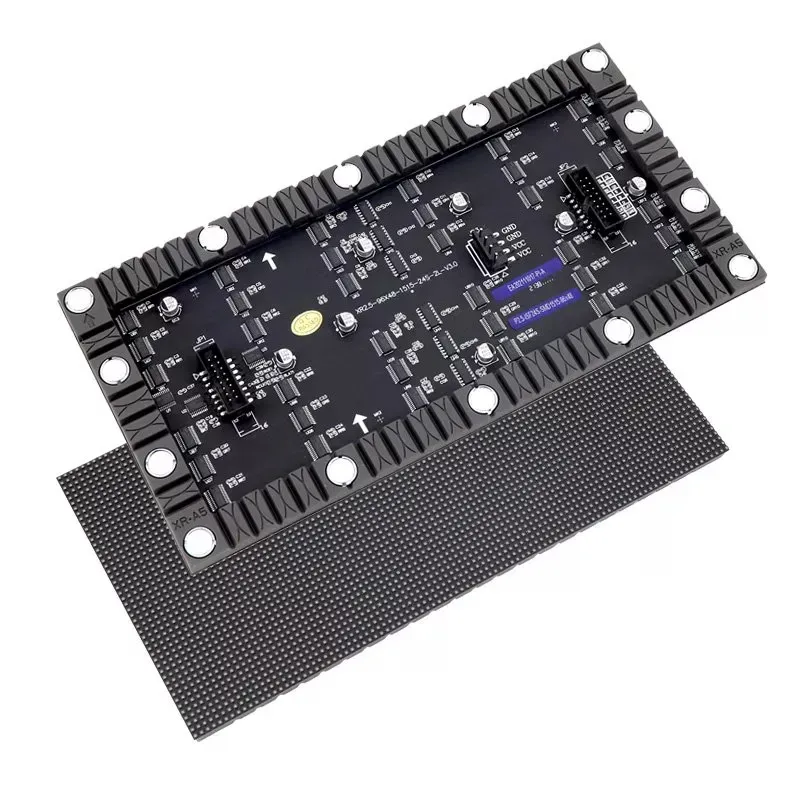
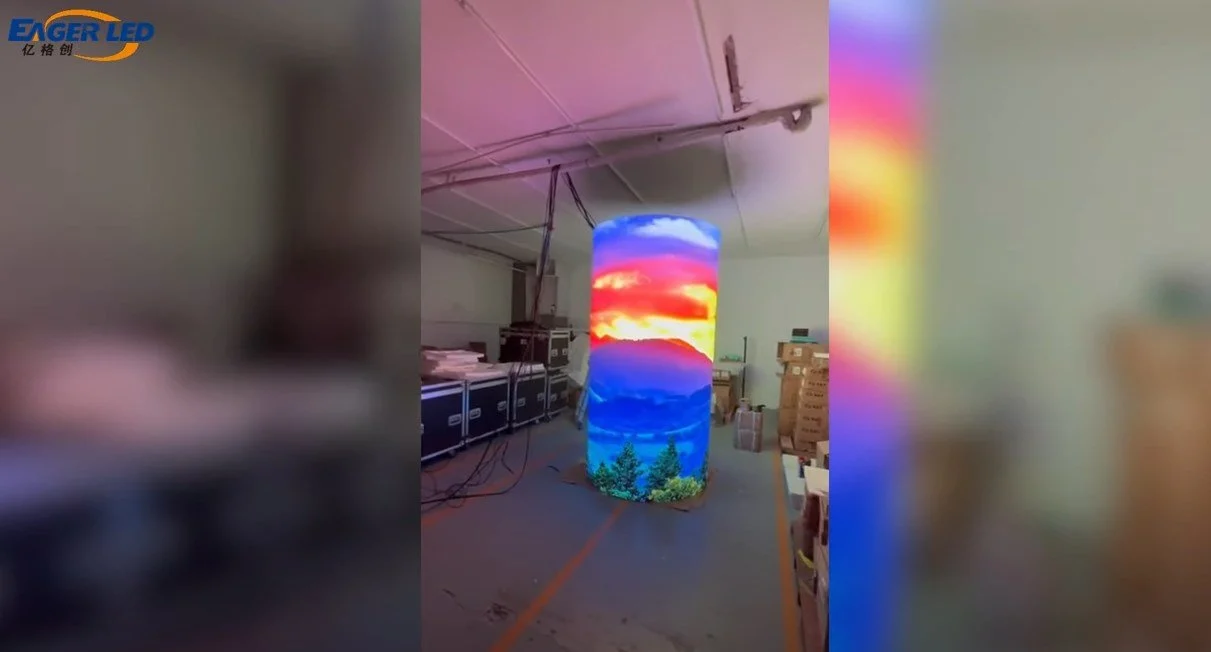
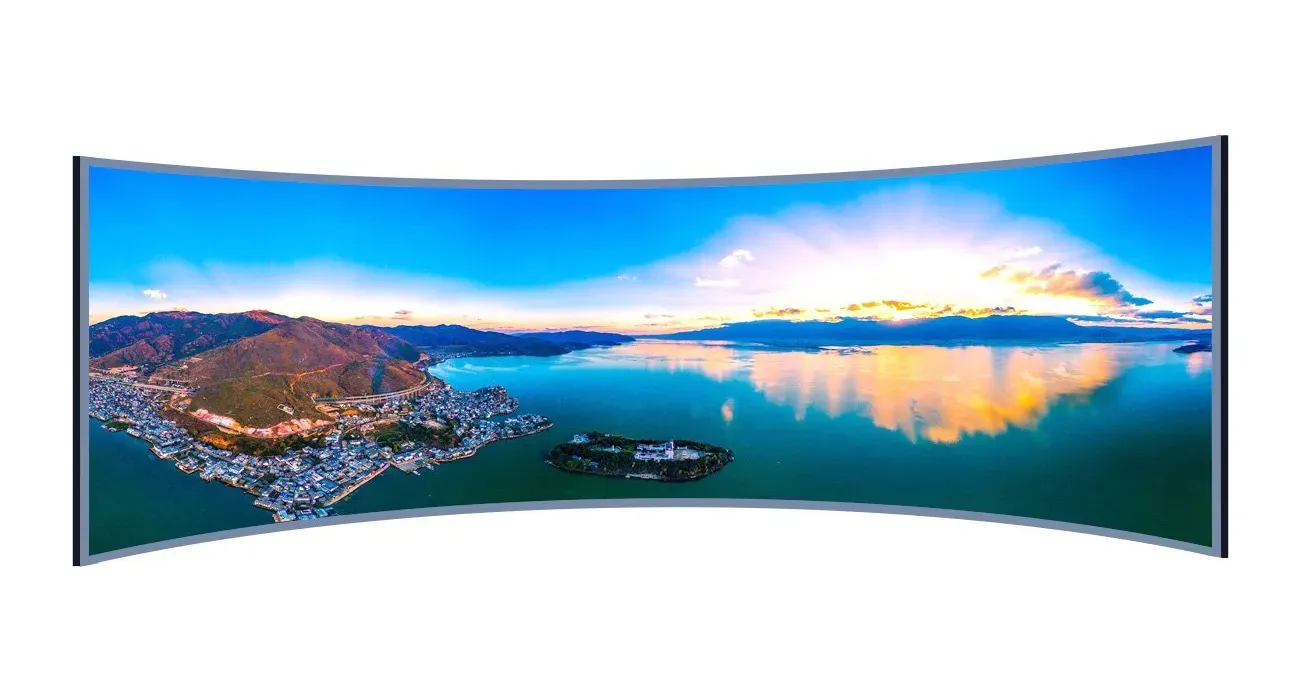
EagerLED is a China-based LED display manufacturer, rather than a Dutch installation company. Its published range includes indoor LED screens, outdoor advertising displays, and rental LED displays, alongside other specialist formats.
Among LED screen suppliers considered for Dutch projects, EagerLED represents a direct manufacturing route for distributors, rental businesses, and AV integrators able to manage local delivery responsibilities.
A useful inquiry should define cabinet dimensions, pixel pitch, service direction, controller requirements, spare components, and intended use. Request the exact proposed configuration instead of assuming that a feature applies across every series.
Direct procurement also requires a written allocation of transport, import handling, local installation, commissioning, and after-sales work. Manufacturing supply does not automatically include a Dutch installation crew or local replacement stock. Buyers should establish those arrangements before committing to a project schedule.
09. Outlook Electronics B.V.
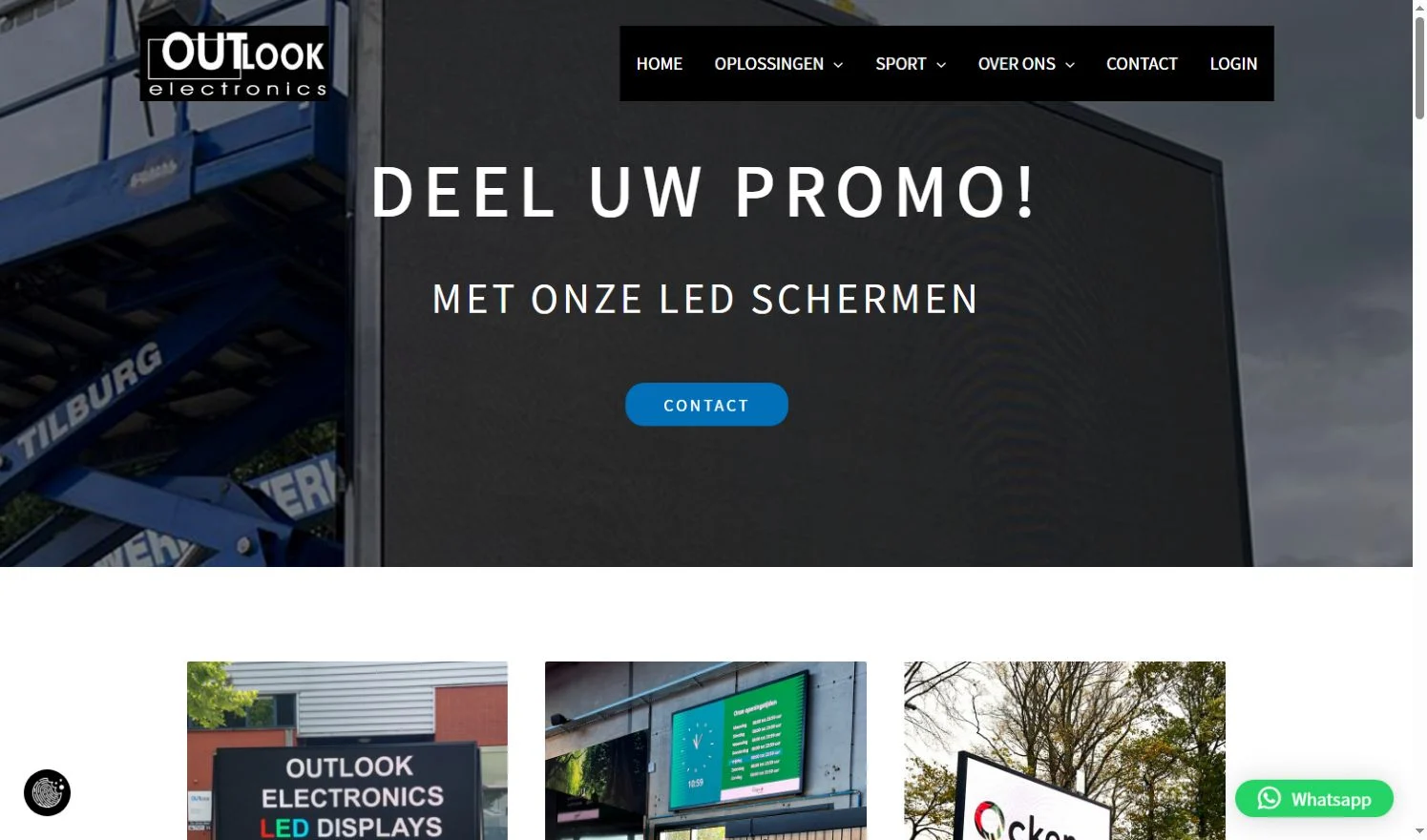
Outlook Electronics lists indoor and outdoor LED screens, mobile displays, scoreboards, clocks, and other information display products. Its published range gives it particular relevance where video content must coexist with functional information.
Sports organizations and contractors comparing LED screen suppliers can investigate how scoreboard operation, sponsor advertising, and general video playback are handled within the proposed system.
Ask for a demonstration of the actual operator workflow. Confirm which inputs, control devices, and software functions are included. If the screen must display match information during a live event, document the fallback procedure for a failed source device or interrupted control connection.
10. Rent-All
Rent-All’s professional video rental offering includes modular LED video wall panels alongside other production equipment. The relevant service category is dry hire: equipment rental for customers organizing their own production resources.
Among LED screen suppliers, Rent-All serves a different requirement from a contractor delivering a permanent wall. It is relevant to AV professionals seeking equipment for a defined production period.
Confirm the panel model, processor package, accessories, transport packaging, and replacement arrangements. Technical teams should also verify compatibility with their existing inventory. Similar cabinet dimensions do not establish interchangeable locks, electronics, calibration, or rigging hardware.
4. Supplier Comparison: Products, Installation, and Support
The practical way to compare LED screen suppliers is to identify their published role first, then investigate the proposed delivery scope. This avoids treating a hardware quotation and an installed system as equivalent offers.
| Position | Supplier | Published offering relevant to this guide | Qualification priority |
|---|---|---|---|
| 1 | Ace Vision | LED screens and information displays; installation and maintenance | Display controls and maintenance responsibility |
| 2 | Vidiled | Fixed, mobile, and modular display sales and rental | Permanent installation versus event package |
| 3 | Leddisplay Expert | Indoor/outdoor displays, rental, installation, and service | Exact configuration and acceptance criteria |
| 4 | Display4All | LED displays within broader AV and signage services | Content platform and system integration |
| 5 | QledX Europe | Indoor, outdoor, and rental ranges through channels | Dealer responsibilities and component support |
| 6 | Megalux | Commercial displays, installation, software, and service models | Ownership and recurring contract scope |
| 7 | Event Displays | Mobile rental, event services, and permanent displays | Site requirements and crew allocation |
| 8 | EagerLED | China-based manufacturing supply | Import, installation, and local support arrangements |
| 9 | Outlook Electronics | LED screens, scoreboards, and information displays | Operational controls and source integration |
| 10 | Rent-All | Professional dry-hire video equipment, including LED panels | Equipment compatibility and production resources |
These descriptions summarize advertised offerings, not verified stock or guaranteed capabilities.
After screening LED screen suppliers by role, send the same project brief to the strongest candidates. A consistent brief makes differences in scope visible before price becomes the dominant consideration.
5. Dutch LED Screen Suppliers vs. Direct Manufacturer Imports
Local procurement and direct manufacturing supply allocate work differently. Neither route is automatically cheaper or more suitable once the complete project is considered.
Dutch LED screen suppliers may offer site visits, local installation coordination, and service agreements. The value depends on what the contract actually includes. A nearby office does not, by itself, prove that replacement modules or qualified technicians are immediately available.
Direct imports can suit integrators that already manage engineering, installation, and servicing. These buyers can evaluate the manufacturing configuration directly, but they must also account for logistics, documentation, delivery risk, and local execution.
| Procurement route | Potential advantage | Responsibility to clarify |
|---|---|---|
| Local installed solution | Coordinated site delivery and service | Exact installation boundaries and response commitments |
| Direct manufacturer purchase | Direct discussion of hardware configuration | Import handling, local engineering, commissioning, and repairs |
| Dealer or distributor channel | Access to a defined product range | Division of responsibility between brand and dealer |
| Professional dry hire | Equipment available for a temporary production | Crew, rigging, operation, insurance, and return conditions |
Compare LED screen suppliers using the same finished outcome: a commissioned display operating at the intended site. Comparing factory hardware against an installed price produces a misleading result.
If your team cannot undertake local repairs, price that service before purchasing equipment. Responsibility becomes harder to negotiate once the wall is already installed.
6. LED Video Wall Applications for Dutch Businesses
The content and operating environment should determine the display specification. A screen used for presentation text needs a different assessment from one showing distant advertising.
LED screen suppliers should translate the application into measurable requirements instead of starting with whichever cabinet happens to be available.
| Application | Content requirement | Site question to resolve |
|---|---|---|
| Corporate presentation space | Legible slides, charts, and live inputs | Where will the nearest viewer sit? |
| Retail and showroom | Product imagery, branding, and scheduled campaigns | How do daylight and reflections change through the day? |
| Trade show stand | Close-viewing graphics and flexible content | What are the access, setup, and dismantling windows? |
| Outdoor advertising | Readable messages under changing light | How will brightness, mounting, and maintenance be managed? |
| Sports facility | Scores, sponsor material, and possible live video | Which control system supplies operational information? |
| Event stage | Camera feeds, playback, and production switching | What does the camera test and redundancy plan require? |
For multi-location projects, standardization can matter as much as screen performance. Ask LED screen suppliers whether the proposed equipment, software settings, and spare components can be managed consistently across the estate.
Decide who owns the content workflow early. An installed wall without approved templates, publishing access, or an operating schedule can remain underused despite functioning correctly.
7. Choosing Pixel Pitch, Brightness, and Service Access
A suitable specification connects the image, physical installation, and maintenance method. LED screen suppliers should provide model-specific information for the proposed configuration.
01. Match Pixel Pitch to Content and Native Resolution
Pixel pitch is the distance between adjacent pixel centers, expressed in millimeters. A smaller pitch places more pixels into a given area, but the benefit depends on viewing distance and content.
For an illustrative calculation, a nominal 4 m × 2.25 m display at exactly 2.5 mm pitch would contain:
- Horizontal pixels: 4,000 ÷ 2.5 = 1,600
- Vertical pixels: 2,250 ÷ 2.5 = 900
- Native resolution: 1,600 × 900 pixels
Actual dimensions must follow the available module and cabinet increments. This example is a calculation, not a product specification.
A processor accepting a 4K input does not turn a lower-resolution wall into a native 4K display. Ask LED screen suppliers to state both input capability and the assembled wall’s physical pixel resolution.
02. Evaluate Brightness and Image Behavior Together
Peak brightness alone does not establish image quality. Compare uniformity, grayscale reproduction, color consistency, and behavior at the brightness level actually used.
For camera-facing applications, test the intended camera frame rates and shutter settings with the proposed display and processing configuration. A refresh-rate headline cannot replace that test.
03. Confirm Access to Every Serviceable Component
“Front service” needs a precise definition. Front-removable modules do not necessarily mean every internal component can be reached from the viewing side.
| Specification | Evidence to request | Problem it helps prevent |
|---|---|---|
| Native resolution | Cabinet layout and pixel map | Content scaled to unsuitable dimensions |
| Operating brightness | Demonstration at intended settings | Uncomfortable or inconsistent images |
| Service access | Component access drawings | Repairs blocked by the building finish |
| Electrical load | Maximum and representative operating figures | Inadequate power planning |
| Control capacity | Processor and receiving-system schedule | Unsupported input or pixel loading |
| Mechanical arrangement | Mounting details and access clearances | Installation conflicts discovered on site |
For outdoor projects, ask LED screen suppliers to distinguish cabinet protection from the protection of the finished installation. Connections, ventilation, drainage, and maintenance procedures also affect operation.
8. LED Screen Prices and Total Ownership Costs
There is no single meaningful price for an LED screen without a defined configuration. Screen area, pixel pitch, cabinet construction, processing, installation complexity, and support scope all affect the proposal.
When LED screen suppliers quote a price per square meter, identify what sits outside that figure. A low hardware rate can exclude the processor, structure, freight, commissioning, or spare parts required for operation.
| Cost category | What to include in the comparison |
|---|---|
| Display hardware | Cabinets, modules, power supplies, receiving electronics |
| Processing and playback | Processor, media player, software, and signal conversion |
| Installation | Structure, mounting, access equipment, cabling, labor |
| Delivery | Packaging, transport, unloading, and applicable import handling |
| Operation | Electricity, connectivity, software fees, and content work |
| Maintenance | Spare components, service visits, cleaning, and repair logistics |
| End of use | Removal, relocation, disposal, or contract exit obligations |
For energy planning, use documented consumption under a representative operating condition. Maximum input power is useful for electrical design, but it is not automatically the correct figure for an annual operating-cost estimate.
Request comparable EUR quotations from LED screen suppliers and make the treatment of VAT explicit. For international purchases, identify the delivery basis and which party pays each logistics charge. Compare the complete commissioned system over an agreed ownership period.
9. Buying, Renting, or Leasing: Which Option Fits Your Project?
Buying generally suits repeated use when the organization can manage the asset. Renting suits temporary demand and projects where equipment requirements change. Leasing or a service agreement can spread payments, but the contract determines ownership and maintenance obligations.
LED screen suppliers may use “rental” and “lease” differently. Establish whether you are obtaining equipment for a short event, financing ownership, or paying for an ongoing display service.
An equipment purchase also brings storage, transport, inspection, and repair responsibilities if the wall will move between venues. These costs can materially change the business case for a rental company building its own inventory.
For lease and service proposals, examine:
- Who owns the equipment during and after the agreement.
- Which repairs and site visits are included.
- Whether software and connectivity are bundled.
- What happens if the screen no longer meets the application.
- Early termination, relocation, and end-of-term conditions.
Before choosing between LED screen suppliers, define acceptance in writing. Agree how the team will assess image uniformity, content playback, controls, and fault reporting. Request the final configuration files and equipment schedule as part of handover.
A documented acceptance process gives the buyer and installer a shared definition of completion.
10. FAQ
01. Can I Arrange an LED Screen Demonstration Before Ordering?
Ask whether the proposed model or a technically representative configuration is available for demonstration. Identify any differences from the final specification. Bring presentation slides, low-brightness footage, brand colors, and other demanding content rather than relying solely on promotional video.
02. What Documents Should Be Included at Handover?
Request the equipment schedule, serial-number record, cabinet layout, wiring diagrams, controller configuration, calibration backups where applicable, operating instructions, and support contacts. Establish which files your team can restore independently and which require supplier assistance.
03. Can I Connect an LED Wall to My Existing AV System?
Often, but compatibility must be checked across the complete signal chain. Confirm source formats, resolutions, frame rates, cable distances, switching requirements, and any protected-content requirements. A matching connector type does not establish that every source will work correctly.
04. Who Should Control the Display’s Administrator Accounts?
The agreement should identify the account owner and give authorized customer personnel suitable access. Separate routine publishing permissions from system administration. Document recovery procedures so an employee departure or service-provider change does not leave the display inaccessible.
05. Can I Expand an Existing LED Screen Later?
Expansion depends on mechanical compatibility, electronics, available processing capacity, and the continued availability of matching components. Color matching can also be difficult across production batches. Plan likely expansion before the initial purchase and retain the original configuration details.
06. What Spare Parts Should I Order With an LED Display?
The appropriate list depends on the model and repair strategy. Discuss compatible modules, power supplies, receiving cards, cables, and relevant mechanical parts. Ask LED screen suppliers to recommend quantities based on the installation size, component availability, and acceptable downtime rather than applying an unexplained percentage.
07. Do Suppliers Provide Training for In-House Technicians?
Some do, but define the syllabus and permitted maintenance tasks. Useful training covers startup, content loading, brightness schedules, fault identification, configuration backup, and escalation. Component replacement should follow the manufacturer’s instructions and the customer’s technical competence.
08. Can I Use Cabinets From Different Suppliers in One Wall?
Do not assume compatibility. Cabinet dimensions, locking systems, scan configurations, receiving electronics, and color characteristics can differ. Even panels that illuminate together may not produce a consistent image. Obtain written compatibility confirmation and test the complete combination before deployment.
11. Conclusion
The most suitable LED screen suppliers in the Netherlands are those whose equipment and delivery responsibilities match the project. Local installation companies, product channels, dry-hire providers, and overseas manufacturers offer different forms of value.
Start with the application, define the finished system, and compare quotations against the same technical and service requirements. Treat native resolution, maintenance access, content control, and repair arrangements as purchasing criteria alongside price.
EagerLED appears eighth in this shortlist as a direct manufacturing option for professional buyers. To discuss a configuration, send EagerLED your project requirements, including screen dimensions, installation environment, viewing distance, intended content, and local installation arrangements.
 Top 10 LED Screen Suppliers in Nigeria (2026)
Related Posts
Fill In Your Needs In Detail
Fill in the screen usage scene and size you need in “Content”.You will get a quote.