In the LED signs vs traditional signs decision, LED usually delivers better ROI when messages change at least monthly, the location has meaningful traffic, and the business can turn timely content into measurable gross profit. Traditional signage usually wins when the message is permanent, power or permitting is difficult, and low operating complexity matters more than flexibility.
The most defensible choice is based on five-year total cost of ownership, not purchase price. This guide compares acquisition, content updates, electricity, software, maintenance, downtime, and incremental revenue. It also provides a transparent break-even model that you can replace with local quotations and your own conversion data. For many sites, a hybrid of permanent brand identification and a smaller LED message area produces the strongest balance.
1. Quick Verdict: Which Sign Type Delivers Better ROI?
Choose an LED sign when one display must support changing promotions, event schedules, pricing, public information, or several audiences throughout the day. The capital cost is higher, but each message update can be published without producing and installing a new face. ROI improves when that flexibility is used consistently and measured against sales, visits, enquiries, registrations, or another commercial outcome.
Choose a traditional sign for a stable logo, building name, safety message, or wayfinding instruction that may remain unchanged for years. A well-designed illuminated cabinet, channel letters, banner, printed panel, or monument sign can deliver excellent value with lower purchase cost and fewer technical dependencies.
Choose a hybrid system when the site needs both permanent identity and frequently changing offers. Keeping the brand on a fixed sign while using a proportionally smaller electronic message center can reduce power and capital cost without giving up dayparting. No option wins by default; the right answer is the one that produces the most incremental gross profit after all ownership costs.
2. What Counts as an LED Sign or Traditional Sign?
2.1. LED sign definition
An LED sign uses light-emitting diode modules to present digital content. Depending on the product, it may show text, images, animation, or full-motion video and can be updated through local software, a network, or a cloud platform. Formats range from roadside electronic message centers and advertising LED screen solutions to storefront video walls and portable displays.
Its economic advantage is not merely brightness. It is the ability to reuse the same physical display for many messages, schedule content by time or audience, and respond quickly without manufacturing another sign face. That advantage has value only when the operator has a content plan and reliable approval workflow.
2.2. Traditional sign definition
Traditional signage is static. The message is printed, painted, routed, fabricated, or applied as vinyl and remains in place until someone physically changes it. Examples include banners, posters, illuminated cabinets, channel letters, directional panels, billboards, and monument signs.
Static does not mean ineffective. Permanent signs are easy to understand, can reinforce a brand continuously, and do not require a content management system. The economic disadvantage appears when the business repeatedly pays for design, printing, fabrication, transport, access equipment, and installation to keep messages current.
3. LED Signs vs Traditional Signs: ROI Drivers at a Glance
The comparison below summarizes the main economic differences. It is a screening tool rather than a quotation: sign size, structure, pixel pitch, brightness, permitting, electrical work, content requirements, and service access can change the result substantially.
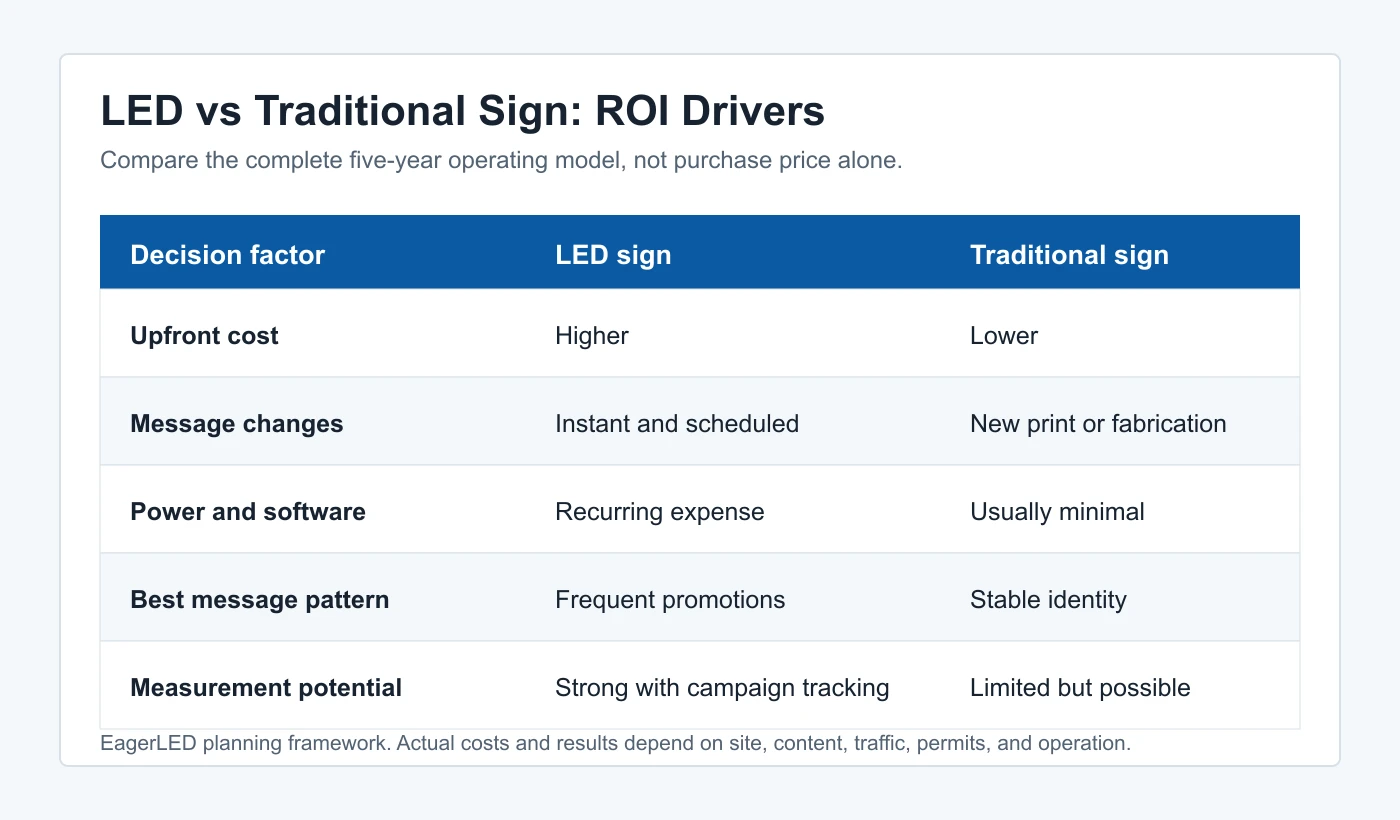
| ROI factor | LED sign | Traditional sign |
|---|---|---|
| Initial investment | Usually higher | Usually lower |
| Content updates | Remote, rapid, repeatable | New print or fabrication |
| Recurring costs | Power, software, content, service | Replacement faces and labor |
| Best use | Changing offers and information | Stable branding and wayfinding |
| Main operational risk | Weak content or technical downtime | Stale message and update delay |
4. How to Calculate Five-Year Signage ROI
4.1. Include every total-cost line item
Build two five-year cash-flow models on the same scope. For an LED display, include the screen, controller, mounting structure, shipping, electrical distribution, data cabling, installation, commissioning, permits, content creation, software, electricity, preventive maintenance, spare modules, access equipment, and expected downtime. For a traditional sign, include fabrication, structure, lighting, installation, every planned replacement face, design, printing, transport, labor, permits, and disposal.
Then estimate economic benefit conservatively. Count incremental gross profit rather than gross revenue because product cost still has to be paid. Add avoided update costs and any documented labor savings. Do not assign value to impressions unless the business has a credible way to connect them with a commercial result.
ROI formula:
ROI = (incremental gross profit + avoided update costs – five-year ownership cost) / five-year ownership cost × 100
4.2. Work through an illustrative example
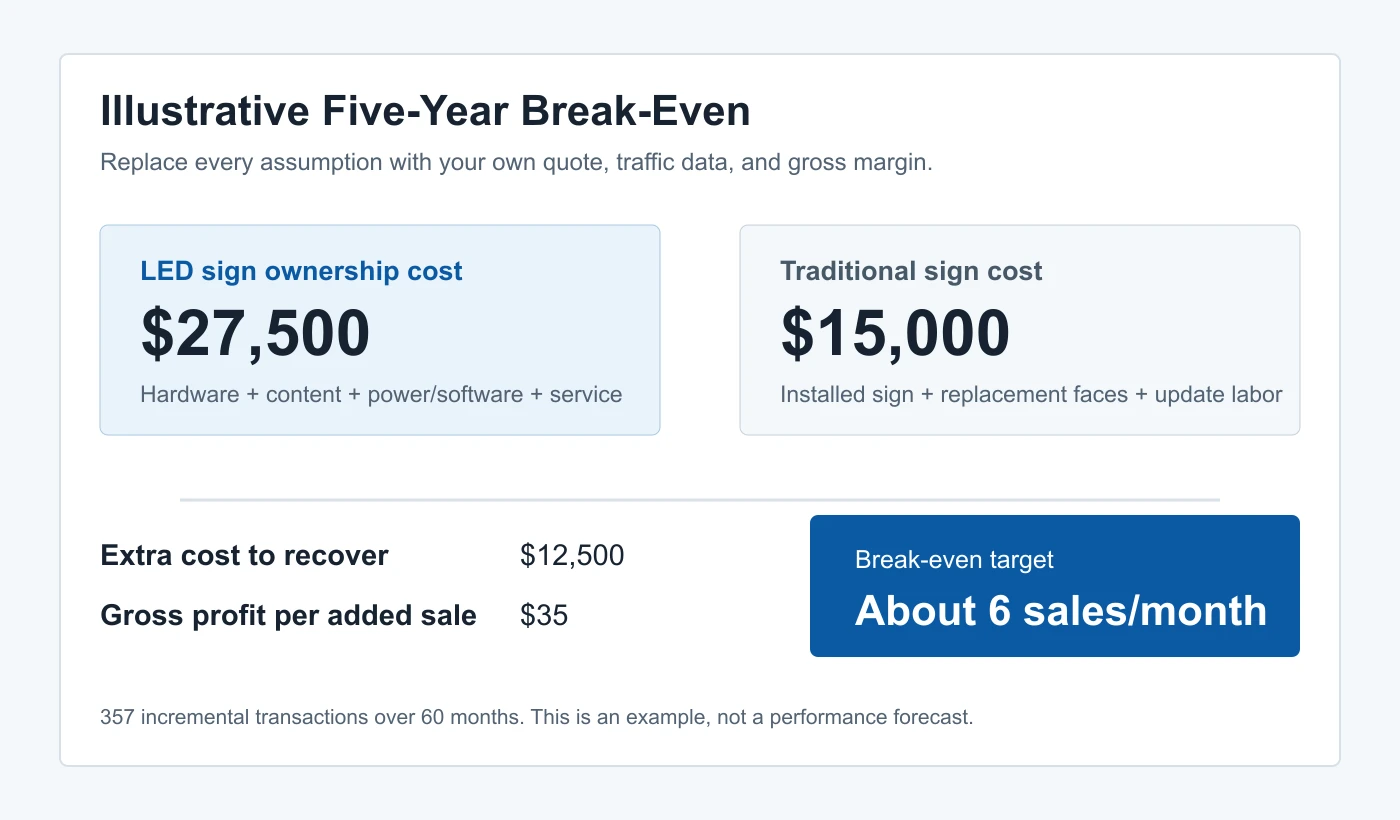
Assume an installed LED sign costs $18,000. Over five years, the owner budgets $3,000 for content and design, $4,000 for electricity and software, and $2,500 for service and spares. Five-year ownership cost is $27,500. A traditional sign costs $4,000 installed, then requires six replacement faces totaling $9,000 and $2,000 of update labor and logistics. Its five-year cost is $15,000.
The LED option therefore needs to recover a $12,500 cost gap. These are transparent planning assumptions, not EagerLED pricing or promised market performance. Replace them with local supplier quotes, electricity tariffs, opening hours, tax treatment, permit fees, content schedules, margins, and maintenance terms.
4.3. Calculate monthly break-even conversions
If each incremental transaction contributes $35 in gross profit, the LED sign needs about 357 additional transactions over five years to recover the $12,500 gap. Spread across 60 months, that is roughly six extra transactions per month. A high-traffic retailer may consider that threshold realistic; a low-traffic facility with a permanent message may not.
Run sensitivity cases before approval. Test lower traffic, weaker conversion, higher power cost, one major repair, and slower content updates. Also test the upside case where the LED sign avoids more static replacements than expected. A purchasing decision is robust when it still works under reasonable downside assumptions.
5. When LED Signs Deliver Better ROI
5.1. Frequent content changes and dayparting
An LED sign becomes more valuable as update frequency increases. Restaurants can promote breakfast, lunch, and evening offers; retailers can rotate product launches and seasonal campaigns; schools and venues can publish schedules; and property managers can change tenant or safety information. Each scheduled change replaces a physical production cycle and shortens the time between decision and display.
5.2. High traffic and multiple offers
A dynamic sign has more opportunities to pay back its premium where many relevant viewers pass the site. The strongest locations combine readable sightlines, sufficient dwell time, a clear call to action, and an offer that can be fulfilled immediately. A large screen cannot compensate for blocked visibility, excessive copy, or a weak proposition.
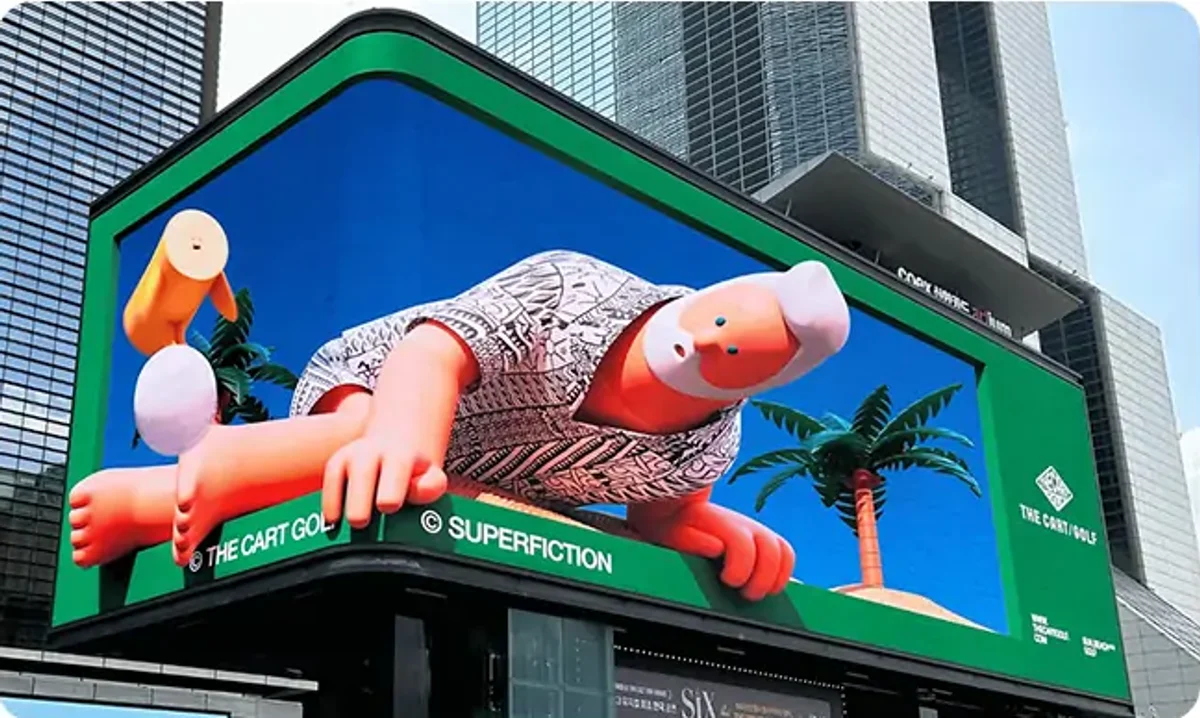
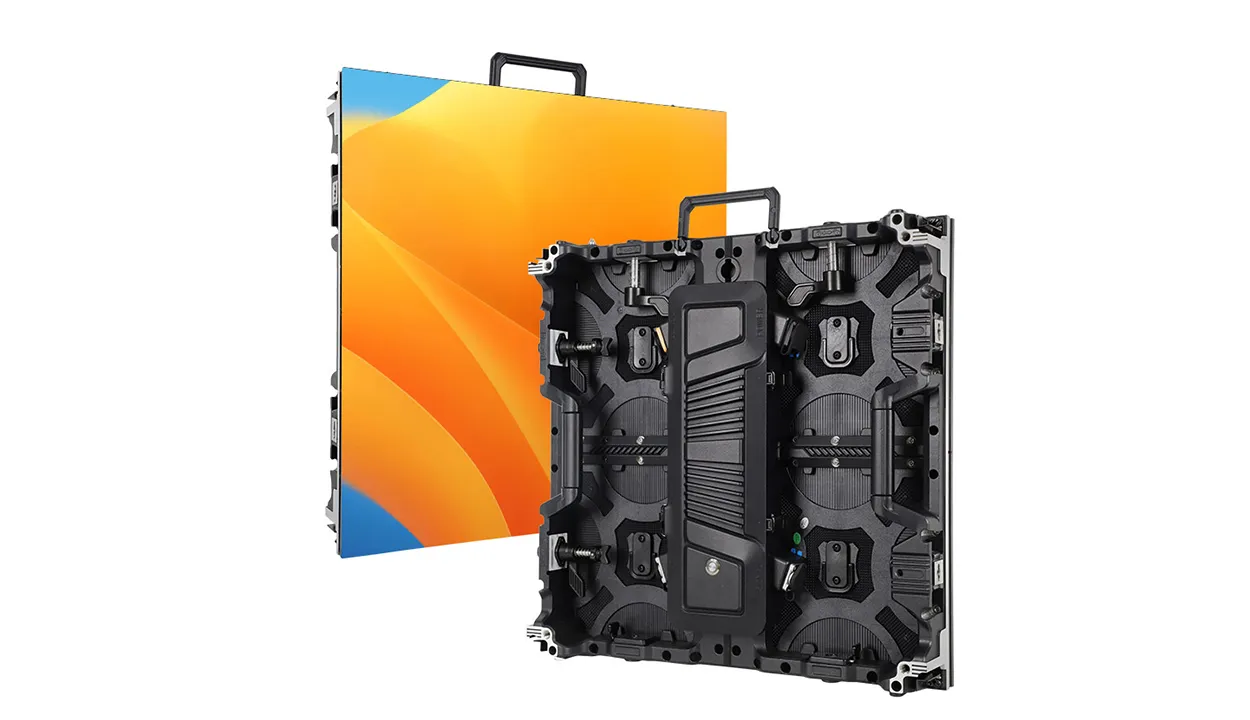
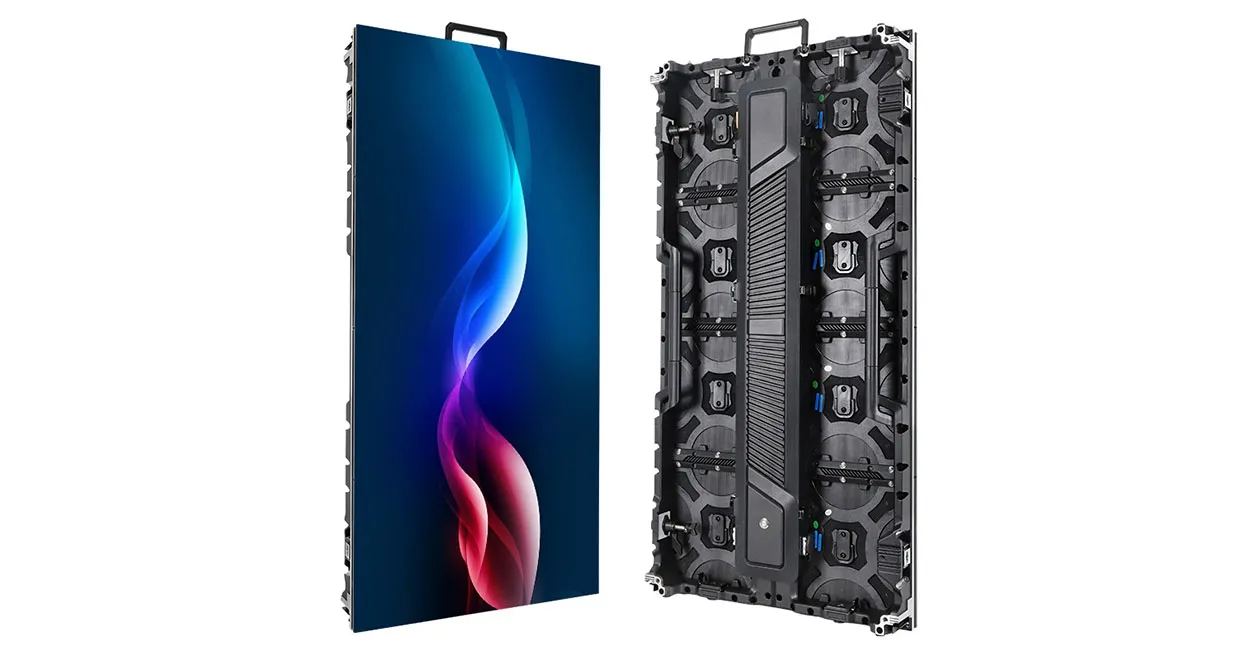
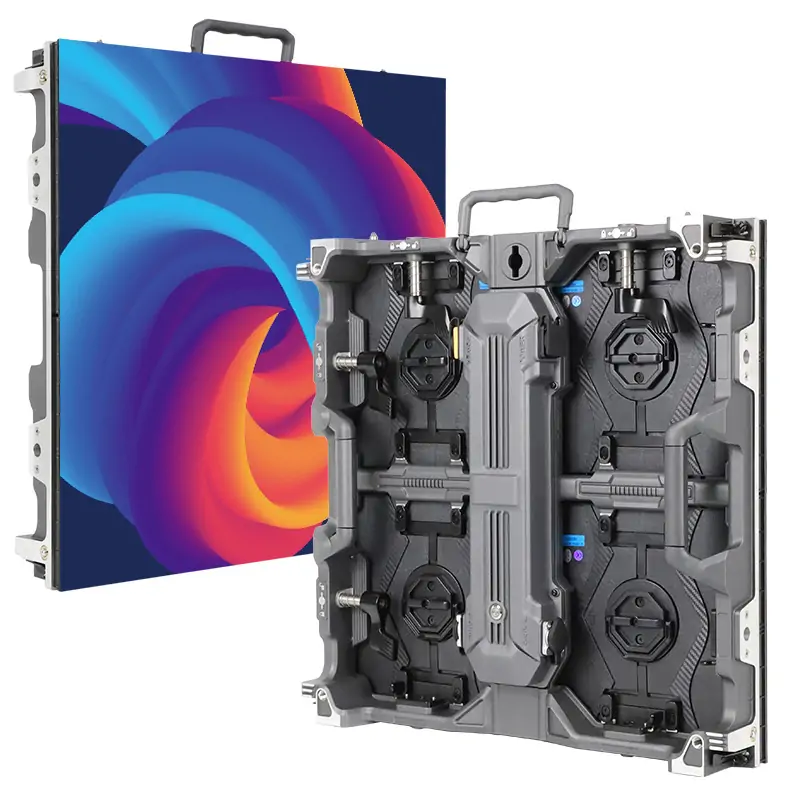
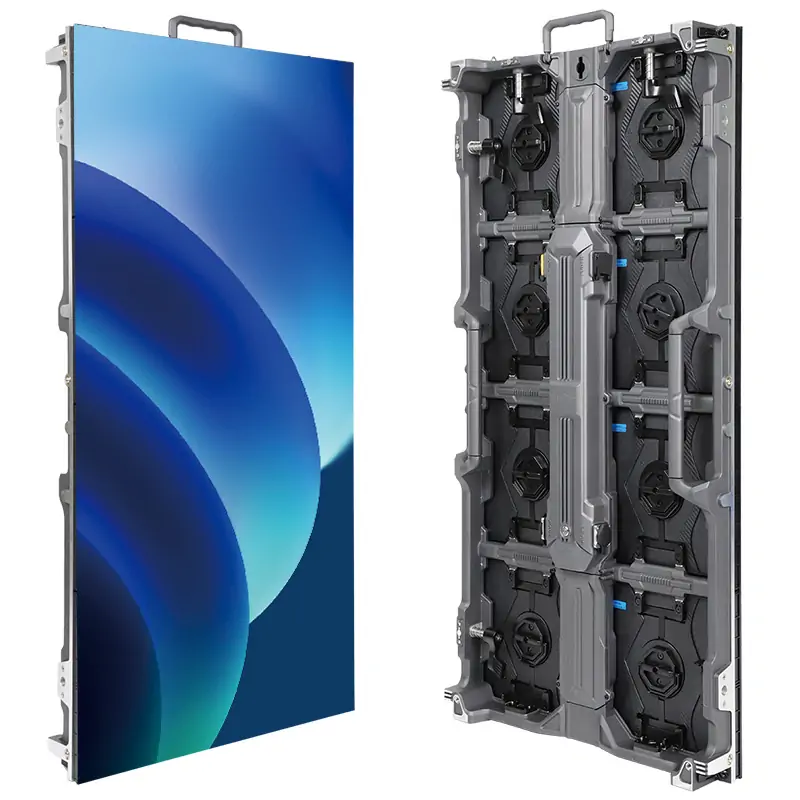
For exposed commercial sites, a purpose-built product such as the EA1000F2 outdoor advertising LED display can support large-format campaigns, but the screen still needs suitable structure, service access, brightness control, and a permitted operating schedule.
5.3. Measurable content operations
LED sign ROI improves when content is treated as an operating process. Assign an owner, define approval times, prepare templates, schedule campaigns, and use unique offer codes, landing pages, call tracking, point-of-sale tags, or footfall comparisons. Compare equivalent periods and account for promotions, weather, events, and seasonality. The goal is not to prove that every change worked; it is to learn which messages produce enough gross profit to justify the display.
6. When Traditional Signs Deliver Better ROI
6.1. Permanent identity and wayfinding
A static sign is often the rational choice for a building name, logo, entrance marker, parking instruction, room identifier, or regulated safety message. If the information remains useful for years, there may be no update cost for an LED system to avoid. Quality materials, legible typography, correct lighting, and durable installation can deliver a very low annualized cost.
6.2. Low-complexity or restricted sites
Traditional signage also fits sites with limited power, small audiences, strict digital-sign restrictions, or no staff to manage content. It has no player to configure, network to secure, or electronic module to replace. Before specifying a digital display, confirm zoning, luminance limits, animation rules, dwell times, operating hours, structural loads, and electrical availability with the local authority and qualified contractors.
7. What the Evidence Says About Signage Response
Evidence supports the commercial importance of signage, but it does not guarantee a specific project return. A FedEx Office survey reported that 76% of American consumers had entered a store they had never visited before based on its signs, while 68% had purchased a product or service because a sign caught their eye. The March 2012 telephone omnibus survey included 914 U.S. adults from an initial 1,000-person sample and reported a margin of error of ±3.1%. It studied signs broadly, not LED signs alone.
For digital out-of-home media, a 2024 OAAA and Harris Poll study found that 76% of recent DOOH viewers reported taking action. Among respondents who noticed directional DOOH ads, 51% visited the advertised business and 93% of those visitors completed a purchase. The online U.S. survey ran April 2-9, 2024 among 1,023 adults ages 18-64, with a stated ±2.8 percentage-point sampling precision at the 95% confidence level.
Interpretation matters: OAAA research concerns the broader DOOH advertising channel. It is directional evidence that timely, visually engaging digital messages can prompt action, not a performance promise for one owned storefront LED sign. Site traffic, creative quality, audience relevance, visibility, offer strength, and measurement design determine whether an individual installation achieves similar behavior.
8. Costs Buyers Commonly Miss
8.1. Power, brightness, and cooling
Calculate energy from measured or supplier-estimated average consumption, not maximum power alone. Include daily operating hours, seasonal brightness schedules, electricity price, power conversion losses, and any added cooling. The International Sign Association brightness guidance recommends that electronic message centers not exceed 0.3 footcandles over ambient lighting when measured at a distance based on display size. Automatic dimming protects nighttime readability, community acceptance, and compliance; maximum brightness is not the ROI objective.
8.2. Content workflow and software
Budget templates, photography, motion design, scheduling, approvals, software subscriptions, network connectivity, and staff time. A screen showing the same dated slide for months has paid for dynamic capability without receiving its benefit. Define who updates content, how often, from where, and what happens when a campaign expires.
8.3. Permits, structure, and installation
Quotations can be misleading when one includes engineering and installation while another covers hardware only. Align foundation work, steel, wind-load engineering, waterproof distribution, surge protection, lifts or cranes, traffic management, permits, inspections, commissioning, and operator training before comparing prices.
8.4. Maintenance, spares, and downtime
Ask for warranty scope, response time, module availability, spare-part quantities, access method, and expected repair procedure. Front-service cabinets may reduce access costs at a wall-mounted location, while rear service may be simpler where a dedicated service corridor exists. Budget a defined contingency instead of assuming zero failures.
9. Choose LED Specifications That Protect ROI
9.1. Visibility, brightness, and pixel pitch
Select pixel pitch from viewing distance and content detail, then validate the design with actual dimensions and sightlines. Paying for unnecessarily fine pitch raises module count and processing load without always producing a visible benefit. Conversely, pitch that is too coarse can make close-viewed text difficult to read. EagerLED’s LED display board buying guide explains the broader selection factors.
9.2. Environmental protection and service access
Outdoor systems need an enclosure and installation method suited to rain, dust, temperature, humidity, corrosion exposure, wind, and direct sun. Indoor retail applications prioritize appearance, quiet operation, shallow depth, and closer viewing. Evaluate cabinet flatness, calibration, heat paths, access clearance, replaceable modules, and the location of power and data components.
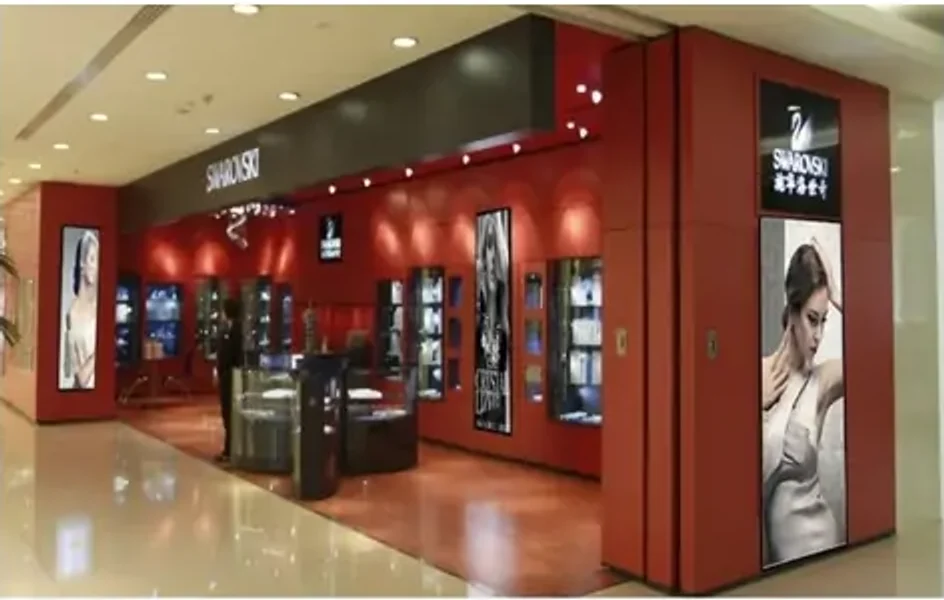
For close-range promotions, LED poster displays can provide a smaller entry point than a permanent video wall. For reception, retail, or corporate interiors, compare the viewing environment with EagerLED’s indoor LED screen options before deciding on brightness and pitch.
9.3. Control, scheduling, and network security
Specify whether publishing will be local, LAN-based, or cloud-managed; whether several locations need central scheduling; and whether proof-of-play or user permissions are required. Separate operational roles, change default credentials, keep firmware records, and agree on offline fallback content. The simplest control architecture that meets the workflow is usually the easiest to maintain.
10. Decision Matrix by Business Use Case
| Use case | Likely best fit | Reason |
|---|---|---|
| Store logo and opening hours | Traditional | Stable message and low complexity |
| Restaurant daypart offers | LED | Several scheduled messages daily |
| Campus or venue calendar | LED | Frequent event and notice changes |
| Directional or safety sign | Traditional | One permanent instruction |
| Retail brand plus promotions | Hybrid | Permanent identity with flexible offers |
| Low-traffic remote location | Usually traditional | Digital premium is harder to recover |
Treat the matrix as a starting hypothesis. The final recommendation should follow a site survey, local code review, audience and traffic assessment, five-year cost model, and content plan. A smaller display at the correct location can produce more value than a larger display with poor sightlines or weak operational ownership.
11. Procurement Checklist
11.1. Establish a baseline
Record current sales, gross margin, enquiries, footfall, message-change cost, update frequency, and staff time before installation. Photograph the existing sightline at relevant times and note traffic direction, viewing distance, dwell time, competing visual clutter, sunlight, and nighttime conditions. Without a baseline, post-installation claims will be difficult to test.
11.2. Compare quotations on the same scope
Give every bidder the same screen dimensions, pixel pitch target, brightness control requirement, operating schedule, content source, structure, electrical scope, network method, installation access, permits, warranty, spares, training, and acceptance criteria. Ask suppliers to separate mandatory items from options and identify exclusions explicitly.
11.3. Define acceptance tests
Before final payment, verify full-screen color, brightness and automatic dimming, uniformity, dead-pixel policy, source switching, scheduled playback, network recovery, startup after power loss, waterproofing where applicable, sensor behavior, spare replacement, and operator access. Keep configuration files, drawings, credentials, firmware records, warranties, and service contacts in one handover package.
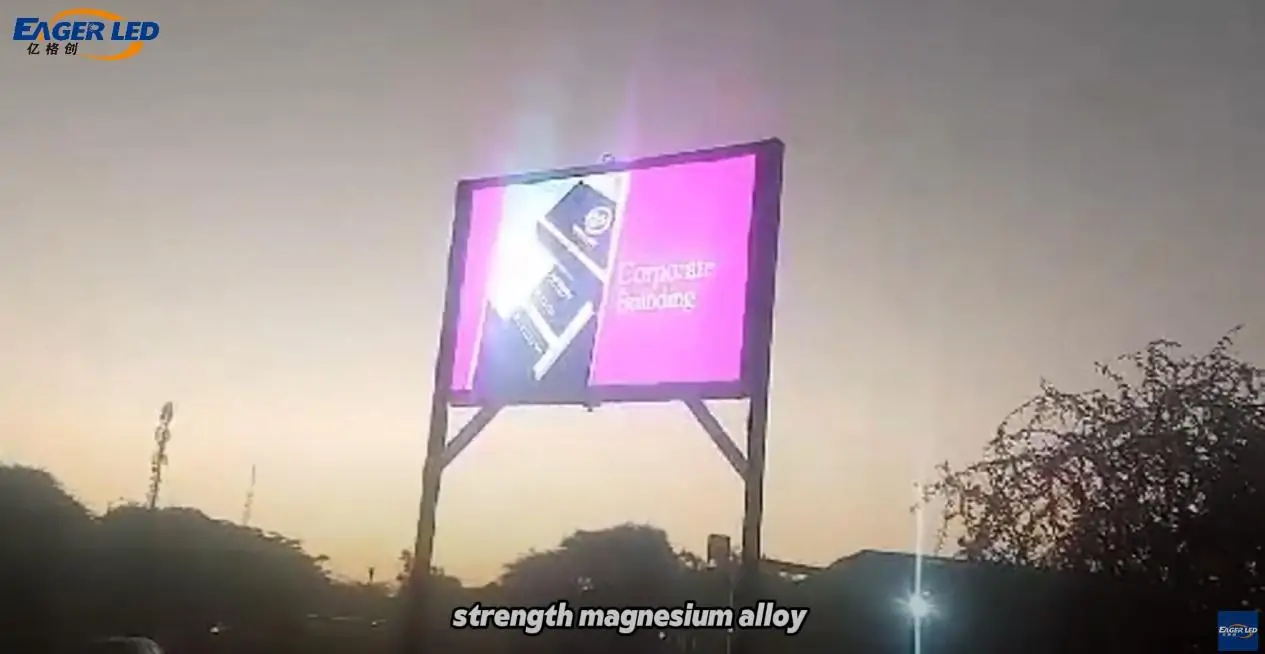
The EagerLED video above shows an outdoor advertising LED screen in a real product and application context. Use demonstrations to judge cabinet access, assembly, image quality, and control workflow, but base the final purchase on the engineered proposal for your site.
12. FAQs
13. Conclusion
LED signs generally deliver better ROI when a business has enough relevant traffic, changes messages at least monthly, and can connect dynamic campaigns with measurable gross profit. Traditional signs remain the stronger investment for stable identity and wayfinding, especially where simplicity, low power use, or local restrictions dominate. A hybrid installation is often the most balanced answer.
Build the decision from a five-year ownership model, conservative conversion assumptions, and a real content workflow. Then validate brightness, pitch, structure, service access, control, and local code before ordering. Contact EagerLED with your site photos, viewing distance, display size, and content schedule for an LED sign configuration and quotation.
 Novastar TU15 Pro, TU20 Pro or TU4K Pro: Which Should You Buy?
 LED Wall vs Green Screen: Which Is Better for Virtual Production?
Related Posts
Fill In Your Needs In Detail
Fill in the screen usage scene and size you need in “Content”.You will get a quote.